Introduction
Front-end development is still one of the easiest ways into tech. No CS degree required, no gatekeeping four-year program standing between you and your first job. You just need to prove you can build things.
That's where it gets messy: search "front-end developer certification" and you'll find bootcamps, vendor programs, free courses, and university certificates, all claiming to be the credential that gets you hired. Some take three weeks; others take seven months.
Employers, meanwhile, increasingly want more than a resume claim of "I know React"; they want validated proof.
This guide breaks down the top front-end certifications worth considering, how to pick one that fits your goals and budget, and what career and salary outcomes to realistically expect once you're certified.
Key Takeaways
- Certifications validate HTML, CSS, JavaScript, and React skills beyond what a resume shows
- Costs range from free (freeCodeCamp) to several thousand dollars for university-affiliated programs
- A real portfolio paired with a certification impresses employers more than the credential alone
- COITB and similar non-profits offer exam-only validation, skipping lengthy training commitments
Why Get Certified as a Front-End Developer?
Not everyone learns to code the traditional way. If you came up through a bootcamp, tutorials, or years of trial and error on personal projects, you don't have a diploma that says "I can do this job." A certification fills that gap.
Proof That Travels Beyond Your Resume
A certification formally validates what you already know. It tells a hiring manager, before they even open your portfolio, that a third party tested your HTML, CSS, JavaScript, or React skills against a set bar. This matters most for:
- Self-taught developers without a CS degree
- Bootcamp graduates competing against university-trained candidates
- Career changers moving from unrelated fields into tech
Staying Current and Interview-Ready
Front-end tools change constantly. React alone shipped three major releases in about a year: React 19, 19.1, and React 19.2, each adding patterns developers are expected to know. A certification with a recently updated exam forces you to study current best practices instead of habits you picked up two years ago.
Studying for a timed, scenario-based exam rehearses the kind of pressure you'll face in a technical interview. Passing gives you a data point that says "I'm ready," which counts for something when imposter syndrome creeps in before a big interview.
That confidence carries you through the interview room, but it doesn't guarantee support while you're studying. Community isn't guaranteed. Check before you assume it's included. Some training platforms build in cohort forums or mentor access. Others, particularly credentialing bodies focused purely on exam-based validation, don't. If peer support matters to you, confirm what's actually included before enrolling.
Top Front-End Developer Certifications to Consider
Here's a curated mix of free, mid-cost, and premium options spanning beginner to intermediate skill levels. Match the technologies covered to what your target job actually asks for.
COITB Front-End Credential Set
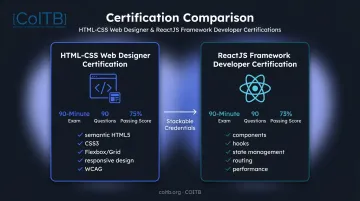
COITB, a non-profit credentialing body based in Oklahoma City, doesn't sell one bundled "front-end developer certification." Instead, it offers two separately earned, stackable credentials that together validate full front-end competency:
- HTML-CSS Web Designer Certification: 90-minute, 90-question exam (75% passing) covering semantic HTML5, CSS3, Flexbox/Grid, responsive design, and WCAG accessibility. Best for 0-6 months of hands-on practice.
- ReactJS Framework Developer Certification: 90-minute, 90-question exam (73% passing) covering components, hooks, state management, routing, and performance optimization. Best for 1-6 months of hands-on HTML/CSS/JavaScript experience.
Both exams run through remote online proctoring, available around the clock, or at an authorized in-person test center. That flexibility matters for working professionals, transitioning veterans, and military spouses studying between moves.
There's no training component; candidates prepare independently and earn a digital badge upon passing. Unsure about readiness? Start with COITB's free practice assessment before scheduling the proctored exam, and contact COITB directly for current pricing.
If you plan to use GI Bill, VET TEC, or MyCAA benefits toward the exam fee, verify COITB's eligibility status with the VA or your Servicing Approving Agency before registering.
Meta Front-End Developer Professional Certificate (Coursera)
A beginner-friendly, nine-course series covering HTML5, CSS, JavaScript, React, Bootstrap, Git/GitHub, and UX/UI basics, ending in a capstone project. Coursera currently estimates seven months at six hours per week, though Meta's own program page cites a shorter 16-week pace at 10 hours weekly. Meta's provider page lists $49/month for grading, portfolio support, and job-board access.
freeCodeCamp Responsive Web Design Certification
Completely free. Learners complete five required projects, then pass a 50-question timed exam. It's a solid budget-friendly option focused on semantic HTML, Flexbox, Grid, and responsive layout. It doesn't cover JavaScript or React, so pair it with another credential if you need those skills.
IBM Front-End Developer Professional Certificate (Coursera)
An 11-course series emphasizing UI/UX design with Figma and Bootstrap, alongside HTML, CSS, JavaScript, and React, plus real Git/GitHub practice. Learners build a portfolio site and a capstone web app. Coursera estimates four months at 10 hours per week, though IBM's launch page claims under three months.
edX W3C Front-End Web Developer Certificate
An intermediate-level, five-course program on HTML5, CSS, and JavaScript, with a distinct focus on accessibility and internationalization standards. It's a good pick if you already have fundamentals down and want deeper standards knowledge, though as of this writing, edX lists it as unavailable for new purchase.
Certificate vs. Certification: What's the Difference?
These terms get used interchangeably online, but they're not the same thing.
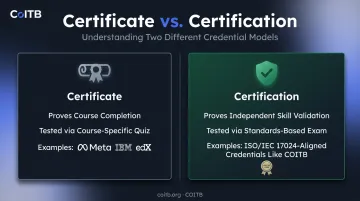
The difference comes down to who validates the skill:
| Aspect | Certificate | Certification |
|---|---|---|
| What it proves | You completed a training program | You passed an independent, standards-based assessment |
| How it's tested | A quiz tied to that specific course | An exam not tied to any course |
| Examples | Meta, IBM, and edX program completions | Credentials aligned to ISO/IEC 17024, like COITB's |
The distinction matters for job seekers. A lot of what gets marketed as a "certification" online is really a certificate, proof you showed up and finished a course, not proof you can independently perform the skill.
Frameworks like ISO/IEC 17024 add another layer of trust. This international standard governs bodies that certify individuals, requiring a documented, audited process for developing and scoring assessments.
Before choosing a program, research the issuing body:
- Is the assessment independent of a specific training course?
- Does the organization publish its exam standards or governance policies?
- Is the credential verifiable by a third party, such as through a digital badge registry?
Neither format is bad on its own. A certificate can still teach real skills. But understanding which one you're earning helps you set the right expectations with employers.
How to Choose the Right Certification Program
Start with the job, not the course catalog.
- Match the curriculum to real job postings. Pull up five front-end job descriptions in your target market and note which technologies appear repeatedly: HTML, CSS, JavaScript, React, or something more niche.
- Weigh cost against time commitment. A free, self-paced option like freeCodeCamp works if you have months to study independently. A structured, paid program might get you there faster on a tighter timeline.
- Check the delivery format against your schedule. Self-paced study suits people juggling a job or family. Live cohorts suit people who need external accountability.
- Verify the credentialing body's standing. Look for alignment to recognized standards, such as ISO/IEC 17024 (the standard COITB's programs align to), rather than taking "industry-recognized" at face value.
- Ask what happens after you pass. Some programs bundle resume help and job-board access into the price. Others hand you a verifiable digital badge and stop there. Know which you're paying for.
A digital badge that's publicly verifiable and compatible with LinkedIn and employer background-check platforms carries more practical weight than a PDF certificate sitting in a folder. COITB's certifications, for example, issue this kind of verifiable badge the moment you pass. Whichever program you choose, pair it with a portfolio of real projects hosted on GitHub. The credential opens the conversation; the portfolio closes it.
Front-End Developer Salary and Job Outlook
The numbers back up why employers keep hiring for this role, even as the tools shift underneath it.
The U.S. Bureau of Labor Statistics groups front-end-adjacent roles under "Web Developers and Digital Designers." According to BLS data, web developers earned a median annual wage of $90,930 in May 2024, with the combined occupational category projected to grow 7% from 2024 to 2034, adding roughly 14,500 openings per year on average.
What Roles a Front-End Certification Can Open
A validated front-end skill set qualifies you for more than one job title:
- Front-End Developer: building and maintaining user-facing interfaces
- Web Designer: combining visual design with HTML/CSS implementation
- UI Developer: focused specifically on interactive interface components
- Junior Full-Stack Developer: pairing front-end skills with basic back-end knowledge
Entry-level pay varies widely. Indeed's junior front-end developer estimate for the U.S. ranges from roughly $45,318 to $95,074, well below the BLS median for the broader, more senior occupational category. Certifications don't guarantee a specific salary; treat them as evidence you bring to a negotiation, not a contract.
Is Front-End Development Still Worth It?
Short answer: yes, with a caveat. AI coding tools have changed the day-to-day work. In the 2025 Stack Overflow Developer Survey, 84% of developers used or planned to use AI tools, yet 46% said they distrusted the accuracy of AI-generated output.
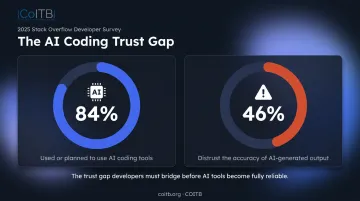
That gap matters. Employers aren't looking for developers who can only prompt an AI assistant. They want people who can review, debug, and ship what the AI produces, and catch it when it's wrong.
That's exactly the skill set COITB's HTML-CSS Web Designer and ReactJS Framework Developer certifications, paired with real project work, are built to prove.
Frequently Asked Questions
Is front-end development worth it in 2026?
Yes. Job growth for web development roles remains positive, and AI tools have shifted the work rather than replaced it. Developers who can build, review, and debug user-facing interfaces are still in demand.
What jobs can I get with a front-end developer certificate?
Common roles include Front-End Developer, Web Designer, UI Developer, and Junior Full-Stack Developer. The exact title depends on your portfolio strength and whether you've paired HTML/CSS with a framework like React, the focus of COITB's HTML-CSS Web Designer and ReactJS Framework Developer certifications.
Do you need a certification to get a front-end developer job?
No, certifications aren't mandatory. They strengthen a resume most when paired with a real portfolio and hands-on projects that prove you can apply what the exam tested.
How long does it take to complete a front-end developer certification?
It ranges from a few weeks for focused, exam-only credentials like COITB's to several months for multi-course programs from providers like Meta or IBM. Your prior experience level affects the timeline most.
How much do front-end developer certifications cost?
Costs range from free (freeCodeCamp) to several thousand dollars for university-affiliated programs. Exam-only credentialing bodies typically fall in between; contact the issuer directly for current pricing.
Are employers likely to recognize a front-end developer certification?
Standards-aligned credentials, especially those referencing frameworks like ISO/IEC 17024 (the standard behind COITB's certifications), tend to carry more weight than unaccredited course certificates. Combining any credential with demonstrated project work matters just as much.