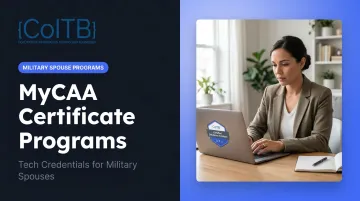
MyCAA exists precisely to address this. The Military Spouse Career Advancement Account offers up to $4,000 in tuition assistance — but with a lifetime cap, choosing the wrong program can burn the entire benefit without producing anything marketable.
This guide covers what MyCAA pays for, which certificate programs deliver the strongest return, why IT credentials stand apart from every other option, and a step-by-step application walkthrough — including the mistakes that cost spouses their funding.
Key Takeaways
- MyCAA provides up to $4,000 lifetime, with a $2,000 fiscal-year cap, for portable career credentials at approved institutions
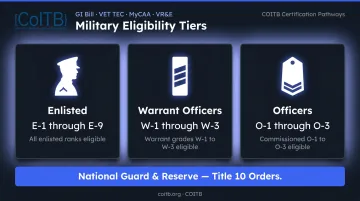
- Eligibility now covers spouses of active-duty service members in grades E-1 through E-9, W-1 through W-3, and O-1 through O-3
- Web development and AI certifications (React, HTML/CSS, GPT) rank among the most remote-eligible credentials that hold up through PCS moves
- Get your Education and Training Plan approved before enrolling or paying anything
- Verify program and school approval separately — a school may be approved without every program being listed
What Is MyCAA and Who Qualifies?
MyCAA (Military Spouse Career Advancement Account) is a Department of Defense workforce development scholarship administered through the Spouse Education and Career Opportunities program (SECO) and Military OneSource. It provides up to $4,000 in financial assistance for portable career training, with a $2,000 annual fiscal-year cap.
Eligibility Requirements
Per current official MyCAA eligibility guidance, the scholarship is open to spouses of active-duty service members in the following pay grades:
- Enlisted: E-1 through E-9
- Warrant Officers: W-1 through W-3
- Officers: O-1 through O-3
- National Guard and Reserve: Spouses of members on Title 10 orders in qualifying grades
Note: If you've seen older information listing a narrower eligibility range (E-1 to E-5, etc.), that reflects a prior policy. Check the current MySECO portal for up-to-date requirements.
The Portability Requirement
MyCAA is specifically designed for portable career fields — credentials you can use at the next duty station without retraining. In practice, that means credentials with multi-state or remote applicability: think online-delivered exams, nationally recognized certifications, and skills that transfer regardless of where orders take your family.
Programs tied to a single state license with no reciprocity — or that depend on a local employer relationship — fall outside the program's scope. When evaluating programs, portability should be your first filter, not an afterthought.
What Does MyCAA Actually Cover?
MyCAA funding has clear boundaries — knowing what qualifies before you enroll saves you from unexpected out-of-pocket costs. According to official MyCAA program materials, the scholarship covers:
What's Included
- Tuition and testing fees for approved programs
- Licenses and certifications in portable career fields
- Associate degree programs at approved institutions
- Continuing education courses to maintain an existing license or certification
- National tests required for credit toward an approved degree
What's Not Covered
Before committing to a program, know these exclusions:
- Books, equipment, and supplies
- Registration, technology, or administrative fees
- Non-credit or audit courses
- Internships and practicums
- Personal enrichment programs
- Costs for any coursework started before MyCAA approval
Starting a class before your financial assistance is approved means MyCAA will not cover it — even if the program is otherwise eligible. Get approval first, then enroll.
The Re-Licensing Benefit
Military OneSource notes that under the 2018 National Defense Authorization Act, each branch may reimburse spouses up to $1,000 for re-licensing or recertification costs after a PCS-related move across state lines. For spouses in state-licensed careers, this benefit is worth tracking separately from MyCAA.
Best MyCAA Certificate Programs by Career Field
When evaluating any program, apply two filters: portability (can you do this job from the next duty station?) and ROI (does this credential lead directly to an employer-recognized job?). The best use of your $4,000 lifetime cap is a standalone credential that's immediately marketable.
IT Certifications
IT credentials are the strongest MyCAA investment for most military spouses. They're remote-friendly by default, transferable across every duty station, and sit in one of the fastest-growing sectors in the labor market. The BLS projects software developer roles to grow 15% through 2034, with a median annual wage of $131,450.
Commonly funded IT credentials include:
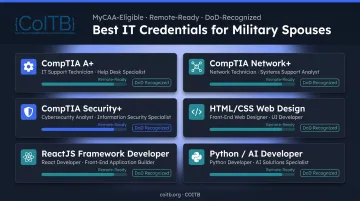
- CompTIA A+: foundational IT support certification, widely recognized by employers
- CompTIA Network+ — networking fundamentals for infrastructure and support roles
- CompTIA Security+ — meets the DoD 8570 baseline requirement, opening government and defense contractor IT roles
- Web development credentials (HTML/CSS, JavaScript, React, Python) — role-specific certifications tied directly to high-demand developer positions
For modern web development credentials, COITB (a non-profit credentialing body) offers ISO/IEC 17024-aligned certifications in HTML-CSS Web Design, ReactJS Framework Development, JavaScript, Python, AI/GPT, and Technical Sales. These credentials target candidates with 0–6 months of hands-on experience and are delivered via online proctored exam from any location, including overseas duty stations. Military CAC and VA-issued IDs are accepted for exam verification.
Verify MyCAA eligibility for specific COITB credentials through DoD before registering. Contact COITB at support@coitb.org or +1 877 402 0840 for current approval status.
Healthcare Certifications
Healthcare certifications offer strong in-person demand near every duty station and solid remote options:
- Medical billing and coding: the strongest remote option; median wages for medical records specialists reached $50,250 in May 2024
- Pharmacy technician — high demand but state-licensed; the North Carolina Board of Pharmacy notes that out-of-state registration may not transfer, making this a tougher fit for frequent movers
- Dental assistant and medical administrative assistant — strong in-person demand but location-dependent
For spouses who PCS frequently, fully remote roles like medical coding have a structural advantage over in-person healthcare credentials that may require re-examination after each move.
Business and Professional Certifications
Other popular MyCAA-funded options include:
- Bookkeeping/QuickBooks certifications: budget-friendly, remote-capable, with consistent demand from small businesses
- TEFL/TESL credentials enable online English teaching from any location, including overseas postings
- CAPM (Certified Associate in Project Management) — project coordination roles with solid remote availability
- Real estate licenses are entirely state-specific and require re-licensing after every out-of-state PCS, making them a poor fit for frequent movers
Why IT Certifications Are the Smartest MyCAA Investment
For a spouse who moves every two to three years, the question isn't just "what job can I get?" — it's "what career can I build without starting over every time we PCS?" That distinction points directly toward remote-friendly, credential-based tech careers — where skills transfer regardless of duty station.
Remote Work Is the Career Continuity Strategy
BLS data shows that 47.5% of information-sector workers telework, compared to 19.5% of all employed workers. That gap is the point. A career built in a high-telework sector doesn't stall at the next duty station — it continues.
Web development and application development roles specifically sit at the intersection of strong remote availability and rising employer demand. Modern credentials in React, JavaScript, Python, and AI tools aren't just portable — they're targeted at roles that employers have structurally moved online.
The AI Skills Edge
The technology landscape has shifted fast. According to the 2025 Stack Overflow Developer Survey, 84% of developers are using or planning to use AI tools, with 51% of professional developers using them daily. The BLS projects data scientist roles — adjacent to AI skills — to grow 34% through 2034, with a median annual wage of $112,590.
A military spouse entering tech now, with credentials in React, Python, and AI tools, isn't entering a saturated field — they're entering a workforce that is actively seeking people who can work with these technologies.
No Technical Background Required
Many military spouses assume they need a computer science degree or years of coding experience to pursue IT credentials. Certifications designed for career starters with 0–6 months of experience exist across the credentialing landscape — no prior technical background required.
COITB's HTML-CSS Web Designer credential serves as the most accessible entry point for career changers: it validates web structure, layout, and responsive design skills without requiring any programming background.
What to look for in any IT certification program:
- Online testing with flexible scheduling (critical for military schedules)
- Industry-recognized credentials, not proprietary badges
- Coverage of specific in-demand technologies (not just general IT concepts)
- Total cost within the $4,000 MyCAA cap
Career Pathways That Stack
Starting with one credential doesn't mean stopping there. COITB supports a structured stacking approach — each certification builds on the last and adds employer-recognized proof of capability:
- HTML-CSS Web Designer — accessible first credential; validates layout and responsive design
- ReactJS Framework Developer — adds front-end depth and component-based development
- JavaScript Professional Developer — broadens language fluency across frameworks
- MySQL Backend Developer — completes a full-stack pathway with database skills
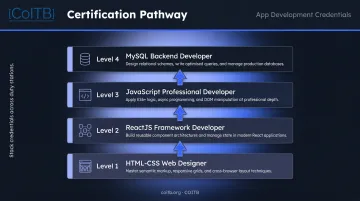
This modular approach fits the military lifestyle. One certification before a PCS, another at the next duty station. Each exam can be taken online, from any location — so a PCS doesn't interrupt the progression.
How to Apply for MyCAA Step by Step
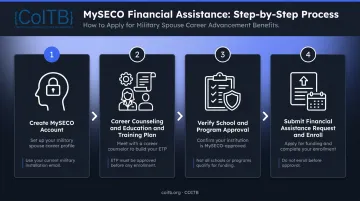
Step 1 — Create Your MySECO Account
Go to mycaa.militaryonesource.mil, create a profile, and complete the DEERS eligibility check using your spouse's DoD ID number.
Step 2 — Complete Career Counseling and Build Your Education and Training Plan
MyCAA requires a career counseling session with a SECO advisor before funding can be approved. Call 800-342-9647 to schedule.
During that session, you will:
- Confirm your chosen program qualifies for MyCAA funding
- Build your Education and Training Plan (E&TP)
- Upload the approved E&TP to your MyCAA account before any financial assistance request can be reviewed
Do not enroll in any class or pay any fees before this step is complete.
Step 3 — Verify Your School and Program Are Approved
Search the approved school list on the MySECO portal and confirm directly with the school that the specific program — not just the institution — is approved. A school can be listed as an approved MyCAA institution while offering individual programs that are not on the approved list.
Step 4 — Submit Your Financial Assistance Request and Enroll
After your E&TP is approved, submit the financial assistance request through the portal. The request window opens 60 days before your class start date; check the current E&TP guidance document for your program's specific submission deadline.
Allow up to 14 business days for review. Do not start class before receiving written confirmation — MyCAA will not reimburse costs paid before approval.
Mistakes to Avoid When Using MyCAA
- Non-portable programs can force you to restart licensing or re-training after every PCS. Before committing, ask: "Can I do this job from the next duty station without additional credentialing?" If the answer is uncertain, find a more portable alternative.
- Spending $4,000 on partial college credits exhausts your lifetime cap without producing an employer-recognized credential. If a PCS interrupts before you finish the degree, those credits are worthless — certifications deliver a clear, marketable qualification within the same budget.
- Waiting too long when a promotion is approaching can cost you eligibility entirely. MyCAA access ends at the point of promotion to a grade outside the eligible range, so start your application as soon as you've chosen a program.
Frequently Asked Questions
How much does MyCAA pay?
MyCAA provides up to $4,000 in lifetime financial assistance, with a $2,000 cap per fiscal year. Ask your MyCAA Career Coach about cap waiver options if your program spans that limit.
What programs can I use MyCAA for?
MyCAA funds licenses, certifications, credentialing exams, and associate degree programs in portable career fields at approved institutions. It's designed for short-term, career-ready training rather than four-year degrees. Portable tech fields — such as web design, front-end development, and AI — are the type of career-ready pathways MyCAA is built to support. Verify that any specific credential and institution are approved through the MySECO portal before enrolling.
Which schools accept MyCAA?
Check the approved school list on the MySECO portal at mycaa.militaryonesource.mil. Confirm that both the school and the specific program are approved — not just the institution name.
Who is eligible for MyCAA?
Spouses of active-duty service members in pay grades E-1 through E-9, W-1 through W-3, and O-1 through O-3 are eligible, including National Guard and Reserve spouses on Title 10 orders. Check the current MySECO portal for the most up-to-date eligibility criteria.
Can I use MyCAA for online certification programs?
Yes. MyCAA funds online programs at approved institutions, which makes fully online certifications practical for military spouses studying across multiple duty stations or from overseas postings.
What is the MyCAA annual cap waiver?
If a program costs more than $2,000 but less than $4,000 total, a military spouse may request a cap waiver through their MyCAA Career Coach to access the full funding without splitting it across two fiscal years. Contact your SECO advisor to confirm current waiver availability.