That creates a real opportunity for career beginners — but also a frustrating problem. Dozens of certifications exist, and most aren't designed for people starting from zero. Some assume prior coding experience. Others are tied to expensive platforms. A few are little more than quiz badges with minimal employer recognition.
This guide cuts through that noise. Below are five beginner-friendly AI certifications worth your time in 2026, selected based on accessibility, provider credibility, and real career relevance.
Key Takeaways
- AI job demand is at record highs — credentials help signal readiness when you lack a portfolio
- The best beginner certifications require little-to-no coding and come from recognized providers
- Costs range from free to ~$300; completion times range from under 10 hours to 6 months
- Match your certification to your career direction — technical vs. non-technical paths differ significantly
- COITB's Certified GPT Professional targets beginners (0–6 months of experience) with ISO/IEC 17024 alignment and remote proctoring
Why AI Certifications Matter for Career Beginners in 2026
The AI skills gap is widening fast. McKinsey's 2025 survey of 238 C-suite leaders found that 46% cited workforce skill gaps as a barrier to generative AI adoption — with 47% saying their organizations were moving too slowly on AI implementation.
For beginners, that gap is an opening.
What a Certification Actually Does for You
When you have no AI work history and no portfolio, a certification gives hiring managers a concrete signal to work with. Specifically, it tells them three things:
- You've pursued structured learning, not just casual curiosity
- You've validated foundational competence against a defined standard
- You're serious enough about the field to invest time and money in it
That shortcut matters, especially for entry-level applicants competing against candidates with longer resumes.
Not All Credentials Carry Equal Weight
A completion badge from a random online quiz and a proctored credential from Microsoft or AWS are not the same thing. Most hiring managers can tell the difference. The credentials worth putting on your resume fall into two categories:
- Vendor-backed certifications from major tech companies (Google, Microsoft, AWS, IBM) that carry brand recognition and appear in job listings
- Standards-aligned credentials from recognized credentialing bodies, such as those structured around ISO/IEC 17024 — the international standard for personnel certification bodies
ISO/IEC 17024 governs how a certifying organization operates: its governance structure, audit cycles, complaint procedures, and integrity controls. When a credential body aligns to this standard, it signals that the certification reflects verified, real-world competency — not just course completion.
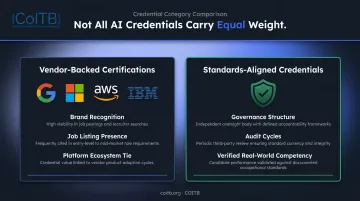
That distinction matters when you're choosing where to invest. COITB's Certified GPT Professional is built around this framework, which means the credential is held to the same operational standards used to evaluate credentialing bodies internationally.
Best AI Certifications for Beginners in 2026
These five certifications were selected based on beginner accessibility, provider credibility, career relevance, and real-world skill outcomes — not just name recognition.
Google AI Essentials
A short, non-technical program offered by Google through Coursera. It covers how generative AI works, prompt writing, and practical use of Google's Gemini AI tools — no coding required. Learners earn a shareable Google career certificate on completion.
At roughly 4–5 hours of content, this is the fastest way to earn a recognized credential from a major tech provider. It's purpose-built for non-technical professionals who need to demonstrate AI awareness to their employer quickly.
| Detail | Info |
|---|---|
| Cost | ~$49/month on Coursera (7-day free trial) |
| Time to Complete | Under 10 hours |
| Best For | Non-technical professionals in marketing, HR, or operations; career changers wanting a fast overview credential |
Microsoft Azure AI Fundamentals (AI-901)
Unlike the course-completion badges that dominate this space, this is a proctored, vendor-backed exam — Microsoft's entry-level AI credential, updated to the AI-901 exam after AI-900 retired on June 30, 2026. It covers core AI concepts, machine learning basics, computer vision, and natural language processing on Azure.
The proctored format gives it more weight than most online learning badges. For career switchers who want proof of structured technical knowledge, this is a stronger resume signal than a course-completion certificate. Verify the current exam code and pricing at Microsoft Learn before enrolling.
| Detail | Info |
|---|---|
| Cost | ~$99 (US pricing; varies by region) |
| Time to Complete | 30–40 hours of prep |
| Best For | Career switchers, IT support professionals moving into AI roles |
IBM AI Developer Professional Certificate (Coursera)
IBM's beginner-level, 10-course series on Coursera covers AI fundamentals, generative AI, prompt engineering, Python basics, and building AI-powered applications — designed for learners with no prior technical background. Completion takes approximately 6 months at 4 hours per week.
This is the most comprehensive option on this list for someone starting from zero. The curriculum includes hands-on labs and portfolio projects, so you finish with actual work samples — a real advantage when applying for entry-level AI roles without prior experience.
| Detail | Info |
|---|---|
| Cost | ~$49/month on Coursera (verify current pricing) |
| Time to Complete | 4–6 months at ~4 hours/week |
| Best For | Complete beginners who want a comprehensive program with hands-on projects |
AWS Certified AI Practitioner (AIF-C01)
COITB (College of IT Business) is a US-based non-profit credentialing body headquartered in Oklahoma City. Their Certified GPT Professional is a 60-question, 75-minute proctored exam with a 71% passing score, covering five domains:
- Foundations of generative AI and GPT models (10%)
- Prompt engineering and output control (20%)
- OpenAI syntax and GPT integration (40%)
- Responsible AI, security, and compliance (15%)
- Applied GPT use cases and industry solutions (15%)
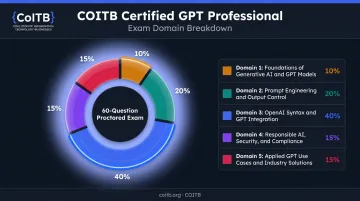
That domain breakdown matters because this isn't a course-completion certificate. It's a proctored credential structured around ISO/IEC 17024 — the international standard for personnel certification — meaning it verifies what you can actually do, not just whether you finished a course. The program targets learners with 0–6 months of AI experience and requires no formal prerequisites.
Remote proctoring runs 24/7 with flexible scheduling. Military CAC cards and VA-issued IDs are accepted for identity verification, which makes this a practical option for veterans, military spouses, bootcamp graduates, and career changers working around variable schedules. Take the free practice assessment at coitb.org/assessment before registering.
| Detail | Info |
|---|---|
| Cost | Contact COITB for current pricing (support@coitb.org or +1 877 402 0840) |
| Time to Complete | Self-paced; flexible remote testing available |
| Best For | Career changers, bootcamp graduates, veterans, and aspiring IT professionals seeking a standards-aligned foundational AI credential |
How to Choose — and What Beginners Get Wrong
The Selection Criteria
These five certifications were chosen based on four factors:
- Accessibility — no or minimal prerequisites; suitable for true beginners
- Provider credibility — major tech vendors, accredited institutions, or standards-aligned credentialing bodies
- Career relevance — does the credential appear in job listings or carry hiring manager recognition?
- Cost-to-value ratio — appropriate investment for someone early in their career
The Most Common Beginner Mistake
The most common trap is chasing the most advanced certification first, or collecting five beginner badges without pairing any of them with real, demonstrable work.
One well-chosen credential plus a portfolio project beats five generic completion certificates on a resume. Recruiters can tell immediately which candidates have applied what they learned.
The Landscape Keeps Shifting
That advice applies even more urgently when you account for how quickly the certification landscape itself moves. AI-900 was retired and replaced by AI-901 in June 2026; AWS pulled its Machine Learning Specialty exam in March 2026. Before enrolling, verify the current exam status, pricing, and prerequisites directly on the provider's official page — what's accurate today may be outdated in three months.
Conclusion
The best AI certification for a beginner is the one that matches your career direction — and that you'll actually finish.
Here's a quick breakdown by situation:
- Need a fast, non-technical credential? Google AI Essentials delivers in under 10 hours.
- Want vendor-backed recognition? Microsoft AI-900 or AWS AI Practitioner are the right targets.
- Starting from zero with time to invest? IBM's AI Developer Professional Certificate includes portfolio projects across a 6-month program.
- Want a standards-aligned credential built for minimal AI experience? COITB's Certified GPT Professional is designed for exactly that.
Employers in 2026 are hiring for demonstrated, applied AI skills. A beginner certification is how you prove you have them.
If that last option fits your situation, COITB's Certified GPT Professional is a proctored, ISO/IEC 17024-aligned credential built for candidates with little to no prior AI experience. Start with the free practice assessment at coitb.org/assessment, then register at coitb.org/auth/signup. Questions? Email support@coitb.org or call +1 877 402 0840.
Frequently Asked Questions
What is the best AI certification for beginners?
Your career goal determines the best fit. Google AI Essentials works for non-technical professionals; Azure AI-900 or AWS AI Practitioner suit cloud-adjacent career switchers; IBM's AI Developer Certificate offers a structured 6-month program with projects. COITB's Certified GPT Professional is designed specifically for learners with 0–6 months of experience who want a standards-aligned, proctored credential.
Which AI skills should I learn in 2026?
Focus on prompt engineering, working with generative AI tools, and basic Python for AI applications. Familiarity with at least one major cloud AI platform — AWS, Google Cloud, or Azure — is increasingly valued. Understanding core machine learning concepts also helps, even in non-technical roles.
Is it worth learning AI in 2026?
Yes. The WEF Future of Jobs Report found that 69% of surveyed employers plan to recruit talent skilled in AI tool design by 2030, and 77% plan to reskill existing workers for AI collaboration. Professionals who build foundational AI skills now are positioned ahead of the curve as adoption accelerates across industries.
Do I need coding experience to get an AI certification as a beginner?
Many beginner certifications require no coding at all — Google AI Essentials is entirely non-technical. Others, like COITB's Certified GPT Professional and IBM's program, touch on basic Python, which can be learned in parallel, so starting with a concepts-first credential before tackling programs with technical prerequisites is a practical approach.
How long does it take to get an AI certification as a beginner?
Timelines vary considerably: Google AI Essentials takes under 10 hours, while vendor exams like Azure AI-900 or AWS AI Practitioner typically require 30–60 hours of prep. IBM's program runs roughly 6 months at 4 hours per week. COITB's Certified GPT Professional is self-paced with flexible remote scheduling.
What jobs can I get with a beginner AI certification?
A beginner AI credential can support roles like AI associate, prompt engineer, technical support specialist, AI tools administrator, and junior data analyst. Pairing your certification with a hands-on project strengthens applications, particularly when competing against candidates with more experience.