Most beginners pick a course based on what's popular or what's cheapest. That's rarely the right filter. The better questions are: What do you want to do with coding? How do you learn best? And what happens after you finish?
This guide covers six of the best beginner coding courses in 2026, walks through how to choose between them, and explains what to do with those skills once you've built them.
Key Takeaways
- Python and JavaScript remain the top beginner languages in 2026, and most courses on this list teach one or both.
- Free courses can lead to jobs but demand more self-discipline and independent project-building than paid options.
- The six platforms covered: freeCodeCamp, Codecademy, Coursera, Udemy, Boot.dev, and CS50 (Harvard/edX).
- Finishing a course is step one; pairing it with a third-party credential like COITB significantly strengthens your résumé.
- No degree required — employers increasingly hire on demonstrated skills, portfolio work, and verifiable certifications.
Why Learning to Code in 2026 Is a Smart Move
The job market numbers are hard to ignore:
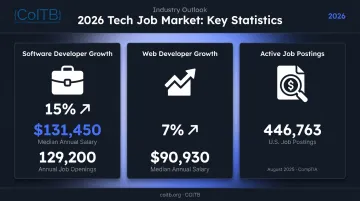
- The U.S. Bureau of Labor Statistics projects 15% growth for software developers from 2024–2034, with a 2024 median salary of $131,450 and roughly 129,200 openings expected annually
- Web developers and digital designers are growing at 7%, with a median wage of $90,930
- CompTIA counted 446,763 active U.S. tech job postings in August 2025, with software developers and engineers making up the largest single category
The barrier to entry has also dropped sharply. Nearly 80% of new GitHub developers used Copilot within their first week, and platforms like Codecademy let you write and run real code in a browser with no setup required. What once took weeks of environment configuration now takes about an hour.
Here are the six platforms that make the most sense for beginners right now.
Best Coding Courses for Beginners in 2026
Selection criteria: beginner accessibility, curriculum quality, project-based learning, cost-to-value ratio, certificate options, and real-world career preparation.
freeCodeCamp
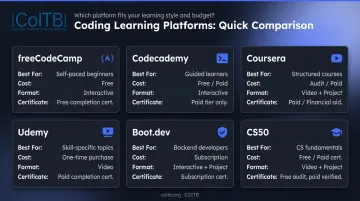
freeCodeCamp is a 501(c)(3) nonprofit where every course, project, and certification is completely free. It's one of the most widely used self-paced resources for aspiring web developers, with more than 2.1 billion minutes of usage logged and over 40,000 graduates reporting developer jobs.
Its core content covers HTML, CSS, JavaScript, React, Python, SQL, and Git — all delivered through browser-based coding challenges and portfolio-quality projects. Sign-in is required to save progress and claim certificates, but no payment is ever needed.
| Feature | Details |
|---|---|
| Best For | Self-motivated beginners targeting web development or front-end careers |
| Cost | Free (nonprofit) |
| Format | Self-paced coding challenges and portfolio projects |
| Certificate | Free verified certificates on completing each path |
| Key Topics | HTML, CSS, JavaScript, React, Python, SQL, Git |
Codecademy
Codecademy is the cleanest "start coding now" option on this list. Learners write and run real code directly in the browser from lesson one — no downloads, no setup. Over 50 million people have used the platform.
The free tier covers Python, JavaScript, HTML, and CSS basics — enough to explore whether coding suits you before committing to a paid plan. Codecademy Pro ($19.99/month billed annually) unlocks full career paths, professional certificates, and technical interview prep.
| Feature | Details |
|---|---|
| Best For | Absolute beginners who need a gentle, interactive introduction |
| Cost | Free tier available; Pro from ~$19.99/month (billed annually) |
| Format | Interactive browser-based exercises with instant feedback |
| Certificate | Pro subscription required for completion certificates |
| Key Topics | Python, JavaScript, HTML/CSS, SQL, career paths |
Coursera — Google & Meta Professional Certificates
Coursera partners with universities and major tech companies to offer structured, guided certificate programs. For beginners, the standouts are the Google IT Support Professional Certificate (beginner-level, approximately 3 months at 10 hours/week) and the Meta Front-End Developer Professional Certificate (beginner-level, approximately 7 months at 6 hours/week) — both requiring no prior experience or degree.
Google's certificate carries particularly strong employer recognition: Coursera cites 1.7 million job postings across certificate fields and reports that 75% of graduates see a positive career outcome within six months. Financial aid is available for eligible learners.
| Feature | Details |
|---|---|
| Best For | Career changers who want a credential backed by a major tech brand |
| Cost | Free to audit; Coursera Plus ~$59/month or $399/year; financial aid available |
| Format | Video lectures, quizzes, and peer-reviewed projects |
| Certificate | Industry-recognized certificates from Google, Meta, IBM, and others |
| Key Topics | IT support, front-end development, HTML/CSS/JavaScript, React, Python |
Udemy — 100 Days of Code: The Complete Python Pro Bootcamp
Dr. Angela Yu's "100 Days of Code" is one of Udemy's most enrolled and highest-rated courses, with over 1.7 million students and a 4.7/5 rating from more than 427,000 reviews. It delivers around 57 hours of video across 100 project-based lessons — each day building something functional in Python.
Udemy runs frequent sales where top courses drop significantly in price (often under $15). Lifetime access means you can revisit content at any pace. Before buying, check the "last updated" date and recent reviews — quality varies widely across Udemy's broader catalog.
| Feature | Details |
|---|---|
| Best For | Beginners committed to learning Python through daily, project-based challenges |
| Cost | Often discounted; verify current price on Udemy |
| Format | Pre-recorded video with coding challenges and projects; lifetime access |
| Certificate | Completion certificate (limited employer recognition; portfolio carries more weight) |
| Key Topics | Python, automation, web scraping, Flask, data science basics |
Boot.dev
Boot.dev is built for beginners who want to pursue backend development and who struggle with motivation in traditional course formats. It wraps a structured curriculum around a gamified experience — learners earn points, complete quests, and progress through paths covering Python, SQL, TypeScript, Go, and more, guided by an AI mentor called "Boots" that uses the Socratic method rather than handing out answers.
Interactive coding and submissions require a paid membership (~$59/month or $399/year); free access covers reading and video explanations.
| Feature | Details |
|---|---|
| Best For | Beginners who want structured backend paths and thrive with gamified accountability |
| Cost | Free to read/watch; interactive access ~$59/month or $399/year |
| Format | Gamified interactive lessons, coding challenges, and community quests |
| Certificate | Professional certificates on path completion |
| Key Topics | Python, SQL, TypeScript, Go, Git, data structures |
CS50 by Harvard (edX)
CS50 is Harvard's introductory computer science course — free to audit on edX, with more than 7 million enrollments since its launch and a reputation as one of the best free courses ever created. It covers foundational CS concepts (algorithms, data structures, memory management, security) using C, Python, SQL, JavaScript, HTML, and CSS.
Expect 12 weeks at 10–20 hours/week — this is a course built for Harvard students, and it shows. The paid verified certificate runs approximately $219. Beginners who want to understand why code works, not just how to write it, will get more out of CS50 than almost anything else on this list.
| Feature | Details |
|---|---|
| Best For | Beginners who want deep CS fundamentals and can commit to a challenging pace |
| Cost | Free to audit; verified certificate ~$219 |
| Format | Video lectures, problem sets, and a final project (self-paced) |
| Certificate | Paid Harvard/edX verified certificate |
| Key Topics | C, Python, SQL, JavaScript, HTML/CSS, algorithms, web programming |
How to Choose the Right Beginner Coding Course
Picking a course by brand name or price tag often leads to the wrong fit. The four filters below help you match a platform to your learning style, career target, budget, and what you actually want to prove at the end.
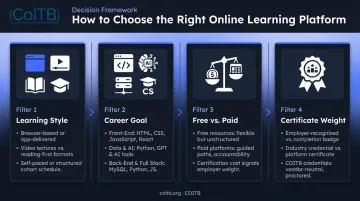
Filter 1: Learning Style
Different platforms suit different learners:
- Interactive, browser-based → Codecademy, Boot.dev
- Video-heavy, self-paced → Udemy, Coursera
- Project and reading-based → freeCodeCamp
- Rigorous academic → CS50
If you've never coded before and want the lowest friction on-ramp, Codecademy or freeCodeCamp are the easiest starts. If you already know you prefer video explanations, Udemy or Coursera will fit better.
Filter 2: Career Goal
Your target role should drive your language and platform choice:
- Front-end web development → freeCodeCamp, Codecademy, or the Coursera Meta certificate (HTML/CSS/JavaScript/React)
- Data, AI, or automation → Udemy 100 Days or Boot.dev (Python-first)
- Backend development → Boot.dev (structured backend curriculum)
- CS fundamentals before specializing → CS50
Filter 3: Free vs. Paid
A 2024 Open Praxis study found MOOC completion rates around 12.6% by traditional measures — rising to about 43% for active, engaged learners. The gap comes down to structure and accountability.
The core trade-off:
- Free (freeCodeCamp, CS50 audit) — zero cost, job-viable, but you supply all the schedule and momentum yourself
- Paid/structured (Coursera guided certificates, Boot.dev gamified paths) — external accountability and deadlines built in, which measurably improves completion
Neither is universally better. The right choice depends on how disciplined you are without a deadline.
Filter 4: Certificate Weight
Not all certificates carry equal weight:
- Udemy completion certificates → limited employer recognition on their own; your portfolio matters more
- Coursera Google/Meta certificates → stronger employer recognition, especially Google's
- freeCodeCamp certificates → free and respected in the developer community, particularly alongside a portfolio
- CS50 verified certificate → strong reputation, especially for CS-adjacent roles
Platform certificates document that you completed a course. They don't independently validate that you can do the work. For entry-level roles, pairing coursework with a portfolio or a third-party credential — something that tests skills independently — closes that gap.
From Course Completion to Career Validation
Finishing a coding course is a real achievement. But hiring managers — especially at companies reviewing dozens of self-taught or bootcamp-trained applicants — increasingly want proof that goes beyond a platform's own certificate.
The challenge for self-taught developers and bootcamp graduates is a credential gap: employers can't easily verify whether a Udemy certificate or bootcamp diploma represents production-ready skills or surface-level familiarity.
This is where third-party credentialing becomes practical. COITB (College of IT and Business) is a nonprofit credentialing body that offers ISO/IEC 17024-aligned certifications in the exact technologies covered by beginner coding courses:
- HTML-CSS Web Designer — 90 questions, 90 minutes, 75% passing score
- JavaScript Professional Developer — 90 questions, 90 minutes, 73% passing score
- ReactJS Framework Developer — 90 questions, 90 minutes, 73% passing score
- Professional Python Developer — 58 questions, 75 minutes, 70% passing score
- MySQL Backend Developer — 90 questions, 90 minutes, 70% passing score
Because COITB does not deliver training, its assessments are genuinely third-party — a neutral organization confirms your skills, not the same platform that sold you the course. Each passed exam produces a digital badge with a verification URL that employers and recruiters can confirm directly from your LinkedIn profile or résumé.
No degree or prior formal training is required. Candidates with 0–6 months of hands-on practice from any platform are the target audience. Exams are available via:
- Remote online proctoring — 24/7, with webcam and stable internet (military CAC and VA-issued IDs accepted)
- Authorized in-person test centers — for candidates who prefer a supervised environment
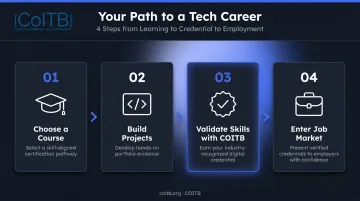
Put together, the full pathway from course completion to job market looks like this:
- Choose a course from the list above based on your learning style and goal
- Build projects during and after the course to demonstrate applied skills
- Validate your skills with a recognized third-party credential from COITB
- Enter the job market with both a portfolio and an independently verified certification
Veterans and military-connected learners should note that GI Bill, VET TEC, MyCAA, and VR&E funding could apply — verify eligibility with VA/SAA before registering. A free practice assessment is available at coitb.org to gauge readiness before scheduling an exam.
Frequently Asked Questions
What are the best coding courses for beginners in 2026?
The top platforms are freeCodeCamp, Codecademy, Coursera, Udemy, Boot.dev, and CS50. There's no single "best" — the right choice depends on your learning style, budget, and career goal.
What is the best programming language for beginners in 2026?
Python and JavaScript remain the top recommendations. Python leads in readability and is central to data, AI, and automation. JavaScript dominates web development and gives you immediate browser-based feedback. The 2025 Stack Overflow Developer Survey found JavaScript at 66% usage and Python at 57.9% among surveyed developers.
How do I start learning to code in 2026?
Pick one low-barrier platform — Codecademy or freeCodeCamp are both solid starting points — and commit to 30–60 minutes of daily practice. Start building small projects early rather than studying theory alone. Consistent daily practice beats occasional marathon sessions every time.
Is it worth learning to code in 2026?
Yes. Software developers have a $131,450 median salary and 15% projected job growth through 2034. Coding skills also increasingly benefit roles outside pure development — data analysis, marketing operations, product management, and technical sales all reward people who can read or write code. Coding skills also increasingly benefit roles outside pure development — data analysis, marketing operations, product management, and technical sales all reward people who can read or write code. Once you've built those skills, a credential like COITB's JavaScript or Python certification can help you prove them to employers.
How long does it take to learn coding as a beginner?
Most beginners reach foundational proficiency in 3–6 months of consistent daily practice. Job-ready skills typically take 9–18 months, depending on hours invested per week, the structure of your learning path, and how actively you build portfolio projects alongside coursework.
Do I need a degree to get a job in tech?
Not for many entry-level developer and IT roles. Employers are increasingly hiring on demonstrated skills, portfolio work, and verifiable certifications. That said, hiring practices are changing gradually — skills-first hiring is growing but not universal. Self-taught and bootcamp-trained candidates are most competitive when they can independently validate their capabilities through third-party credentials — organizations like COITB offer certifications in HTML/CSS, JavaScript, React, and Python specifically designed to do that.