Introduction
The job market for data and tech roles has a filtering problem. Hiring managers sorting through hundreds of applications can't interview everyone who claims to know SQL or Python — and self-reported skills on a résumé don't tell the whole story. For career changers, bootcamp graduates, and self-taught learners, this creates a real barrier.
That's where certifications come in. A credential gives employers a fast, reliable signal that a candidate has gone beyond casual tutorials and can demonstrate competency under structured exam conditions.
According to the 2025 Stack Overflow Developer Survey, SQL is used by 58.6% of developers and Python by 57.9% — making them two of the most widely relevant skills across every corner of the tech industry. TIOBE's June 2026 rankings place Python at #1 overall, reinforcing its dominance.
This guide breaks down what SQL and Python certification programs test, how to evaluate program quality, and which path fits your career target — whether you're validating self-study, transitioning careers, or stacking credentials on top of existing qualifications.
Key Takeaways
- SQL and Python consistently rank among the most requested skills in data and tech job postings
- Most data roles benefit from proficiency in both SQL and Python; they're complementary, not competing skills
- Certifications function as credibility signals for career changers and candidates without formal CS degrees
- ISO/IEC 17024 alignment signals a credentialing program built to measurable professional standards — not just a pay-to-pass exam
- The right certification depends on your target role, not just what's most popular
Why SQL and Python Certifications Are Worth Pursuing in 2026
The Credibility Gap for Career Changers
For professionals with established tech portfolios, certifications are optional. For everyone else — career changers pivoting from finance or healthcare, bootcamp graduates, veterans translating service experience into civilian tech roles — certifications do specific work that a résumé alone can't.
They answer the employer's first question: Has this person actually committed to learning this skill, or just dabbled?
Three concrete problems certifications solve:
- Creates a logical learning path from syntax basics to applied competency — especially useful when you don't know what to study first
- Signals discipline to employers by requiring a proctored exam, not just course completion
- Validates demonstrated ability through standardized testing, not self-reported skill claims
Certification vs. Certificate: A Critical Distinction
These two terms look similar on paper but carry very different weight with employers.
| Certificate | Certification | |
|---|---|---|
| What it proves | You completed a course | You passed a standardized exam |
| How it's earned | Course completion | Proctored examination |
| Issued by | Online learning platforms | Credentialing bodies |
| Employer signal | You watched the videos | You demonstrated competency under test conditions |
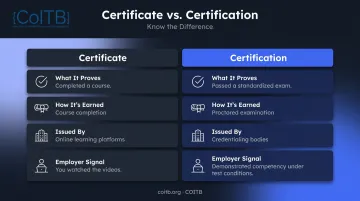
Credentials aligned to standards like ISO/IEC 17024 — such as COITB's Professional Python Developer and MySQL Backend Developer certifications — fall into the certification category, with formal exam requirements and structured validity standards.
The AI Factor
AI tools can generate SQL queries and Python scripts, but that doesn't make human expertise obsolete. Stack Overflow's 2025 AI survey found that 46% of developers distrust AI output accuracy, 66% cite AI answers that are "almost right, but not quite," and 45% say debugging AI-generated code is more time-consuming than writing it manually.
Employers still need professionals who can validate AI output, understand data architecture, and apply logical reasoning to real business problems. Certifications now signal this deeper comprehension — not just syntax memorization.
What SQL Certification Programs Actually Cover
SQL certifications span a wide range, from foundational query-writing to advanced database administration. Most beginners should focus on foundational-to-intermediate programs before pursuing vendor-specific credentials.
Beginner and Platform-Level SQL Certifications
Entry-level programs typically test:
- Basic SELECT queries, filtering, and sorting
- JOINs across multiple tables
- Aggregate functions (COUNT, SUM, AVG, GROUP BY, HAVING)
- Subqueries
- Data manipulation — INSERT, UPDATE, DELETE
Platform-based certificates (from major online learning providers) are accessible and affordable, but they carry less weight with technical hiring managers than proctored exams. They work well for building foundational fluency before you pursue a proctored credential.
Vendor and Role-Specific SQL Certifications
The next tier covers vendor-specific credentials tied to specific database platforms:
| Certification | Issuer | Exam Format | Fee |
|---|---|---|---|
| Azure Data Fundamentals (DP-900) | Microsoft | Proctored, passing score 700 | $99 USD |
| Oracle Database SQL (1Z0-071) | Oracle | 63 questions, 120 min, 63% pass | Contact Oracle |
| SnowPro Core | Snowflake | Pearson VUE proctored | Contact Snowflake |
These exams test applied knowledge of specific platforms and carry considerably more weight in enterprise hiring. Expect 2–6 months of preparation.
Of the platforms represented in this tier, MySQL stands out for how broadly it applies across job roles. DB-Engines ranks MySQL #2 globally as of June 2026 with a score of 856 — behind only Oracle, and ahead of SQL Server, PostgreSQL, and MongoDB. That reach makes MySQL proficiency directly transferable across backend development, web applications, and junior data roles.
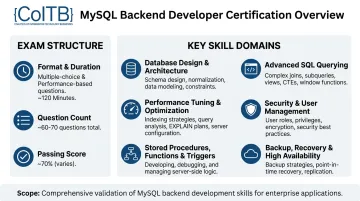
COITB's MySQL Backend Developer certification covers the full production skill set: 90 questions over 90 minutes, testing SELECT queries, JOINs, aggregate functions, subqueries, database design, query optimization, stored procedures, and backup/recovery. It's designed for candidates with 0–6 months of hands-on experience and is available via online remote proctoring or authorized test centers.
What Python Certification Programs Actually Cover
Python certifications are similarly tiered — entry-level syntax validation up to advanced role-based credentials in data science, AI engineering, or backend development.
Entry-Level Python Certifications
The Python Institute's pathway is the most structured entry-level option:
- PCEP (Certified Entry-Level Python Programmer) — 30 questions, 40 minutes, from $69. Covers core syntax, data types, loops, functions, and basic error handling
- PCAP (Certified Associate Python Programmer) — Intermediate coding ability, from $295, delivered through Pearson VUE
- PCPP1 (Certified Professional Python Programmer Level 1) — 45 questions, from $325, Pearson VUE with OnVUE online proctoring
These exams include code-oriented item types (gap fill, code insertion, scenario-based items) — more rigorous than standard multiple-choice.
Advanced and Role-Based Python Certifications
Professional-level Python certifications move beyond syntax and test how you apply Python to real job tasks — cleaning data, building automation scripts, working with libraries, and applying OOP principles in context.
COITB's Professional Python Developer certification is built around eight applied knowledge domains. The exam covers six core areas:
- Core syntax, data types, control flow, and functions
- Data structures — lists, dictionaries, and strings
- Object-oriented programming (classes, inheritance, encapsulation)
- File handling, APIs, modules, and virtual environments
- Error handling, debugging, and PEP 8 style
- Building small applications and automation scripts
The exam runs 58 multiple-choice and scenario-based questions over 75 minutes, with a 70% passing score. It targets candidates with 0–6 months of hands-on experience and is available online with remote proctoring or at an authorized COITB test center.
Should You Get SQL, Python, or Both?
How SQL and Python Fit Together
SQL and Python are complementary, not competing. SQL handles data retrieval and storage; Python takes over for analysis, transformation, and automation. In practice, they're designed to work together — pandas' DataFrame.to_sql writes directly to SQL databases, and SQLAlchemy is explicitly built as the Python SQL toolkit and ORM.
Stack Overflow 2025 shows both languages at roughly equal adoption rates (~58%), which reflects how frequently roles require both rather than one or the other.
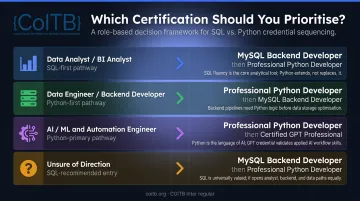
Career-Role Decision Framework
Use this as a starting point:
| Target Role | Priority |
|---|---|
| Data Analyst, BI Analyst, Reporting | SQL first, then Python |
| Data Engineer, Backend Developer | Python primary, SQL alongside |
| AI/ML, Automation Engineering | Python first, SQL as needed |
| Unsure of direction | Start with SQL — lower learning curve, immediate job applicability |
For career changers without formal degrees, holding both certifications signals broader capability. That combination, backed by even one or two portfolio projects, can effectively substitute for years of traditional experience on a résumé. COITB's Professional Python Developer and MySQL Backend Developer certifications are designed precisely for this scenario — validating job-ready skills for candidates at the 0–6 month experience level, regardless of background.
What to Look for in a Quality Certification Program
Not all certifications carry the same weight. Evaluate programs on three factors:
- Credibility of the issuing body — Is it an industry-recognized organization, or a self-issued badge from a course platform?
- Exam rigor — Does it include a proctored or practical exam, or just a completion quiz?
- Alignment to professional standards — Programs aligned to ISO/IEC 17024 undergo independent quality assessment. ANAB (part of ANSI) accredits personnel certification bodies to ISO/IEC 17024, ensuring the credential meets a verified benchmark rather than being self-defined by the issuer
Beyond credential quality, logistics affect whether you can actually complete the exam:
- Remote testing availability — critical for working professionals, deployed service members, and candidates far from test centers
- Flexible scheduling — 24/7 online proctoring removes scheduling barriers
- Renewal requirements — credentials with renewal cycles signal that the issuer keeps content current
COITB's Python and MySQL certifications are aligned to ISO/IEC 17024 standards, delivered via online remote proctoring or authorized test centers, and designed specifically for candidates with 0–6 months of experience. Veterans may be able to fund exam fees through GI Bill, VET TEC, MyCAA, or VR&E — though eligibility requires verification through VA/SAA before registering.
One caution: avoid collecting certifications that don't align to a specific career target. Pick one or two credentials that directly match your goal, pass them, then build projects that prove the skills.
Frequently Asked Questions
Is SQL certification worth it?
For career changers and beginners, yes. It functions as a credibility filter, helps résumés survive initial screening, and proves commitment to the field. For experienced professionals, the primary value is career mobility and access to new roles rather than automatic salary increases at a current employer.
Which certification is best for SQL?
It depends on career stage. Beginners benefit most from foundational programs that combine structured learning with a proctored credential. More advanced professionals often seek role-aligned or vendor-specific credentials. Either way, prioritize programs backed by recognized credentialing bodies that include a proctored exam.
Can I learn Python and SQL at the same time?
Yes — and for most data and tech career paths, learning both simultaneously is strategically smart. SQL retrieves and stores data; Python analyzes and transforms it. Many job roles require proficiency in both, and the skills reinforce each other from the start.
Is SQL still relevant in 2026?
Yes — SQL ranks among the most universally required skills across data analyst, data engineer, backend developer, and business intelligence roles. AI tools may generate queries, but understanding data architecture and validating output still requires genuine SQL expertise.
Is a Python certification worth it for beginners?
For beginners, a Python certification provides structure, validates foundational skills to employers, and creates a clear learning milestone. It's especially valuable for candidates without a computer science degree, as it proves real competency rather than self-reported familiarity.
What is ISO/IEC 17024 and why does it matter for certifications?
ISO/IEC 17024 is an international standard for personnel certification bodies, requiring credentialing organizations to meet independent benchmarks for impartiality, consistency, and competence validation. Credentials aligned to this standard carry greater weight with employers because the quality bar is set externally, not by the issuing organization itself.