Introduction
Software development is changing fast — and developers who can build, integrate, or prompt AI systems are commanding serious attention from employers. The U.S. Bureau of Labor Statistics projects software developer employment to grow 16% from 2024 to 2034, adding roughly 267,700 jobs — with AI software development explicitly named as a demand driver.
The certification market hasn't kept pace with that demand. Dozens of credentials now exist, ranging from rigorous, exam-based certifications that validate real skills to course completion badges that confirm you watched some videos. Knowing which credentials actually signal readiness to employers — and which ones don't — is the difference between a résumé that gets a callback and one that doesn't.
This guide covers five developer-relevant AI certifications worth your time, how to evaluate them, and how to choose the one that fits where you are right now.
Key Takeaways
- AI certifications with standardized assessments carry more hiring weight than course completion certificates
- The best credentials for developers cover prompt engineering, LLM integration, Python, and cloud AI services
- Cost ranges from ~$28/month (DataCamp) to $100 (AWS), with free and subsidized options available for eligible candidates
- COITB, DataCamp, AWS, Microsoft, and IBM each offer developer-accessible credentials across different experience levels
- Prerequisites matter: choose a credential that matches your current background, not just your aspirations
What Are AI Certifications for Developers?
Hiring managers treat certifications and certificates differently, and knowing which is which affects how you position yourself on a résumé.
A certification requires passing a standardized assessment that validates real-world competency, independent of any specific course. A certificate confirms you completed a learning program. As the Institute for Credentialing Excellence defines it, certifications assess competencies acquired independently, while certificates are tied directly to a training event.
For developers, this distinction is practical: an employer can verify a certification through a badge URL or credential ID. A course completion certificate tells them you sat through content, not that you can apply it.
What the AI Certification Landscape Covers for Developers
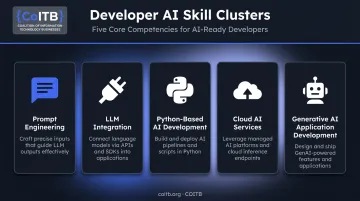
Developer-focused AI credentials fall into five skill clusters:
- Prompt engineering — structuring inputs to get reliable, useful outputs from language models
- LLM integration — connecting models to applications via APIs and SDKs
- Python-based AI development — building functional AI features using libraries like OpenAI's Python SDK
- Cloud AI services — deploying and managing AI workloads on platforms like AWS and Azure
- Generative AI application development — building chatbots, summarizers, and retrieval-augmented generation pipelines
The certifications below were selected based on developer-specific relevance, accessible prerequisites, and recognized credentialing standards.
Top AI Certifications for Developers
These five credentials were chosen based on skill coverage, exam format, cost accessibility, and practical applicability to modern developer roles.
COITB Certified GPT Professional
COITB is a US-based non-profit credentialing body whose programs are governed in alignment with ISO/IEC 17024 standards for personnel certification bodies. The Certified GPT Professional targets developers building applied skills in generative AI, prompt engineering, and GPT-based application development.
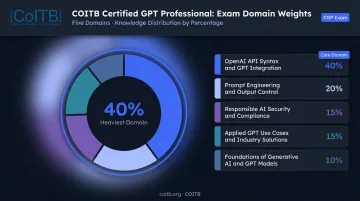
The exam consists of 60 multiple-choice and scenario-based items completed in 75 minutes, with a passing score of 71%. It's structured around five domains:
- Foundations of Generative AI and GPT Models (10%)
- Prompt Engineering and Output Control (20%)
- OpenAI API Syntax and GPT Integration — 40%, the heaviest domain
- Responsible AI, Security, and Compliance (15%)
- Applied GPT Use Cases and Industry Solutions (15%)
That 40% weight on API integration is meaningful. Candidates must demonstrate Python-based GPT API calls, JSON response parsing, environment variable management, error handling for rate limits, and React-based response rendering. Candidates who have actually built something will have a clear advantage here.
Testing and credentialing logistics:
- Remote online proctoring available 24/7 (webcam + stable internet required; military CAC and VA-issued ID accepted)
- In-person testing available at authorized COITB test centers
- Digital badge issued automatically on passing, verifiable via a unique credential URL and shareable to LinkedIn's Licenses & Certifications section
| Detail | Info |
|---|---|
| Cost | Not publicly listed; contact COITB at support@coitb.org or +1 877 402 0840 for current pricing. Veteran benefit funding (GI Bill, VET TEC, MyCAA, VR&E) may apply — verify eligibility with VA before registering. |
| Key Skills | Prompt engineering, OpenAI API integration, Python GPT development, responsible AI, applied generative AI use cases |
| Prerequisites | 0–6 months of hands-on AI practice; accessible to bootcamp grads, self-taught developers, and career changers |
| Exam Format | 60 items, 75 minutes, 71% passing score |
DataCamp AI Engineer for Developers Associate
DataCamp's developer-specific AI engineering certification covers LLM integration, prompt engineering, chatbot development, and API-driven AI application building — all assessed through a practical Python exam, not just theory.
The assessment format is notable: two timed exams followed by a four-hour practical exam completed in Python, built around a real-world scenario with three tasks. All three must be completed within 30 days of registration. The structure filters for candidates who can produce working code under time pressure, not just answer multiple-choice questions.
A companion learning track on DataCamp covers OpenAI API integration, open-source library usage, and LLMOps — directly aligned with what the practical exam tests.
| Detail | Info |
|---|---|
| Cost | Included with DataCamp Premium at $28/month billed annually |
| Key Skills | Prompt engineering, LLM concepts, API integration, chatbot development, AI solution implementation, software engineering principles |
| Prerequisites | No formal prerequisites stated; the Python practical exam establishes competency benchmarks in practice |
| Exam Format | Two timed exams + four-hour Python practical exam; 30-day completion window |
Microsoft Azure AI Fundamentals (AI-900)
Note: AI-900 was retired on June 30, 2026. Microsoft has released AI-901 as its replacement. If you're pursuing this credential pathway, verify current exam availability and details directly at Microsoft Learn.
While active, AI-900 covered core AI and machine learning concepts, Azure AI services, NLP and computer vision workloads, generative AI fundamentals, and responsible AI principles — weighted across five skill domains. Microsoft stated that software engineering experience was not required, making it an accessible entry point for developers new to cloud AI environments.
| Detail | Info |
|---|---|
| Cost | Final displayed price was $99 USD (regional variation applied); exam now retired |
| Key Skills | Core AI/ML concepts, Azure AI services, responsible AI, generative AI workloads |
| Prerequisites | No formal coding or data science background required; basic cloud awareness helpful |
| Exam Format | Standardized Microsoft exam; official instructor-led course was one day |
AWS Certified AI Practitioner (AIF-C01)
Amazon's entry-level AI credential validates fluency in AI, machine learning, and generative AI concepts within the AWS ecosystem. AWS held 29% of worldwide cloud infrastructure spending in Q3 2025 — making familiarity with AWS AI services commercially relevant for a large portion of developer work.
The exam covers five domains, with the highest weight on Applications of Foundation Models (28%) and Generative AI Fundamentals (24%). Named AWS tools include Amazon Bedrock, Amazon SageMaker Clarify, and Amazon Augmented AI.
One caveat for developers: the AIF-C01 targets candidates who use AI/ML solutions rather than those who build or code models. Developing or coding custom models is explicitly out of scope. This makes it a strong foundational credential, but developers looking to validate engineering depth should pair it with something more hands-on.
| Detail | Info |
|---|---|
| Cost | $100 |
| Key Skills | AI/ML fundamentals, generative AI concepts, responsible AI, AWS AI service integration, security and governance |
| Prerequisites | No coding background required; up to six months of AWS AI/ML exposure recommended |
| Exam Format | 65 questions, 90 minutes, available via Pearson VUE or online proctoring |
IBM AI Developer Professional Certificate (Coursera)
The IBM AI Developer Professional Certificate is a 10-course beginner series on Coursera, estimated at six months at four hours per week. It's completion-based rather than an independent proctored exam, which is worth understanding before you register. Completing the series earns a Professional Certificate from Coursera and a digital badge from IBM, but it does not require passing a separate proctored assessment.
That said, the curriculum is genuinely useful for developers building foundational AI knowledge. Courses cover Python for AI development, generative AI applications, Flask-based app development, chatbot construction, and prompt engineering — progressively building toward project-based work.
| Detail | Info |
|---|---|
| Cost | Included with Coursera Plus at $59/month; $399/year standard |
| Key Skills | Python for AI, generative AI applications, prompt engineering, Flask, chatbot development |
| Prerequisites | No prior AI or programming experience required; Python course is included in the series |
| Credential Type | Completion-based Professional Certificate (not an independent proctored exam) |
How to Choose the Right AI Certification
A common mistake developers make is defaulting to the credential they see advertised most often — without checking whether it includes a practical assessment, follows recognized credentialing standards, or covers skills actually used in developer roles.
Evaluation Criteria That Matter
Before registering for any AI certification, check these factors:
- Assessment format — Does it require passing a standardized exam, or just completing coursework?
- Skill alignment — Does it cover the specific tools you'll use: Python, LLM APIs, prompt engineering, or cloud AI services?
- Prerequisites — Are they realistic for your current background, or will you need significant prep time to get there?
- Credentialing standards — Is the certifying body independent of the training, or is it granting its own certificates?
- Scheduling flexibility — Can you take it remotely with flexible scheduling, or does it require in-person attendance?
Matching Credential to Career Stage
| If you are... | Consider starting with... |
|---|---|
| New to AI with a self-taught or bootcamp background | COITB Certified GPT Professional |
| A Python developer transitioning into AI engineering | DataCamp AI Engineer for Developers |
| Working in cloud environments and need an AWS foundation | AWS Certified AI Practitioner |
| Building structured AI knowledge from scratch | IBM AI Developer Professional Certificate |
| Working in enterprise environments on Azure (check current exam availability) | Microsoft AI-900 (Azure AI Fundamentals) |
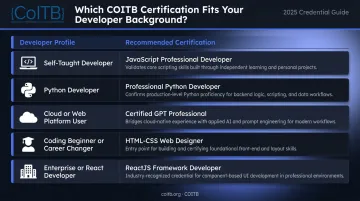
Developers with cloud experience should lean toward platform-specific credentials like AWS. Those earlier in their journey — self-taught developers or bootcamp grads — benefit from credentials with flexible prerequisites and real-world skills validation, where an exam-based credential like COITB's signals verified, job-ready skills to employers. For working professionals, remote proctoring with flexible scheduling matters just as much as the credential itself — it determines whether you can realistically fit exam prep around existing job commitments.
Conclusion
The right AI certification isn't the most expensive option or the most-advertised one. It's the credential that aligns with your current skill level, the AI tools you'll actually work with, and the employers you want to attract.
Before enrolling, do three things: confirm the credential requires a skills-based assessment (not just course completion), check that prerequisites match your actual background, and verify that your target employers in your industry recognize the credential.
One credential worth checking against that list: COITB's Certified GPT Professional. It covers applied skills including GPT API integration, prompt engineering, and Python-based development, uses an exam-based format (not just course completion), and is aligned with ISO/IEC 17024 standards. Take the free practice assessment at coitb.org/assessment or contact the team at support@coitb.org to see whether it fits your goals.
Frequently Asked Questions
Is getting an AI certification worth it for developers?
AI certifications help developers stand out in a market where employers need concrete evidence of applied skills. Certifications that require a standardized assessment — rather than just course completion — carry more weight because they represent verified competency an employer can independently confirm.
Which AI certification is best for developers?
Your current experience level and target role should guide the choice. Developers new to AI — especially those without a formal CS background — can start with COITB's Certified GPT Professional, which validates applied generative AI skills through a standardized exam. Developers targeting cloud-specific or platform-specific roles can explore vendor-aligned options after establishing that foundation.
How do I get into AI as a developer?
Start with Python basics and prompt engineering fundamentals, then build small projects using LLMs or AI APIs like OpenAI's. Once you have hands-on experience, validate those skills with a recognized exam-based certification to signal readiness to employers.
What is the difference between an AI certificate and an AI certification?
A certificate confirms you completed a course. A certification requires passing a standardized assessment that validates actual competency, independent of any specific training program. Employers increasingly prefer certifications because they're verifiable and represent demonstrated skill, not just time in a course.
Do I need a computer science degree to get an AI certification as a developer?
No. Most developer-focused AI certifications are designed for self-taught developers, bootcamp graduates, and career changers. Prerequisites typically center on basic Python familiarity and some hands-on AI experimentation — not academic credentials.