Introduction
Hiring managers increasingly screen candidates for demonstrated, verifiable skills — not just degree credentials. According to the World Economic Forum's 2024 skills-first report, 46% of workers say their formal qualifications are not relevant to their current roles, and 58% believe they have skills employers simply can't see from their résumés alone.
The problem most professionals face isn't motivation — it's knowing which certification actually moves the needle. Pursue the wrong credential and you've spent months on a badge nobody recognizes. Pursue the right one and you're suddenly qualified for roles that were previously out of reach.
This guide covers the most in-demand certifications across web development, application development, AI and generative AI, and technical sales — with the practical context you need to pick the credential that fits your specific career goals.
Key Takeaways
- Certifications validate standardized competency through examination — not just course completion.
- 91% of employers say IT certifications play a key role in hiring decisions, making them credible screening signals.
- Cloud, cybersecurity, and AI credentials lead to some of the highest salaries in tech.
- Matching certification to your target role matters more than chasing the most popular badge.
- ISO/IEC 17024-aligned credentials are especially valuable for career changers with little to no formal experience.
Why Certifications Matter for Career Growth
Certifications vs. Certificates vs. Degrees
These terms get used interchangeably, but they mean different things to employers:
- Certification — Proof of competency validated through a standardized exam administered by a recognized body. You either meet the standard or you don't.
- Certificate — Proof that you completed a course or program. No external validation of what you actually know.
- License — Government-issued authority to practice in a regulated profession (medicine, law, engineering).
The distinction matters because employers weight these differently. A certification issued by a body aligned to ISO/IEC 17024 — the international standard for personnel certification — signals impartiality and rigor. An informal certificate of completion doesn't carry the same weight in a hiring screen.
The Tangible Career Impact
The salary data on certified versus non-certified professionals is clear:
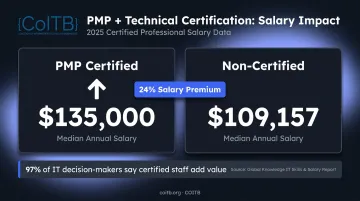
- PMP holders earn a median salary of $135,000 in the U.S., compared to $109,157 for non-certified project managers — nearly a 24% premium according to PMI's 2025 salary survey.
- 97% of IT decision-makers say certified staff add value, and 22% estimate that value at $30,000 or more annually, per Skillsoft's 2024 IT Skills and Salary Report.
Beyond salary, certifications help candidates pass automated screening, qualify for higher-level roles from the start, and differentiate themselves from candidates with identical years of experience.
Certifications Stay Current. Degrees Don't.
Degree programs take years to update curricula. Certifications don't. That salary and hiring advantage compounds in fast-moving fields like AI, cloud, and application development — where a credential issued last year reflects current employer expectations more accurately than a degree awarded three years ago.
Best Certifications for Career Growth and Success
The certifications below were selected based on employer demand, issuing body credibility, career ROI, and accessibility across experience levels.
IT and Application Development Certifications
As organizations build and maintain web applications, AI-powered tools, and cloud-connected systems, the demand for developers with verified, hands-on skills keeps climbing. The Bureau of Labor Statistics projects software developer employment to grow 15% from 2024 to 2034, with a median 2024 salary of $131,450.
What makes this certification category distinctive is accessibility. Unlike credentials that require years of prior experience, IT and application development certifications can be earned by self-taught developers, bootcamp graduates, and career changers with as little as a few months of hands-on practice.
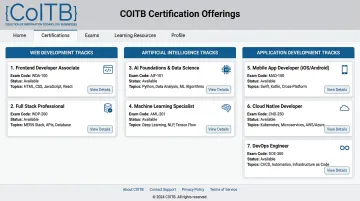
COITB (College of IT Business), a non-profit credentialing body aligned to ISO/IEC 17024 standards, offers seven certifications in this space — each validated through a standardized exam with no formal degree prerequisite:
| Certification | Core Skills Validated | Questions / Time | Passing Score |
|---|---|---|---|
| ReactJS Framework Developer | Components, Hooks, Routing, APIs | 90 / 90 min | 73% |
| HTML-CSS Web Designer | HTML5, CSS3, Flexbox, Grid, Accessibility | 90 / 90 min | 75% |
| JavaScript Professional Developer | ES6+, DOM, Async/Await, Fetch API | 90 / 90 min | 73% |
| Professional Python Developer | Python 3, OOP, Automation | 58 / 75 min | 70% |
| MySQL Backend Developer | SQL, Schema Design, Query Optimization | 90 / 90 min | 70% |
| Certified GPT Professional | Prompt Engineering, GPT APIs, Responsible AI | 60 / 75 min | 71% |
| Technical Sales Specialist | SaaS Sales, Discovery, Objection Handling | 60 / 75 min | 70% |
Who these credentials serve: self-taught developers, bootcamp graduates, career changers, veterans using GI Bill or VET TEC benefits (verify eligibility with VA/SAA before registering), project managers stacking technical credentials on existing PMP or PSM certifications, and military spouses seeking portable, remote-friendly career validation.
Exams are delivered online with remote proctoring (webcam + stable internet required; military CAC and VA-issued ID accepted) or in person at authorized test centers. Digital badges are issued upon passing and can be shared directly to LinkedIn and résumés for employer verification.
Project Management Certifications
Project managers are in demand across every major industry. PMI's PMP and CAPM certifications are the most widely recognized credentials in the field.
| CAPM | PMP | |
|---|---|---|
| Target | Entry-level PMs | Experienced project leads |
| Prerequisites | Secondary degree + 23 hours PM education | Bachelor's + 3 yrs leading projects, or high school diploma + 5 yrs |
| Salary Impact | Career entry accelerator | ~24% salary premium vs. non-certified peers |
| Industries | Technology, healthcare, finance, government, construction | All of the above |
The PMP is considered the benchmark for established project professionals. With over 1.7 million active PMP holders worldwide and 211,917 new certifications issued in 2024, it carries clear market recognition. The CAPM is the right starting point for those still building experience.
Note for PMs: COITB certifications in ReactJS, Python, GPT, and related technologies are specifically designed to stack on top of existing PM credentials — helping project managers close the technical credibility gap when transitioning into technical PM, engineering manager, or tech lead roles.
Cybersecurity Certifications
The cybersecurity workforce shortage is a structural problem — and it's getting worse. ISC2's 2024 workforce data puts the global cybersecurity workforce gap at 4.8 million professionals, up 19% from the prior year.
Key certifications by career stage:
| Certification | Level | Key Requirement | Career Outcome |
|---|---|---|---|
| CompTIA Security+ | Foundational | No prerequisites | Security analyst, IT auditor |
| CySA+ | Intermediate | Security+ recommended | Cybersecurity analyst |
| CISSP | Advanced | 5 years paid experience in 2+ domains | Security manager, CISO |
CompTIA Security+ is DoD-recognized under the DoD 8140 framework, making it a strong entry point for both federal roles and private-sector positions. CISSP holders in North America reported an average salary of $147,757 according to ISC2's 2024 salary data — among the highest in the profession.
Cloud Computing Certifications
Cloud credentials rank among the highest-paying IT certifications available. Skillsoft's 2024 survey reported U.S. average salaries of:
- $155,597 — AWS Certified Solutions Architect Associate
- $148,849 — Microsoft Certified: Azure Administrator Associate (AZ-104)
- $190,204 — Google Professional Cloud Architect
Cloud skills are in demand across engineering, DevOps, IT administration, finance, healthcare, and retail — wherever organizations are shifting infrastructure off-premise. These salaries reflect that demand.
Experience recommendations by tier:
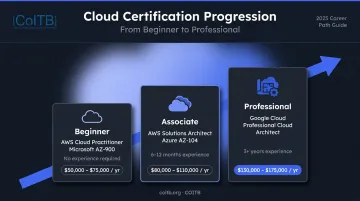
- Beginner: AWS Cloud Practitioner, Microsoft AZ-900 (no experience required)
- Associate: AWS Solutions Architect Associate, Azure AZ-104 (6–12 months hands-on recommended)
- Professional: Google Cloud Professional Cloud Architect (3+ years industry experience recommended)
Data and AI Certifications
Data science employment is projected to grow 34% from 2024 to 2034 according to the BLS, placing it among the fastest-growing occupations tracked. The World Economic Forum's Future of Jobs Report 2025 identifies AI and machine learning specialists among the fastest-growing roles globally, while McKinsey reports 92% of companies plan to increase AI investments over the next three years.
Key credentials in this category:
| Certification | Type | Target Role |
|---|---|---|
| IBM Data Science Professional | Professional certificate (Coursera) | Data scientist, analyst |
| Google Data Analytics | Professional certificate (Coursera) | Data analyst |
| Microsoft Power BI (PL-300) | Exam-based, annual renewal | BI developer, analyst |
| COITB Certified GPT Professional | ISO/IEC 17024-aligned exam | AI practitioner, developer, technical PM |
Important distinction: IBM and Google offerings are professional certificate programs — structured learning series without a single standardized external exam. The Microsoft PL-300 and COITB's Certified GPT Professional are exam-based credentials, with the latter explicitly designed for professionals entering the generative AI space with minimal prior experience.
For professionals new to AI who want a third-party validated credential, the Certified GPT Professional covers prompt engineering, GPT API integration, responsible AI practices, and real-world use cases. The exam is designed for candidates with 0–6 months of hands-on AI experimentation.
How to Choose the Right Certification
How These Certifications Were Selected
The certifications above were selected using four criteria:
- Employer demand — frequency in job postings and hiring screens
- Issuing body credibility — alignment to recognized standards like ISO/IEC 17024
- Accessibility — available across experience levels, not just senior professionals
- Career ROI — measurable salary impact or competitive hiring advantage
Common Mistakes to Avoid
- Chasing popularity over fit. A certification may be well-known — but if it doesn't match your target role or tech stack, it won't move the needle in your job search.
- Stacking low-value certificates. Collecting five course-completion certificates rarely creates the same signal as one rigorous, exam-validated certification.
- Skipping credential verification. Confirm that employers in your target field actually recognize the credential before you register. Search job postings in your area for the certification name.
Matching Certification to Career Stage
| Career Stage | Recommended Approach |
|---|---|
| No experience / career changer | Start with foundational credentials: COITB HTML-CSS Web Designer or Certified GPT Professional |
| 1–3 years experience | Target role-specific credentials: COITB JavaScript Professional, Python Developer, or ReactJS Framework Developer |
| 3+ years / technical track | Pursue advanced application credentials: COITB ReactJS Framework Developer, MySQL Backend Developer, or Certified GPT Professional |
| PM stacking technical skills | Add COITB technical credentials (ReactJS, Python, GPT) on top of existing PMP/PSM |
Conclusion
The best certification for your career isn't necessarily the most popular or the most expensive. It's the one that aligns with where you want to go, validates skills employers in that field look for, and is backed by an issuing body they recognize.
The strategic approach: identify your target role, research which credentials appear most frequently in job postings for that role, and pursue the certification that closes the most important gap between where you are and where you're aiming.
COITB is a non-profit credentialing body offering ISO/IEC 17024-aligned certifications in web development, AI, and application development — designed for candidates with as little as 0–6 months of hands-on experience. COITB credentials are a strong fit for:
- Career changers and bootcamp graduates validating job-ready skills
- Self-taught developers seeking an industry-recognized credential
- Project managers stacking technical credentials on an existing PMP or PSM
- Veterans and military spouses transitioning into civilian tech careers
Exams are available online with remote proctoring from any location. Veterans and military spouses may be eligible for funding through GI Bill, VET TEC, MyCAA, or VR&E — verify eligibility with your VA counselor or State Approving Agency before registering.
Take the free practice assessment at coitb.org/assessment, or contact COITB at support@coitb.org / +1 877 402 0840.
Frequently Asked Questions
Which certifications are best for career changes?
Credentials with low or no experience prerequisites work best for career changers. Entry-level options in web development, AI, application development, and front-end frameworks — such as those offered by COITB — validate transferable skills without requiring years of prior experience in the new field.
What certification is most in demand?
Cloud, security, and project management credentials remain broadly requested across industries. Within the tech sector, AI and application development credentials — including GPT professional certifications and ReactJS framework credentials — are among the fastest-growing in employer demand.
Do certifications actually help you get a job?
Certifications don't guarantee employment, but they serve as credibility signals that help candidates pass screening, qualify for higher-level roles, and demonstrate initiative. Their impact is strongest when combined with practical experience or portfolio work.
What is the difference between a certificate and a certification?
A certificate confirms you completed a course. A certification, by contrast, demonstrates that you passed a standardized exam administered by a recognized credentialing body — proving a defined skill level, not just participation. Employers treat these differently, and certifications carry more weight in formal credential verification.
How long does it take to earn a professional certification?
It ranges widely — from a few weeks for foundational IT credentials to several months for certifications like Security+ or AWS Solutions Architect, and up to a year or more for CISSP or PMP. Most programs support self-paced preparation alongside full-time work.
Are IT certifications worth it for beginners with no experience?
Yes — entry-level IT certifications are particularly valuable for beginners because they provide standardized, third-party proof of skill that compensates for a lack of formal work history. Credentials aligned to ISO/IEC 17024 carry added credibility because they meet an internationally recognized standard for personnel certification.