Key Takeaways
- The GI Bill (Chapter 33 and Chapter 30) reimburses approved certification exams up to $2,000 per test and covers full vocational programs under separate funding caps
- Always verify any certification against the VA's WEAMS database before enrolling — approval status varies by credential
- Web developers earned a $90,930 median annual wage in May 2024, with 7% job growth projected through 2034
- Credentials aligned to ISO/IEC 17024 standards carry more employer weight than unaccredited programs
- Confirm GI Bill coverage with your VA Education Benefits counselor before registering for any remote-proctored certification exam
What the GI Bill Covers for Certifications and Licenses
The GI Bill covers more than college tuition. Both Chapter 33 (Post-9/11 GI Bill) and Chapter 30 (Montgomery GI Bill) cover approved professional certification exams and licensing programs — giving veterans an accessible entry point into tech careers without a four-year degree.
Two Distinct Funding Mechanisms
The VA distinguishes between two types of benefit coverage, and the difference matters for your claim:
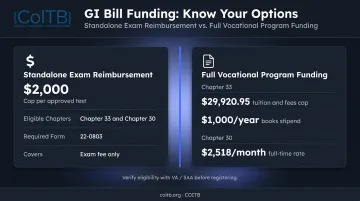
1. Standalone License/Certification Test Reimbursement
- Covers the exam fee for a VA-approved certification test
- Capped at $2,000 per approved test under both Chapter 33 and Chapter 30
- Claim through VA Form 22-0803, along with your test results or license copy and a receipt showing registration fees
- The VA does not reimburse costs for obtaining the physical license document itself
2. Full Vocational/Non-College-Degree Program Funding
- For structured certification programs enrolled through an approved institution
- Chapter 33 cap: $29,920.95 for net tuition and mandatory fees (August 1, 2025–July 31, 2026), plus up to $1,000/year for books and supplies
- Chapter 30 rate: up to $2,518/month full-time for veterans with 3+ years of active duty (October 2025–September 2026)
What Documentation You'll Need
To claim exam reimbursement, gather:
- Completed VA Form 22-0803 (revised January 2025)
- Copy of test results or earned license/certification
- Receipt showing registration and administrative fees paid
Failed exams, retakes, and renewal tests may also be covered under certain circumstances. Confirm the specifics with your School Certifying Official (SCO) before assuming they're excluded.
Before registering for any certification exam, verify the credential's approval status through VA WEAMS or your State Approving Agency (SAA) to confirm your benefits apply.
Why Veterans Are Choosing Web Design and IT Careers
The skills veterans bring out of service map directly onto what tech employers want. Structured problem-solving, attention to detail, working under pressure, executing projects against tight constraints — these aren't soft skills. They're the daily requirements of software and web development work.
Veterans from MOS backgrounds like 25B (Information Technology Specialist), 17C (Cyber Operations Specialist), and 25Q (Multichannel Transmission Specialist) already have technical foundations that civilian candidates spend months building. A certification gives that experience a credential employers can verify.
The Job Market Case
The numbers support the pivot. According to BLS data updated August 28, 2025:
| Role | Median Annual Wage (May 2024) | Projected Growth (2024–2034) | Annual Openings |
|---|---|---|---|
| Web Developer | $90,930 | 7% | ~14,500 |
| Web & Digital Interface Designer | $98,090 | 7% | ~14,500 |
| Software Developer | $133,080 | 15% | — |
Demand spans healthcare, finance, e-commerce, and government — not a single industry or tech cycle. That cross-sector breadth means a web or application development credential transfers well regardless of where veterans settle after transition.
Accessibility for Veterans in Transition
IT certifications built for transitioning veterans remove common logistical barriers. COITB exams, for example, are delivered entirely online with remote proctoring — military CAC and VA-issued IDs accepted — so there's no travel, no set class schedule, and no training program to enroll in before testing.
For veterans navigating a PCS move or running through TAP simultaneously, that means:
- Complete the exam from any location with a webcam and stable internet
- Schedule around family commitments and relocation timelines
- Skip the training enrollment — test when you're ready, not when a cohort starts
- Use GI Bill, VET TEC, or VR&E benefits toward the credential (verify eligibility with the VA or your SAA before registering)
Top GI Bill Approved Web Design and IT Certifications to Consider
Before enrolling in any certification program, search the VA's WEAMS License/Certification database. This is the authoritative source — not third-party lists, not a credentialing body's website, not this article.
How to Use WEAMS
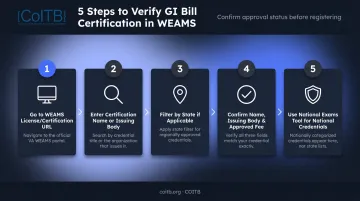
- Go to the WEAMS License/Certification search at the URL above
- Enter the certification name, category, or issuing body
- Filter by state if applicable
- Confirm the exact credential name, issuing body, and approved fee match what you're enrolling in
- For national exam searches, use the WEAMS National Exams tool instead
Critical point: Research for this guide was unable to extract credential-level WEAMS records confirming specific web design, Python, or AI certifications as currently approved. That doesn't mean they aren't — it means you must check the live database yourself. Approval status changes, and a certification listed in a blog post from six months ago may not match the current WEAMS record.
Front-End and Web Design Credentials
Certifications covering HTML, CSS, JavaScript, and UI/UX fundamentals are among the most practically accessible for veterans entering tech. They validate the skills needed for entry-level front-end roles, freelance web work, and marketing-side landing page development.
Two COITB credentials anchor this tier:
- HTML-CSS Web Designer: Covers semantic HTML5, CSS3, Flexbox, CSS Grid, responsive design with media queries, and WCAG accessibility standards. Validated through a 90-question, 90-minute proctored exam.
- ReactJS Framework Developer: Builds on that foundation, validating component architecture, React Hooks, state management, and REST API integration for candidates moving into dynamic front-end engineering roles.
Both exams are available via remote online proctoring, with military CAC and VA-issued IDs accepted for identity verification. Verify GI Bill coverage with your VA Education Benefits counselor before registering. COITB's official guidance states: "GI Bill, VET TEC, MyCAA, and VR&E coverage of specific COITB credentials depends on COITB's current approval status in the VA WEAMS database and your State Approving Agency (SAA)."
Back-End and Full-Stack Development
For veterans with stronger technical backgrounds (signals, cyber operations, network administration), back-end credentials in Python and database management represent a higher entry salary ceiling.
COITB offers:
- Professional Python Developer: 58 questions, 75 minutes, 70% passing score; validates Python 3, OOP, modules, and standard library
- MySQL Backend Developer: 90 questions, 90 minutes, 70% passing score, covering relational database design, SQL querying, and schema design
Stacking these with a front-end credential creates a full-stack signal that's more compelling to employers than any single certification.
Emerging AI and GPT Certifications
AI fluency is becoming an expected layer on top of core development skills, not a standalone career path. Stack Overflow's 2025 Developer Survey puts that in numbers: 84% of respondents use or plan to use AI tools, up from 76% in 2024.
COITB's Certified GPT Professional certification validates prompt engineering, GPT API integration, responsible AI practices, and applied use cases including AI chatbots, automation workflows (N8N, Flowise, Zapier), and content systems. The exam is 60 questions, 75 minutes, with a 71% passing threshold.
Before registering for any COITB credential, confirm current WEAMS approval status directly with your VA Education Benefits counselor or contact COITB at support@coitb.org or +1 877 402 0840.
How to Verify Whether a Certification Program Is GI Bill Approved
Step-by-Step WEAMS Verification
- License/certification search: inquiry.vba.va.gov/weamspub/buildSearchLCCriteria.do — search by credential name, category, and state
- National exam search: Use the separate national exams tool for credentials the VA categorizes differently from professional licenses
- Institution/program search: inquiry.vba.va.gov/weamspub/buildSearchInstitutionCriteria.do — for full training programs rather than standalone exam reimbursement
- Confirm the details: Record the exact credential name, issuing body, and approved fee directly from WEAMS — third-party sources may be outdated
If a Certification Isn't Listed
A credential missing from WEAMS doesn't permanently disqualify it. Providers can request approval through their State Approving Agency (SAA), which reviews programs against Title 38 requirements and state/federal criteria. Timelines vary by state — Virginia, for example, requires providers to attend a monthly Initial Approval Training Webinar before the review begins.
Veterans cannot initiate this process — it must come from the provider. If a credential you want isn't listed, contact the credentialing body directly and ask about their SAA approval status and timeline.
Before You Enroll
Confirm your benefits before registering for any exam or program:
- VA GI Bill Hotline: Call 888-GIBILL-1 (888-442-4551), Monday–Friday, 7 a.m.–6 p.m. Central
- Ask VA: Submit a question at va.gov/contact-us/ask-va — typically answered within 7 business days
- School Certifying Official (SCO): Your SCO at an enrolled institution can certify your enrollment and confirm benefits are applied correctly
How to Pick the Right IT Certification for Your Career Goals
Start with a Self-Assessment
Before comparing credentials, answer these questions:
- What tech skills did you use in service? (networking, systems administration, cybersecurity, signals, software development)
- Are you starting from zero, or do you have hands-on coding experience?
- What type of role are you targeting — front-end design, back-end development, full-stack, AI applications?
Let those answers determine your entry point — that's more reliable than any one-size-fits-all starting point.
Certification Tiers: Cost vs. Career ROI
| Tier | Example Roles | Approximate Salary Range | Typical Path |
|---|---|---|---|
| Entry/Front-End | Junior Web Designer, Freelance Web Dev | $60K–$80K starting | HTML-CSS → ReactJS |
| Mid-Level Web Dev | Front-End Engineer, React Developer | $85K–$100K median | JavaScript + ReactJS stack |
| Advanced Full-Stack/AI | Full-Stack Engineer, AI Practitioner | $110K–$133K+ | React + Python + MySQL + GPT |
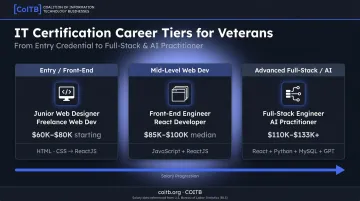
These salary figures are anchored to BLS May 2024 data — not aspirational marketing numbers. Entry-level salaries will typically land below the median; credentials accelerate the timeline to reach it.
Why Standards Alignment Matters
According to CompTIA, 91% of employers believe IT certifications play a key role in hiring decisions and are a reliable predictor of employee success. But not all certifications carry equal weight.
Credentials aligned to ISO/IEC 17024 — the international standard for personnel certification bodies — carry more credibility than unaccredited programs because they require:
- Standardized, proctored assessments (not just course completion)
- Defined passing scores validated against measurable competency standards
- Formal governance including appeals, complaints, and audit procedures
This distinction is visible to hiring teams. A certificate issued for completing online modules doesn't carry the same weight as a credential from a body with independent, proctored validation. COITB's credentials are aligned to ISO/IEC 17024 principles through its governance structure. To confirm current accreditation status, contact COITB directly at support@coitb.org.
Practical Accessibility Factors
Credential quality only matters if you can actually sit the exam. Look for certifications with:
- Remote online testing — eliminates geographic barriers during relocation or transition
- No mandatory prerequisites — allows veterans with self-taught or military-acquired skills to test directly without enrolling in prerequisite courses
- Flexible scheduling — particularly relevant for veterans managing family obligations or transition timelines
COITB's full exam catalog is available via remote proctoring from any location with a webcam and stable internet connection, with military CAC accepted for identity verification.
From Certified to Hired: Next Steps for Veterans in Tech
Presenting Credentials Effectively
On your resume and LinkedIn profile:
- List the issuing body, full credential name, and date earned — not just "web design certification"
- Place certifications in a dedicated section near the top if you're early-career or career-changing
- Match credential language to job description keywords — "ReactJS Framework Developer" maps better to a posting that says "React" than a generic "front-end certification"
- Add your digital badge verification URL to LinkedIn's Licenses & Certifications section so recruiters can verify with one click
Veteran-Specific Job Placement Resources
These programs connect your credential to your first tech role:
- Hiring Our Heroes Fellowships — places transitioning service members with employers for hands-on civilian work experience
- VA Vocational Rehabilitation (Chapter 31 / VR&E) — supports employment preparation for veterans with at least a 10% service-connected disability rating; separate from GI Bill funding
- DoD SkillBridge — available to transitioning service members with 180 days or fewer remaining before separation; DoD covers pay and benefits during the training period

Note that SkillBridge is specifically for transitioning service members, not all veterans. VR&E eligibility requires a documented service-connected disability rating through the VA.
Build a Portfolio Alongside Your Studies
Certifications validate knowledge. A portfolio demonstrates application. Employers in web design and development consistently value both. A candidate with a credential and three real projects consistently outperforms one with credentials alone.
Even simple projects make the difference. Start building before you finish studying:
- A responsive HTML/CSS landing page demonstrating layout and design skills
- A React component pulling live API data — directly applicable to ReactJS Framework Developer exam content
- A Python script that automates a real task, showcasing practical Professional Python Developer skills
Don't wait until after you pass the exam. Employers want to see the work, not just the badge.
Frequently Asked Questions
Do you need a certificate to be a web designer?
No formal certificate is required — portfolio and demonstrated skills are the primary hiring signals in web design. That said, certifications validate foundational knowledge and give employers measurable proof of competence, which is especially useful for career changers or veterans who lack a traditional CS degree to point to.
Is a web design certificate worth it?
The value depends on the credential's industry recognition and your specific goals. For veterans using GI Bill benefits to offset the cost, the financial barrier drops significantly. An accredited, proctored certification becomes a low-cost, verifiable credential — far more defensible to employers than self-study alone.
Is web design still worth it in 2026?
Yes. BLS projects 7% employment growth for web developers and digital designers from 2024 to 2034, with approximately 14,500 annual openings and a $90,930–$98,090 median wage range. Skills in responsive design, front-end frameworks like React, and UI/UX continue to be sought across nearly every industry sector.
Is AI replacing web design?
AI automates repetitive tasks — generating boilerplate code, resizing layouts, suggesting color palettes — but designers who understand both design principles and how to direct those tools are growing more valuable. Certifications in front-end development and AI fluency put you in a stronger position as that shift continues.
Can veterans use the GI Bill for certification programs?
Yes. Both Post-9/11 (Chapter 33) and Montgomery GI Bill (Chapter 30) cover approved professional certification exams and licensing programs. Standalone exam fees are reimbursable up to $2,000 per approved test. Always verify the specific certification in VA WEAMS before enrolling — approval is credential-specific, not blanket.
How do I find GI Bill approved certification programs?
Use the VA's WEAMS Public search tool at inquiry.vba.va.gov/weamspub/buildSearchLCCriteria.do. Search by certification name, filter by category and state, and confirm the results with your VA Education Benefits counselor or School Certifying Official before committing to any program or paying any fees.