Introduction
The US Bureau of Labor Statistics projects roughly 317,700 computer and IT job openings every year, with a median wage of $105,990 across the sector. What's changed recently is who can compete for those roles. Many employers no longer treat a four-year degree as a filter — they're hiring on demonstrated skills, certifications, and hands-on project work.
That shift creates a real opening for career changers, self-taught learners, bootcamp graduates, and anyone who wants to enter tech without spending four years and $100,000+ on a traditional degree.
This article covers the best online courses for starting an IT career without a degree. For each course, you'll find what skills it builds, how long it takes, what it costs, and which career paths it leads to — so you can choose based on where you want to end up.
Key Takeaways
- You don't need a college degree to land an entry-level IT job — skills, certifications, and portfolio work increasingly matter more.
- The strongest online IT courses combine structured learning, hands-on practice, and pathways to recognized credentials.
- Most entry-level IT paths take 3–6 months of focused study to become job-ready.
- Pairing a course with an independent, third-party certification gives employers verifiable proof of your skills, not just a course completion badge.
- Courses covered here span IT support, cybersecurity, front-end development, and AI.
Why You Don't Need a Degree to Start an IT Career Today
The degree requirement in tech has been loosening for years. Research from Harvard Business School and the Burning Glass Institute found that 46% of middle-skill and 31% of high-skill occupations experienced significant degree resets — meaning employers stopped requiring degrees for roles that previously listed them. That same research projected 1.4 million additional jobs opening to workers without college degrees over five years.
Major employers have already acted on this shift:
- Bank of America publicly documented no-degree tech hiring pathways
- IBM runs apprenticeship programs specifically for candidates without four-year degrees
- Accenture operates similar programs targeting non-traditional candidates
Skills-first hiring is still gaining ground, but these aren't pilot programs — they're established pipelines.
Entry-Level IT Roles You Can Target Without a Degree
| Role | BLS Median Salary | Notes |
|---|---|---|
| Computer support specialist | $61,550 | ~50,500 openings per year |
| Web developer / digital designer | $95,380 | 7% projected growth |
| Information security analyst | $124,910 | 29% projected growth |
| Data scientist | $112,590 | 34% projected growth |
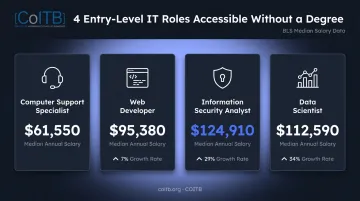
These aren't outlier roles — they're mainstream IT positions that hiring managers fill regularly, and many postings don't require a degree if the candidate can demonstrate the right skills.
Online courses have become a credible entry path because the strongest ones teach directly to those demonstrable skills — the same competencies hiring managers screen for in technical interviews and assessments.
Best Online Courses to Start an IT Career Without a Degree
These courses were selected based on content quality, beginner accessibility, industry recognition, and the specific career paths they unlock.
Google IT Support Professional Certificate (Coursera)
Developed by Google and delivered through Coursera, this program is built for complete beginners. No prior IT experience is required. It covers core IT support skills across six courses — troubleshooting, networking, Linux, Windows, system administration, and security fundamentals.
It's one of the most recognized entry-level IT credentials available, and over 1 million learners have completed Google Career Certificates as of 2025. The program reports that 75% of certificate graduates see a positive career outcome within six months, and completers can apply directly with Google and 150+ US employer partners.
IT support and help desk roles are typically the most accessible entry points into tech without a degree — this certificate is built specifically for that path.
| Skills covered | Networking fundamentals, troubleshooting, Linux, Windows, system administration, cloud basics, IT security |
| Time to complete | ~3 months at 10 hours/week (self-paced) |
| Cost and access | Enroll for free on Coursera; financial aid available; full access typically requires Coursera subscription ($59/month or ~$239/year promotional) |
CompTIA A+ Exam Prep Courses (Professor Messer / Udemy)
CompTIA A+ is the most widely recognized entry-level IT certification in the industry. It's not a course — it's a two-part vendor-neutral exam — but structured prep courses from Professor Messer (free) and paid options on Udemy prepare you to pass both parts and earn the credential.
A 2024 labor market analysis by JFF and Lightcast found 4,369 national entry-level IT job postings listing CompTIA A+ as a preferred or required credential — the most in-demand CompTIA certification in that analysis. For help desk and IT support roles, it's one of the most direct credentials you can put on a resume.
The exam requires passing both Core 1 and Core 2, each priced at $253 USD at retail as of February 2024.
| Skills covered | Hardware troubleshooting, operating systems, networking basics, mobile devices, security fundamentals, cloud concepts |
| Time to complete | Typically 3–5 months of prep before sitting the two-part exam |
| Cost and access | Professor Messer's course materials are free; Udemy paid courses vary (one updated Core 1 course lists at $124.99 full price); exam vouchers are $253/part at official retail pricing |
Meta Front-End Developer Professional Certificate (Coursera)
Developed by Meta, this nine-course program teaches front-end web development from scratch — HTML, CSS, JavaScript, React, version control with Git, and UI/UX principles — and ends with a capstone portfolio project. No prior experience required.
Front-end development is one of the most accessible IT career paths for self-starters. React remains one of the most widely used frameworks among professional developers, confirmed by the Stack Overflow 2024 Developer Survey of 65,000+ respondents. The portfolio project gives you tangible work to show employers during interviews.
One important step after completing this program: pair the Meta certificate with independent, third-party credentials that employers can verify. COITB — a non-profit credentialing body aligned to ISO/IEC 17024 standards — offers certifications that map directly to this program's curriculum. The HTML-CSS Web Designer, JavaScript Professional Developer, and ReactJS Framework Developer certifications validate each layer of front-end skills through proctored exams (90 questions, 90 minutes, 73–75% passing score).
For learners who've worked through Meta's program, these credentials convert course completion into independently verified proof of competency — something employers can check via a digital badge URL on LinkedIn or a resume.
| Skills covered | HTML, CSS, JavaScript, React, responsive design, Git version control, UI/UX principles |
| Time to complete | ~7 months at 6 hours/week (self-paced) |
| Cost and access | Enroll for free on Coursera; financial aid available; full access typically requires Coursera subscription |
IBM Cybersecurity Analyst Professional Certificate (Coursera)
Developed by IBM, this 14-course program covers security fundamentals, network security, threat analysis, SIEM tools, penetration testing basics, database vulnerabilities, incident response, and digital forensics. It targets entry-level cybersecurity analyst roles and is accessible to beginners.
Cybersecurity has the strongest labor market tailwind of any IT specialization: the BLS projects 29% growth for information security analysts through 2034, with a median salary of $124,910. That growth rate is roughly four times the average for all occupations. The IBM credential provides brand-name recognition alongside practical, tool-based training — a strong combination in a field where verified skills matter more than credentials alone.
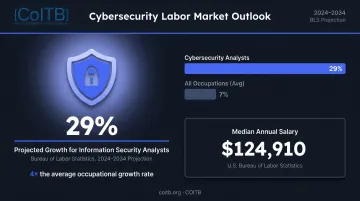
This path demands more from beginners than IT support — it's not a casual start — but for learners willing to put in 4–6 months of focused effort, the career ceiling is far higher.
| Skills covered | Network security, threat analysis, SIEM tools, penetration testing basics, incident response, digital forensics, generative AI fundamentals |
| Time to complete | ~4 months at 10 hours/week (self-paced) |
| Cost and access | Enroll for free on Coursera; financial aid available; full access typically requires Coursera subscription |
Google AI Essentials Certificate (Coursera)
Developed by Google, this short foundational course teaches practical AI skills — prompt engineering, generative AI tools, AI ethics, and applying AI in workplace contexts. No coding experience is required.
AI and big data rank among the fastest-growing skill areas globally, according to the World Economic Forum's Future of Jobs Report 2025. CompTIA reported nearly 125,000 active AI job postings in May 2025.
This certificate is best positioned as a complementary skill layer, not a standalone IT career credential. It's most valuable when paired with deeper technical study — Python, data tools, or applied AI development.
For learners who want to formally validate AI skills after this course, COITB's Certified GPT Professional certification targets exactly this knowledge set. It's an entry-level to intermediate credential requiring 0–6 months of AI tool experience, with a 60-question proctored exam (75 minutes, 71% passing score) — a natural next step for Google AI Essentials completers who want employer-verifiable proof of their AI skills.
| Skills covered | Prompt engineering, generative AI tools, AI ethics, practical AI workflows, workplace AI applications |
| Time to complete | ~4 hours for the core course; deeper AI/Python paths extend to 3–6 months |
| Cost and access | Available on Coursera; financial aid available; check current access pricing |
How We Selected These IT Courses
Each course on this list was evaluated against four criteria:
- Beginner accessibility — no degree or prior experience required to start
- Skills relevance — content aligns with what IT employers currently hire for, not general technology literacy
- Industry recognition — the certificate or credential produced carries employer weight
- Hands-on components — practical projects, labs, or applied exercises beyond video lectures
What Learners Get Wrong When Choosing IT Courses
- Prioritizing free over structured — free resources are useful for supplementing a curriculum, not replacing it
- Chasing unrecognized certificates — a certificate from an unrecognized source adds no employer signal to your resume
- Selecting outdated content — courses teaching deprecated tools or frameworks actively hurt your job search
Why Third-Party Certification Matters Beyond Course Completion
Course completion badges confirm you finished a program. They don't prove you can apply those skills on the job. Third-party certifications close that gap by independently verifying competency through proctored exams — separate from any training provider.
Credentialing bodies like COITB operate under ISO/IEC 17024-aligned standards and administer those exams independently. Passing one means an employer can verify your skills through a digital badge URL rather than taking your word for it.
The employer demand is real: nearly 1 in 3 job postings now request some form of non-degree credential (Lightcast), and SHRM's 2025 data shows over 3 in 4 HR professionals say skills credentials factor into hiring decisions.
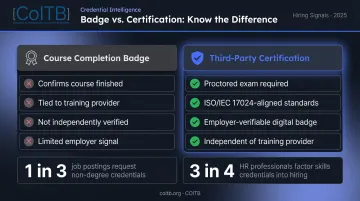
Course completion builds your knowledge. An independent certification is what makes that knowledge verifiable to employers.
Conclusion
Starting an IT career without a degree in 2025 is well-supported by employers — provided you can demonstrate practical, verified skills. The courses above cover the clearest entry points across IT support, front-end development, cybersecurity, and AI.
Choose a course based on the specific role you want, not what's most popular or cheapest. Complete it, build projects, and treat course completion as step one — not the finish line.
For learners who want to formally validate the skills they've built through online courses, COITB offers ISO/IEC 17024-aligned certifications across:
- HTML-CSS Web Designer
- JavaScript Professional Developer
- ReactJS Framework Developer
- Certified GPT Professional (AI/Generative AI)
- Professional Python Developer
- MySQL Backend Developer
- Technical Sales Specialist
Each credential is delivered via proctored exam, comes with an employer-verifiable digital badge, and is designed for candidates with 0–6 months of hands-on experience — the stage most online course completers are at when they finish.
Take the free practice assessment at coitb.org/assessment to gauge readiness before registering at coitb.org/auth/signup. For questions, contact COITB at support@coitb.org or +1 877 402 0840.
Frequently Asked Questions
What online job pays the most without a degree?
In IT, information security analysts ($124,910 median), data scientists ($112,590 median), and senior software engineers and DevOps engineers — which can reach well into six figures at mid-to-senior levels — consistently rank among the highest-paying roles accessible without a degree. Starting in an entry-level IT role and building verified skills over 3–7 years is the most direct path to those positions.
How do I make $10,000 a month without a degree?
Earning $10,000+ per month without a degree is realistic in IT at mid-to-senior levels in software engineering, cybersecurity, and DevOps. Getting there takes time — typically several years of building verified skills through certifications, project work, and progression into higher-paying specializations.
What career can I get 100% online?
Several IT careers are fully remote-accessible, including IT support specialist, cybersecurity analyst, web developer, front-end developer, and AI/data roles. Remote hiring in tech is widespread enough that location is rarely a barrier to entry for any of these paths.
Do employers actually hire people who completed online IT courses without a degree?
Yes. Skills-first hiring is now common across IT, with major employers explicitly removing degree requirements from many technical roles. Candidates who complete structured courses, earn recognized certifications, and build a project portfolio are regularly hired for entry-level IT roles.
How long does it take to become job-ready in IT through online courses?
Most entry-level IT paths take 3–6 months of focused study. IT support and help desk roles have the shortest ramp. Front-end development, cybersecurity, and AI paths typically take 4–9 months when portfolio or certification preparation is included alongside the core course.
Should I get certified after completing an IT online course?
Yes. Pairing a course with an independent, third-party certification significantly strengthens your application because it provides employer-verifiable proof of skill that goes beyond a completion badge. Look for certifications administered by independent credentialing bodies aligned to recognized standards — the credential confirms you can apply the skills, not just that you watched the videos.