This matters most for separating service members, veterans within one to two years of discharge, and their families. Get it wrong, and you're looking at financial strain, career drift, and mental health struggles that compound over time.
Many veterans reduce the whole process to "attend TAP and get a job." That's a mistake. The transition touches employment, identity, family dynamics, and healthcare navigation all at once, and most people underestimate how much time and effort it actually takes.
This article breaks down the real challenges, the step-by-step process, the federal programs worth knowing about, and what separates a smooth transition from a painful one.
Key Takeaways
- Transition covers employment, mental health, identity, and family readjustment, not just landing a job
- Start preparing one to two years before separation for stronger post-service outcomes
- TAP, SkillBridge, and the GI Bill only pay off with early, proactive engagement
- Translate military skills into civilian terms and earn recognized credentials to boost employability
What Is the Military-to-Civilian Transition?
The military-to-civilian transition is the process of separating from active duty and reintegrating into civilian life across employment, education, healthcare, and community. The goal is straightforward on paper: a sustainable civilian career, financial stability, and a renewed sense of purpose.
In practice, it's messier than that summary suggests.
It helps to separate two terms people often use interchangeably:
- Separation is the administrative, military-side event—your discharge date, retirement paperwork, and final out-processing.
- Transition (and ongoing reintegration) is the personal and career adjustment that follows, and it can span months or years after your last day in uniform.
A peer-reviewed review of reintegration research frames this second piece as both a process and an outcome. You're not just leaving the military. You're rebuilding your role in a family, a workplace, and a community, often at the same time.
Challenges Veterans Face During Transition
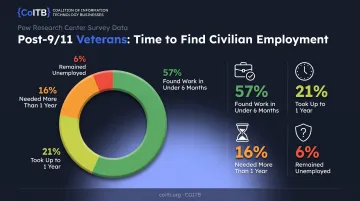
Employment sits at the top of most veterans' concern lists, and the data backs that up. In Pew Research's 2019 survey of post-9/11 veterans, only 25% had a civilian job lined up before leaving service. Nearly half started searching immediately after discharge with nothing secured.
The same survey found real variation in how long that search takes:
- 57% found work in less than six months
- 21% took up to a year
- 16% needed more than a year
- 6% were unable to find work at all
The Resume Gap
Most veterans have never written a civilian resume or sat through a non-military interview. Job titles like "Platoon Sergeant" or "Signals Intelligence Analyst" mean nothing to a hiring manager without translation.
A qualitative study of transitioning veterans found this gap shows up constantly. Employers and peers don't understand how military experience maps to civilian roles unless someone spells it out.
Identity, Structure, and Family
Beyond the job search, three other pressures show up repeatedly:
- Loss of identity and purpose: Military service often anchors your sense of self; losing that anchor is linked to depression and social withdrawal
- Loss of structure: Leaving a regimented schedule can leave veterans feeling directionless, even when they're glad to be out
- Family readjustment: Veterans whose service strained their marriage were far more likely to report post-discharge family problems (77% versus 34%, per Pew)
On top of all that, veterans suddenly have to navigate VA healthcare, benefits enrollment, and other services that used to happen automatically. Nobody hands you a checklist. You have to build one.
How the Transition Process Works (Step-by-Step)
A successful transition follows a phased flow: early preparation, self-assessment, skill-building, application, and adjustment. It's not a checklist you finish in a weekend.
What goes into it: time, honest self-reflection, access to the right resources, and a willingness to ask for help instead of white-knuckling it alone. What comes out the other side: a shift from military identity and rank to a civilian career identity, resume, and professional network.
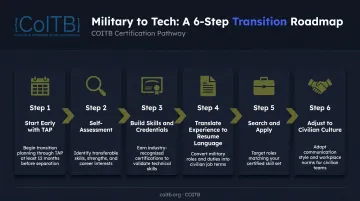
Step 1: Start Early and Tap Into Transition Resources
Engage with the Transition Assistance Program (TAP) as early as possible. Official guidance recommends Initial Counseling and pre-separation counseling begin no later than 365 days before transition, and retirees should start at least two years out. Earlier is always better than later.
Step 2: Complete a Self-Assessment
Before picking a career direction, map your strengths, interests, and transferable skills. The VA now points veterans to the O*NET Interest Profiler, a free tool that matches your interests to career paths, after retiring its older CareerScope assessment.
Step 3: Build Civilian-Ready Skills and Credentials
Many veterans close skills gaps through further education, bootcamps, or industry certifications. This step matters more than people expect. A degree or MOS title alone often doesn't convince a hiring manager you can do the job today.
For veterans pursuing IT and tech careers, third-party certifications help prove you can do the work now. COITB, a nonprofit credentialing body, offers seven certifications covering ReactJS, HTML-CSS, JavaScript, Python, MySQL, generative AI, and technical sales.
Each exam is built for candidates with 0 to 6 months of hands-on practice from a bootcamp, self-study, or on-the-job experience during service. You don't need years of civilian work history first.
Exam logistics fit active-duty and transitioning service members:
- 75 to 90 minutes with multiple-choice and scenario-based questions
- 70-75% score required to pass
- Online remote proctoring or authorized test centers (deployed and OCONUS friendly)
- Digital badge for your resume and LinkedIn as soon as you pass
Step 4: Translate Military Experience Into Civilian Resume Language
Strip the jargon. Quantify what you accomplished instead of describing your duties.
"Led 12-person maintenance team, reducing equipment downtime by 30%" tells a hiring manager something. "Responsible for unit readiness" doesn't.
The Department of Labor's transition curriculum teaches this skill directly: identify transferable soft and hard skills, then rewrite them in language that mirrors the target job description.
Step 5: Search, Apply, and Evaluate Fit
Use a mix of general job boards, veteran-specific hiring programs, and old-fashioned networking. Don't grab the first offer out of relief. Weigh it against what your self-assessment told you in Step 2.
Pew Research found 42% of veterans felt overqualified for their first civilian job, often a sign they settled too fast.
Step 6: Adjust to Civilian Work Culture
The offer is not the finish line. Expect a learning curve around workplace norms, communication styles, and self-directed growth without the military's rank structure. Stay tied into mentors and veteran employee resource groups while you settle in.
Military Transition Assistance Programs and Resources
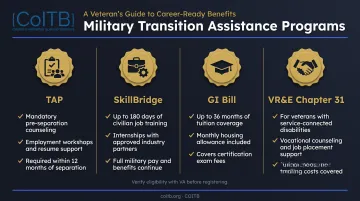
TAP (Transition Assistance Program) is the DoD's mandatory off-ramp for separating service members. It combines pre-separation counseling, VA benefits briefings, and Department of Labor employment workshops.
Most members with at least 180 continuous active-duty days must complete it. Capstone review is due no later than 90 days before separation.
Beyond TAP, a few other programs are worth knowing:
SkillBridge lets eligible service members complete civilian job training or internships during their final 180 days of service, with commander authorization and continued military pay. Participation has climbed: more than 22,000 service members used it in 2024, and over 6,000 employers are now signed on.
VA education and vocational benefits cover more ground than most veterans realize:
- GI Bill — tuition, degrees, distance learning, and on-the-job training
- VR&E (Chapter 31) — counseling, education, and work-readiness support for veterans with a service-connected disability rating of 10% or higher
Nonprofit and private support fills in the gaps. Hire Heroes USA offers no-cost career coaching, resume review, and interview prep for veterans and military spouses. Many employers also run dedicated veteran-hiring initiatives.
Programs only help if you use them. A 2022 GAO oversight report found that nearly a quarter of service members flagged as needing the most support skipped the required two-day TAP class, and 70% didn't start TAP more than a year in advance.
Don't lean on one program alone. Pair TAP and VA benefits with skills-validation options—such as third-party certifications—for a stronger civilian landing.
Key Factors and Common Misconceptions
Key Factors That Influence a Successful Transition
Several factors separate veterans who land on their feet quickly from those who struggle:
- Planning timeline: Starting before separation leaves room to explore roles instead of grabbing the first offer
- Skills translation: Clear reframing of military experience into civilian job language employers recognize
- Mentor or peer network: At least one person who has already made the jump
- Financial cushion: Savings that buy time to find the right fit, not just any job
- Mental health support: Help for stress early, before it compounds into bigger setbacks
Veterans who treat transition as an ongoing project, not a one-time event, usually navigate the first year with fewer false starts.
Common Misconceptions About Military Transition
Even with those factors in place, a few myths still trip people up:
- "Completing TAP guarantees a job." It doesn't. TAP gives you tools and information. Applying them is on you.
- "Rank automatically translates to a civilian hire." Leadership experience matters, but employers want specific skills tied to the role they're filling.
- "Transition stress is PTSD." Normal stress after a major life change usually eases within weeks. Symptoms lasting longer than a month that disrupt work or home life may need a professional assessment; the two are not the same.
- "Transition ends at the first civilian job." Readjustment in family life, identity, and community often continues well past that milestone.
Frequently Asked Questions
What challenges do veterans face when transitioning to civilian life?
The biggest hurdles are finding civilian employment, translating military skills into resume language, losing the identity and structure service provided, readjusting family roles, and navigating VA benefits on your own.
What is the military transition program?
The Transition Assistance Program (TAP) is the DoD's mandatory program for separating service members. It combines pre-separation counseling, a VA benefits briefing, and Department of Labor employment workshops.
How long does the military-to-civilian transition typically take?
It varies widely. Job searches often resolve within six months to a year, but full reintegration, including identity and family adjustment, can span months to a couple of years. Early preparation shortens the roughest part of that curve.
What is SkillBridge and who qualifies for it?
SkillBridge lets eligible service members with 180 or fewer days left in service train or work with a civilian employer, with commander approval, while still receiving military pay and benefits.
How do you translate military experience into a civilian resume?
Remove jargon and acronyms, quantify what you accomplished with numbers, and mirror the language used in the civilian job description you're targeting.
Can certifications help veterans transition into tech careers?
Yes. Industry-recognized credentials—such as COITB certifications in ReactJS, Python, JavaScript, or generative AI—can validate technical skills even with little civilian tech experience and support applications for entry-level IT roles.