Introduction
The rules for who needs to understand AI have shifted. Fast. According to the 2024 Microsoft-LinkedIn Work Trend Index, 66% of leaders say they would not hire someone without AI skills — and 71% would choose a less-experienced candidate with AI skills over a more-experienced one without them.
That pressure now reaches well beyond engineering teams. Managers, consultants, product leads, and operations professionals are all expected to evaluate AI tools, guide adoption decisions, and communicate outcomes to stakeholders — without necessarily writing a line of code.
COITB's Certified GPT Professional certification was built for exactly this audience. It's a business-focused credential designed for professionals who need to understand, evaluate, and strategically apply generative AI — no coding background required.
This guide covers what the exam tests, how to prepare effectively, and what to expect when you sit for it.
Key Takeaways
- Generative AI leader credentials test business strategy and use case judgment — not coding ability
- Most exams include 50–60 scenario-based questions covering AI fundamentals, governance, and product applications
- Foundational AI fluency (prompting, model types, responsible use) is the single biggest prep lever
- Free official learning paths — typically 7–8 hours — cover the core domains tested on exam day
- COITB's Certified GPT Professional credential validates real-world generative AI skills for professionals at any experience level
What Is the Generative AI Leader Certification?
The Google Cloud Certified Generative AI Leader is an external credential aimed at professionals who want to apply generative AI strategically — not build AI systems from scratch. It validates your ability to identify the right tools, assess business impact, and communicate AI decisions to stakeholders.
For professionals specifically looking to validate GPT and generative AI skills through a structured credential, COITB's Certified GPT Professional certification offers a comparable entry point aligned to real-world AI application — no machine learning engineering background required. The sections below cover the Google credential's exam format as a reference, so you can benchmark what generative AI leader-level knowledge looks like across the field.
Exam Format at a Glance
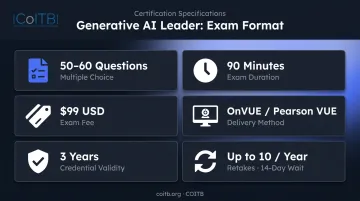
| Detail | Current Specification |
|---|---|
| Questions | 50–60 multiple-choice |
| Time | 90 minutes |
| Fee | $99 USD + applicable tax |
| Delivery | Online (OnVUE) or Pearson VUE test centers |
| Validity | 3 years |
| Retakes | Up to 10 total attempts per year; 14-day wait after a failed attempt |
| Prerequisites | None |
Difficulty Level
The exam sits at an easy-to-moderate difficulty. You don't need a machine learning background, but you do need genuine familiarity with Google Cloud's AI product landscape and how to match solutions to business problems. The official preparation path runs approximately 7–8 hours across five free courses, which most working professionals can complete within a few weeks of focused study.
Who Should Pursue This Certification?
This credential was designed for professionals who influence AI strategy without necessarily implementing it technically. That covers a wide range of roles:
- Business analysts and operations managers evaluating AI tools
- Product managers scoping AI-enabled features
- Consultants advising clients on AI adoption
- HR, marketing, and finance leaders assessing AI's organizational impact
- Project managers overseeing AI initiatives
No coding skills are required. If your work touches AI decisions — budgets, vendor selection, use case prioritization, risk assessment — this certification puts a recognized credential behind your judgment.
Career Impact
A 2024 Google/Ipsos Cloud Learning Services survey found that 80% of Google Cloud learners say certification contributes to faster promotion, and 85% say cloud certifications provide skills for in-demand roles. These are self-reported figures, but the pattern holds across similar surveys: credentials backed by major cloud providers carry real weight with hiring managers.
Start with a Foundation If You're New to AI
If you have little to no prior AI exposure, jumping straight into Google Cloud's ecosystem can feel disorienting. A short foundation-building step shortens your learning curve considerably.
COITB's Certified GPT Professional certification is designed specifically for this situation. It covers foundational generative AI concepts — prompt engineering, model behavior, responsible AI, and real-world use cases — at an entry-level pace, targeting candidates with 0–6 months of hands-on AI experience.
Completing it first gives you the vocabulary and conceptual framework to move through the Generative AI Leader material faster and with more confidence. No technical background required.
Exam Structure: Four Domains You'll Be Tested On
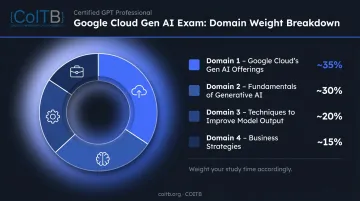
The exam blueprint breaks into four weighted domains. Study time should mirror that weighting — not be distributed equally.
| Domain | Weight |
|---|---|
| Fundamentals of Generative AI | ~30% |
| Google Cloud's Gen AI Offerings | ~35% |
| Techniques to Improve Gen AI Model Output | ~20% |
| Business Strategies for a Successful Gen AI Solution | ~15% |
Fundamentals of Generative AI (~30%)
This domain covers the conceptual layer across four topic clusters:
- Core definitions: AI, ML, NLP, deep learning, and generative AI
- Model types: LLMs, diffusion models, and multimodal systems
- The ML lifecycle from data ingestion through model management
- Foundation model selection based on modality, context window size, cost, and security requirements
Google Cloud's Gen AI Offerings (~35%)
This is the highest-weighted domain — and the one with the most distinct products to recognize. You need to identify the business value and appropriate use cases for:
- Gemini for Google Workspace — AI features embedded in Docs, Gmail, Sheets, and Meet
- Vertex AI Platform: Google's managed ML infrastructure for building and deploying models
- Vertex AI Agent Builder — tools for creating AI agents and conversational experiences
- Customer Engagement Suite: AI for contact centers and customer service workflows
- Vertex AI Search — search and recommendation capabilities powered by Google's AI
The focus is on recognizing what each product does and matching it to the right business scenario — no configuration required.
Techniques to Improve Gen AI Model Output (~20%)
This domain covers practical methods for getting better results from AI models:
- Prompt engineering techniques: zero-shot, one-shot, few-shot, chain-of-thought, and ReAct
- Grounding approaches using first-party data, third-party data, and Google Search
- Retrieval-Augmented Generation (RAG) and fine-tuning basics
- Output control parameters, including temperature and top-p
Business Strategies for a Successful Gen AI Solution (~15%)
This domain approaches AI from the decision-maker's seat:
- Solution selection frameworks and ROI measurement
- Google's Secure AI Framework (SAIF)
- Responsible AI principles: fairness, accountability, transparency, and privacy
Key Concepts You Must Master Before the Exam
The Four Google Model Families
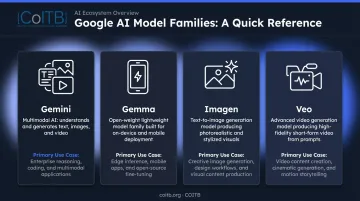
Exam questions will ask you to match a business need to the correct model family. Know these cold:
| Model | What It Does | When to Use It |
|---|---|---|
| Gemini | Multimodal — text, images, video, audio | Enterprise AI, agents, complex reasoning |
| Gemma | Lightweight open models built from Gemini research | Local deployment, mobile, IoT applications |
| Imagen | Text-to-image generation | Visual asset creation, photorealistic imagery |
| Veo | Video generation with native audio | Cinematic video, creative production |
Prompt Engineering
This theme appears across multiple domain sections. Know each method clearly:
- Zero-shot: Give the model a task with no examples — relies entirely on its training
- One-shot: Provide one input-output example before the task
- Few-shot: Provide several examples to demonstrate format, tone, or expected behavior
- Chain-of-thought: Ask the model to reason step-by-step before reaching a conclusion; best for multi-step problems
- ReAct: Interleaves reasoning with actions (like search) and uses retrieved observations to inform the next reasoning step
For the exam, pair each technique to a realistic business scenario. Few-shot works well for customer email classification. Chain-of-thought fits financial analysis or policy interpretation. ReAct applies when the model needs to query external data mid-task.
Grounding and RAG
Grounding connects a model's output to verified data sources — the primary tool for reducing hallucinations. Two main approaches:
- Vertex AI Search — Google's managed RAG solution; appropriate when you need fast, scalable document retrieval without building a custom pipeline
- RAG Engine APIs — for organizations that need a customized retrieval pipeline using their own data and methods
Choose based on your organization's need for speed versus control over retrieval and ranking.
Model Limitations and Mitigations
Every model family has known failure modes. The exam tests whether you can match each limitation to the right mitigation:
| Limitation | Google-Recommended Mitigation |
|---|---|
| Hallucinations | Grounding to verified data sources |
| Knowledge cutoff | RAG or real-time retrieval integrations |
| Bias and fairness gaps | Continuous monitoring, diverse training data |
| Edge cases | Human-in-the-loop (HITL) review |
Responsible AI and SAIF
Google's Secure AI Framework (SAIF) has six elements — the exam tests these at a strategic level:
- Expand strong security foundations to the AI ecosystem
- Extend detection and response to AI-specific threats
- Automate defenses to keep pace with evolving risks
- Harmonize platform-level controls for consistency
- Adapt controls with faster feedback loops as models change
- Contextualize AI risks within surrounding business processes
SAIF addresses the security layer — but Responsible AI goes broader. Exam questions expect you to evaluate these practices as a business decision-maker: avoiding unfair bias, protecting privacy, communicating model limitations, maintaining human oversight, and applying Explainable AI tools where transparency is required.
How to Prepare: Study Plan and Resources
The Official Free Learning Path
Google Cloud Skills Boost offers five no-cost courses that form the official preparation sequence:
- Gen AI: Beyond the Chatbot — Reframes what generative AI actually is beyond simple chatbot use cases
- Gen AI: Unlock Foundational Concepts — Covers model types, LLMs, training, and core terminology
- Gen AI: Navigate the Landscape — Maps Google Cloud's AI product ecosystem
- Gen AI Apps: Transform Your Work — Applies generative AI to business workflows and productivity
- Gen AI Agents: Transform Your Organization — Covers AI agents, automation, and organizational transformation
Complete all five. Retake each embedded quiz until you score 100%.
A Practical 5-Week Study Plan
| Week | Focus | Daily Time |
|---|---|---|
| Week 1 | Gen AI fundamentals and model types | 1.5–2 hrs |
| Week 2 | Google Cloud's AI product ecosystem | 1.5–2 hrs |
| Week 3 | Prompt engineering, grounding, RAG | 1.5–2 hrs |
| Week 4 | Business strategies and responsible AI/SAIF | 1.5–2 hrs |
| Week 5 | Practice exams, domain review, weak areas | 2–2.5 hrs |
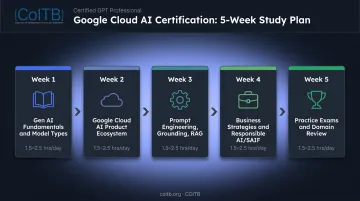
If you already have solid AI fluency, compress weeks 1 and 4 and weight your time toward Week 2.
Core Study Resources
- Generative AI Leader Exam Guide PDF — The official blueprint; read this before anything else
- Official sample questions — Available through the Google Cloud certification page
- Skills Boost module quizzes — Repeat until 100% on every module
Study Strategy That Mirrors the Exam
Don't memorize product names in isolation. Practice use-case mapping: given a business scenario, identify the appropriate Google Cloud solution.
For example, a contact center handling high inquiry volume points to Customer Engagement Suite. A team building a custom document retrieval system points to RAG Engine. Actual exam questions are framed exactly this way.
Beyond the official resources, third-party practice exams help surface weak domains quickly. Key habits to build in that final review week:
- Work through at least two full-length practice tests under timed conditions
- Review explanations for every wrong answer and map each gap back to the relevant exam domain
- Flag any domain where you score below 75% and revisit the corresponding Skills Boost module
What to Expect on Exam Day
Scheduling the Exam
COITB's Certified GPT Professional exam is available in two formats. Register through COITB's exam portal, then choose the option that fits your schedule and location:
- OnVUE — Remote online proctoring from home or office
- Pearson VUE test center — Online proctored — take the exam from any location with a webcam and stable internet connection
- Authorized COITB test center — In-person at a COITB-authorized testing location near you
Remote Proctoring Requirements
- Complete any required system check or software setup before exam day
- Ensure a quiet, private room with no written materials visible
- Have a functioning webcam and microphone
- Log in at least 15 minutes before your scheduled start time
- Government-issued photo ID required for identity verification — military CAC and VA-issued IDs are accepted
Once your setup is confirmed, you're ready to focus on the exam itself. Here's how to make the most of your time once it starts.
Test-Taking Tips
- Many questions are scenario-based — read carefully before selecting an answer
- Use the flag feature to mark uncertain questions and return to them
- Target roughly 2 minutes per question; time pressure is low for this exam
- A result appears immediately after submission; candidates who pass receive a digital badge to display on LinkedIn and their résumé, with official confirmation delivered to your registered email
Frequently Asked Questions
How much does the Generative AI Leader certification cost?
The exam fee is $99 USD plus applicable tax. The official five-course preparation path on Google Cloud Skills Boost is available at no cost, so total out-of-pocket preparation expenses are minimal.
Is the Generative AI Leader certification worth it?
For non-technical professionals leading or influencing AI initiatives, yes. The credential is backed by Google Cloud, validates strategic AI knowledge, and the 2024 Google/Ipsos survey found 80% of Google Cloud learners say certification contributed to faster promotion.
What is the best generative AI certification for leaders?
The Google Cloud Certified Generative AI Leader is currently the most recognized business-focused Gen AI credential available. Candidates should also evaluate credentials tied to the specific AI tools and platforms their organization already uses.
Do I need a technical background to pass?
No. The exam focuses on business strategy, use case identification, and conceptual understanding of AI systems. No coding or engineering experience is required to take or pass the exam.
How many questions are on the Generative AI Leader exam?
The exam contains 50–60 multiple-choice questions within a 90-minute window. Most candidates do not experience significant time pressure.
How long does it take to prepare?
The official learning path runs approximately 7–8 hours. Actual study time varies by background — those already familiar with AI concepts may need significantly less. Use the exam guide PDF as your benchmark rather than a fixed timeline.