With dozens of certifications available — from free platform badges to cloud giant credentials to ISO-aligned credentialing bodies — picking the right one is genuinely confusing. The wrong choice costs months and real money.
This article cuts through the noise. It covers the five best online full stack developer certifications for 2026, organized by who they're actually built for, with a practical framework for choosing the right one at your career stage.
Key Takeaways
- Cloud certifications (AWS, Google) carry the strongest salary signal for mid-to-senior developers.
- If you're just starting out or switching careers, structured foundational programs (IBM, Meta) or ISO/IEC 17024-aligned credentials like COITB deliver the clearest skills validation.
- ISO/IEC 17024-aligned credentials offer independently verified skills validation — a different category from course completion badges.
- Certifications get you past the recruiter screen; deployed projects on GitHub close interviews.
- Match your credential choice to your experience level and target role, not to the most recognizable logo.
Why Full Stack Developer Certifications Matter in 2026
Employers aren't just checking whether you finished a course — they want evidence you can make real architectural decisions across the full stack. That shift changes which certifications actually move the needle.
AI has raised the bar in a specific way: syntax generation is essentially free now. According to CoderPad's 2025 State of Tech Hiring report, technical assessments now include system design problems in 25.52% of cases and code review tasks in 27.81% — formats that test architectural judgment rather than syntax recall. Certifications that include scenario-based and applied assessments signal that kind of judgment — and hiring managers notice the difference.
The Three Types of Certifications (and Why It Matters)
Not all "certifications" mean the same thing to a hiring manager. The type you hold tells them something specific about what you've proven:
| Type | Examples | What It Proves |
|---|---|---|
| Skills-validation credentials (ISO-aligned) | COITB | Independent third-party verification of real competency |
| Platform course completion certificates | IBM, Meta (via Coursera) | Structured learning completed; brand recognition helps with ATS filters |
| Vendor/cloud certifications | AWS Developer, Google Cloud | Architecture judgment and platform-specific deployment skills |
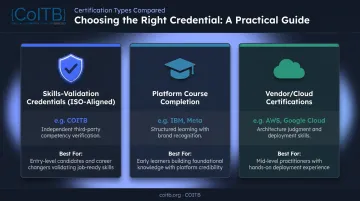
Career changers and early-stage developers typically get more traction from the first two categories before pursuing vendor credentials. Mid-level developers see stronger returns from cloud certifications once their fundamentals are solid.
Best Online Full Stack Developer Certifications for 2026
Selection criteria: career impact, skills coverage across frontend and backend, accessibility across experience levels, credential credibility, and alignment with what employers are actually asking for in 2026.
COITB Full Stack Developer Credential Pathway
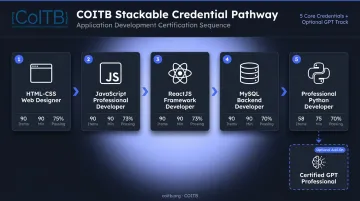
COITB is a non-profit credentialing body headquartered in Oklahoma City whose certifications are aligned to ISO/IEC 17024 standards (the global benchmark for personnel certification bodies). Rather than offering a single bundled "full stack" exam, COITB structures its full stack pathway as a sequence of individually stackable credentials:
Recommended full stack sequence: HTML-CSS Web Designer → JavaScript Professional Developer → ReactJS Framework Developer → MySQL Backend Developer
Candidates can also add Professional Python Developer and Certified GPT Professional for broader back-end and AI coverage. Each credential is a separate, independently proctored exam with its own digital badge issued on passing.
What distinguishes COITB from platform-based programs: no mandatory course enrollment is required. Candidates prepare however works for them — bootcamp, self-study, on-the-job practice — then sit the exam. The credential validates the skill, not the learning method.
Exam specs for each credential in the full stack pathway:
| Certification | Items | Time | Passing Score |
|---|---|---|---|
| HTML-CSS Web Designer | 90 | 90 min | 75% |
| JavaScript Professional Developer | 90 | 90 min | 73% |
| ReactJS Framework Developer | 90 | 90 min | 73% |
| MySQL Backend Developer | 90 | 90 min | 70% |
| Professional Python Developer | 58 | 75 min | 70% |
Exams are available via remote online proctoring (webcam + stable internet required; military CAC and VA-issued ID accepted) or at authorized test centers. COITB also offers a free practice assessment at coitb.org/assessment to gauge readiness before registering.
| Technologies covered | HTML, CSS, JavaScript, React, Python, MySQL, GPT |
| Cost | Per-exam pricing available at coitb.org; contact support@coitb.org for current rates and enterprise/bulk options |
| Best for | Self-taught developers, bootcamp graduates, career changers, and veterans with 0–6 months of experience who want an independently verified credential |
IBM Full Stack Software Developer Professional Certificate
For candidates who prefer a structured, guided learning path, IBM's Professional Certificate on Coursera is one of the most comprehensive options for beginners. The 15-course program covers the full development lifecycle from HTML and CSS through to Docker, Kubernetes, microservices, and cloud deployment.
The IBM brand carries real weight with enterprise and corporate employers, and the curriculum includes GitHub portfolio integration, a meaningful advantage for early-career candidates who need to show deployed work alongside a credential.
The curriculum does lean heavily on IBM's own cloud ecosystem (OpenShift, IBM Cloud Foundry) rather than AWS or GCP, which appear more frequently in job postings. Candidates targeting AWS-first employers may find the cloud-specific sections less transferable.
| Technologies covered | HTML, CSS, JavaScript, React, Node.js, Python, Django, Docker, Kubernetes, CI/CD, microservices |
| Cost & duration | Coursera Professional Certificates start at $49/month; estimated 6 months at 10 hours/week |
| Best for | Entry-level developers and career changers who want a structured, self-paced program with an enterprise name on their résumé |
Meta Front-End and Back-End Developer Professional Certificates
Meta offers two separate Professional Certificates via Coursera that together cover the full stack. The Front-End cert covers HTML, CSS, JavaScript, React, and UX fundamentals across 9 courses (approximately 7 months at 6 hours/week). The Back-End cert covers Python, Django, REST APIs, SQL, and version control across another 9 courses (approximately 8 months at 6 hours/week).
Meta's engineering team built the curriculum, and the React-focused front-end content is current and well-structured: not generic material rebranded under a recognizable name. The Meta name also helps clear automated ATS filters at companies that screen for recognizable brand credentials.
Completing these programs without extending the capstone projects into a personal GitHub portfolio significantly caps their impact. Recruiters expect to see the cert and the code.
| Technologies covered | Front-End: HTML, CSS, JavaScript, React, UX; Back-End: Python, Django, REST APIs, SQL, Git |
| Cost & duration | Coursera Professional Certificates start at $49/month per certificate; 7–8 months each at part-time pace |
| Best for | Beginners and career switchers who want a structured, brand-backed learning path into frontend and backend fundamentals |
AWS Certified Developer – Associate
Once you've built your full stack foundation, cloud deployment skills are what separate junior candidates from mid-level hires. The AWS Certified Developer – Associate (exam code DVA-C02) is one of the most frequently listed cloud credentials in full stack and cloud-native job postings. It validates a developer's ability to design, build, and deploy applications on AWS, covering Lambda, API Gateway, DynamoDB, S3, IAM, and CloudFormation through scenario-based questions that test architectural judgment.
This is where it separates itself from course completion certificates: you can't pass this exam by watching videos. It requires understanding tradeoffs: serverless vs. containers, relational vs. NoSQL, cost vs. resilience. That's the kind of systems thinking AI tools cannot substitute for.
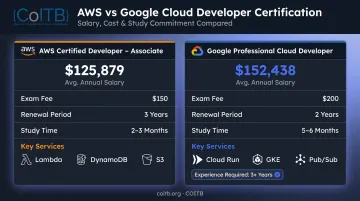
According to Skillsoft's 2025 IT Skills and Salary analysis, AWS Certified Developer – Associate holders report a global average salary of $125,879. The exam costs $150 USD, renews every 3 years, and typically requires 2–3 months of dedicated study for candidates with solid JavaScript or Python experience.
| Technologies covered | Lambda, API Gateway, DynamoDB, S3, IAM, CloudFormation; architecture judgment, not just syntax |
| Exam fee & timeline | $150 USD; 2–3 months of dedicated study; renews every 3 years |
| Best for | Mid-level developers with solid JavaScript/Node.js or Python experience pivoting into Full Stack + Cloud roles at SaaS companies |
Google Professional Cloud Developer
Google's Professional Cloud Developer certification is the most demanding credential on this list. It requires 3+ years of industry experience, including at least 1 year designing solutions on GCP, and the exam reflects that bar. It tests production-level ability across Cloud Run, GKE, Pub/Sub, Firestore, observability, and deployment pipelines.
This credential targets developers at AI-integrated or data-heavy product companies running on Google Cloud. Skillsoft's 2024 survey data reports an average salary of $152,438 in the United States for Professional Cloud Developer holders.
At a $200 USD exam fee with a 2-year renewal cycle, this isn't the place to start. But for experienced developers targeting senior full stack or cloud architect roles at GCP-heavy companies, it's one of the highest-signal credentials available.
| Technologies covered | Cloud Run, GKE, Pub/Sub, Firestore, observability, security, deployment pipelines on GCP |
| Cost & duration | $200 USD exam fee; 5–6 months of preparation including real GCP project work; renews every 2 years |
| Best for | Experienced full stack developers (3+ years) targeting AI-integrated, cloud-native product companies using Google Cloud |
How to Choose the Right Full Stack Certification
The most common mistake candidates make is choosing certifications based on brand prestige rather than career stage. Here's how to think about it practically.
Match Credential Type to Experience Level
0–2 years (early career / career changer):
- Start with a skills-validation credential to establish independently verified baseline competency — COITB's stackable pathway (HTML-CSS Web Designer, JavaScript Professional Developer, ReactJS Framework Developer) is built for exactly this stage
- Build 3–5 deployed projects on GitHub alongside certification work to demonstrate applied knowledge
2–4 years (mid-level):
- A cloud platform certification delivers strong returns at this stage, but only after you've solidified core language and framework skills
- Pair cloud credentials with TypeScript proficiency and React/Node.js depth in your portfolio
- Hiring managers at this level want to see cloud credentials backed by real deployed work — not one without the other
4+ years (senior / specialist):
- Professional-tier cloud architect credentials signal systems thinking at scale
- Architecture credentials carry more weight than stacking additional foundational certificates
A Practical Decision Framework
Regardless of where you fall in the experience ranges above, the same sequencing logic applies. Work through these steps rather than collecting credentials randomly:
- Establish foundational credibility with one skills-validation credential that proves you can do the work
- Build 3–5 deployed projects on GitHub that demonstrate applied knowledge from that credential
- Add one cloud certification when your experience level justifies it
- Repeat: one credentialing goal at a time, paired with real project work
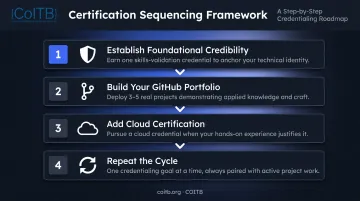
Avoid these common traps:
- Stacking multiple certificates without building real projects. Certifications open the filter; deployed applications close the interview.
- Chasing cloud certifications before mastering fundamentals. You'll spend twice as long studying with half the comprehension.
- Treating any certificate as a substitute for a weak portfolio. It isn't one — and hiring managers know the difference.
Conclusion
The right full stack developer certification in 2026 depends on where you are in your career. Early-stage developers need credentials that validate real fundamentals:
- Beginners: credentials that verify hands-on skills in core technologies
- Mid-to-senior developers: cloud and architecture certifications that signal systems thinking and design judgment
Certifications and portfolio work together. A credential gets you past automated screening; deployed applications and demonstrated problem-solving ability close technical interviews. Treat certification as the starting point, not the destination.
Developers at the early stages of their full stack journey can validate skills in HTML, CSS, JavaScript, React, Python, MySQL, and GPT through COITB's ISO/IEC 17024-aligned certification pathway. The credentials are stackable, require no mandatory course enrollment, and are available via remote online testing with flexible scheduling. Take the free practice assessment at coitb.org/assessment before registering.
Frequently Asked Questions
What certifications should a full stack developer have?
The right mix depends on experience level. Early-career developers benefit most from skills-validation credentials (ISO-aligned, like COITB) or structured programs like IBM or Meta to prove fundamentals. Mid-to-senior developers get the highest ROI from cloud certifications — AWS Developer Associate or Google Professional Cloud Developer — that demonstrate architecture judgment and real deployment capability.
Which full stack developer skills are most in demand in 2026?
Cloud deployment experience (AWS, GCP, Azure), TypeScript, and React plus Node.js top the demand list in 2026. Employers increasingly want developers who can work with AI APIs and modern CI/CD pipelines — the 2025 Stack Overflow survey found Docker usage grew 17 percentage points year-over-year, the largest single-year jump for any technology tracked.
What is the full stack developer roadmap for 2026?
Master HTML, CSS, and JavaScript first, then a frontend framework (React). Move into backend fundamentals — Node.js or Python, plus SQL — then Git and deployment basics. Add TypeScript and a cloud platform next. Pair an appropriate certification with each major stage to validate skills as you build them.
How long does it take to complete a full stack developer certification?
Timelines vary widely. Skills-validation exams (like COITB's individual credentials) can be taken in weeks once fundamentals are solid. Structured programs like IBM and Meta take 6–8 months at part-time pace. Cloud certifications (AWS Developer Associate, Google Professional Cloud Developer) typically require 2–6 months of dedicated study depending on prior experience.
Do full stack developer certifications expire?
Cloud certifications do expire: AWS renews every 3 years, Google Cloud every 2 years, both requiring a recertification exam or approved renewal activity. Platform-based certificates (Coursera, IBM) don't expire on paper but can become outdated. ISO/IEC 17024-aligned credentials like COITB's follow the issuing body's renewal policy — contact COITB directly for current requirements.
Is a free full stack certification worth it for job seekers?
Free certifications from freeCodeCamp, The Odin Project, or Coursera audits demonstrate completed learning but carry less employer weight than independently verified credentials. Pairing any free certificate with a GitHub portfolio of deployed, original projects significantly improves its impact — recruiters consistently weigh working code over completion badges.