For job-seekers, that demand is only worth something if you can demonstrate verified, practical skills. That's where the right certificate program matters. Atlanta learners have several strong options: immersive in-person bootcamps, live online certificates, self-paced global credentials, and independent credentialing-body certifications. The challenge isn't finding a program — it's finding the right one for your background, budget, and timeline.
This guide breaks down the top front-end certificate programs available to Atlanta-area learners, explains what distinguishes each, and helps you make a clearer decision before committing.
Key Takeaways
- Atlanta has 400+ active front-end developer job listings, making it a strong market for credentialed candidates
- Certificate options range from $59/month (Meta/Coursera) to $3,495+ (Noble Desktop) and beyond
- Core skills employers expect: HTML, CSS, JavaScript, React, and responsive design
- COITB offers ISO/IEC 17024-aligned credentials that validate front-end skills for bootcamp grads and self-taught developers
- Georgia Tech's original coding bootcamp has shifted to FlexStack (data/AI focus), so it's no longer a current front-end option
Front-End Developer Certificates in Atlanta: What to Know Before You Choose
A front-end developer certificate is not the same as a degree, and it's not always the same as a bootcamp completion record. The distinction matters.
- Bootcamp certificates confirm you completed a training program. The issuing body sets its own standards.
- Completion certificates (like those from Coursera or edX) confirm you finished a course series. The platform's curriculum defines the bar.
- Credentialing-body certifications (like those from COITB) confirm you passed a standardized, independently administered exam. The standard exists regardless of how you learned.
Each type serves a different purpose. Knowing which one fits your goals — and how Atlanta employers read them — is the right place to start.
Atlanta's Front-End Hiring Market
Metro Atlanta ranks among the top-six U.S. regions for tech talent, with notable clusters in fintech, media, healthcare tech, and e-commerce. Georgia-based companies process more than 70% of U.S. credit card and debit card transactions, driving consistent demand for front-end developers who can build payment interfaces, dashboards, and customer-facing products.
The programs below cover a curated mix of options: in-person Atlanta programs and remote-accessible certificates suited for Atlanta-area learners. Each was selected based on curriculum quality, format flexibility, and relevance to this market.
Top Front-End Developer Certificate Programs in Atlanta
These programs were selected based on curriculum depth, credential recognition, format flexibility, and overall value. Each option below serves a different type of learner — from self-paced online study to in-person bootcamps — so the right choice depends on how you learn best and what employers you're targeting.
COITB Front-End Developer Certifications
COITB is a non-profit credentialing body offering ISO/IEC 17024-aligned certifications in front-end web development. It does not deliver training — it validates skills through independent, standardized exams. This distinction matters: a COITB credential comes from a neutral third party, not the training provider that taught you.
For Atlanta front-end learners, COITB offers three stackable credentials:
- HTML-CSS Web Designer Certification: Validates semantic HTML5, modern CSS3, Flexbox, Grid, responsive design, and accessibility fundamentals (90-item exam, 75% passing score)
- JavaScript Professional Developer Certification: Validates ES6+, DOM manipulation, async/await, Fetch API, and REST integration (90-item exam, 73% passing score)
- ReactJS Framework Developer Certification: Validates component architecture, React Hooks, state management, routing, and API integration (90-item exam, 73% passing score)
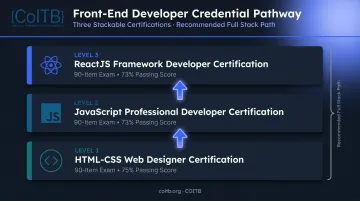
The recommended pathway for Atlanta job-seekers is the full three-credential stack: HTML-CSS → JavaScript → ReactJS. For career changers targeting agencies or junior roles, the two-credential path (HTML-CSS + ReactJS) also works well.
All exams are available online via remote proctoring — accessible from anywhere in Atlanta with a webcam and stable internet — or in person at authorized test centers. Digital badges are issued upon passing and can be verified by employers directly through badge URLs and certification IDs.
| Detail | Info |
|---|---|
| Format | Fully online, remote-proctored; flexible scheduling |
| Technologies Covered | HTML5, CSS3, JavaScript (ES6+), React, responsive design, accessibility |
| Best For | Self-taught developers, bootcamp graduates, and career changers seeking independently verified credentials |
A free practice assessment is available at coitb.org/assessment to gauge readiness before registering. Contact support@coitb.org or +1 877 402 0840 for current pricing.
Noble Desktop Front-End Web Development Certificate
Noble Desktop's Front-End Web Development Certificate is delivered live online with real-time instructor interaction — a structured alternative to self-paced programs for learners who want scheduled accountability.
The curriculum progresses from HTML/CSS fundamentals through JavaScript, Flexbox, CSS Grid, Bootstrap, responsive design, WordPress, and HTML email. The program includes eight mentoring sessions, class recordings, and a verified digital certificate. One free course retake within 12 months is included.
| Detail | Info |
|---|---|
| Format | Live online, instructor-led with real-time interaction |
| Cost & Duration | $3,495 / 108 hours (4 weeks full-time or ~4 months part-time) |
| Best For | Learners who prefer scheduled, classroom-style learning online |
Noble's fixed pricing and transparent curriculum make it one of the clearest apples-to-apples comparisons among these programs. The free retake policy is a meaningful benefit for learners who want a safety net.
General Assembly Software Engineering Bootcamp (Atlanta)
General Assembly operates an Atlanta campus and offers an immersive software engineering bootcamp covering front-end and full-stack web development. With 97,000+ graduates globally and hiring partners including Apple, Coca-Cola, Mastercard, and Cash App, GA carries strong employer brand recognition.
The program is cohort-based and includes career support: 1-on-1 coaching, technical interview prep, résumé reviews, mock interviews, and salary negotiation. Two formats are available:
- Full-time: 12 weeks / 480 hours
- Part-time: 32 weeks / 420 hours
Note: GA's program is broader software engineering, not front-end only. Tuition was not publicly listed at time of writing — verify directly at generalassemb.ly.
| Detail | Info |
|---|---|
| Format | In-person (Atlanta campus) or remote cohort, full-time or part-time |
| Cost & Duration | Verify current tuition at General Assembly's website |
| Best For | Career changers who want a structured, employer-network-connected bootcamp |
Meta Front-End Developer Professional Certificate (Coursera)
Offered through Coursera, the Meta Front-End Developer Professional Certificate is self-paced and beginner-friendly, covering HTML5, CSS, JavaScript, React, Bootstrap, GitHub, Figma, Linux Terminal, and UX/UI design principles. No prior experience is required.
The program results in a shareable digital certificate with the Meta brand — widely recognized by employers globally. Cost depends on completion speed and Coursera's current pricing:
- Coursera Plus subscription: ~$59/month
- Estimated completion: 7 months at 6 hours/week (9-course series)
| Detail | Info |
|---|---|
| Format | Self-paced online via Coursera; subscription-based |
| Cost & Duration | ~$59/month; typically 7 months at 6 hrs/week |
| Best For | Budget-conscious learners or working professionals who need maximum flexibility |
How We Chose These Programs
Programs were evaluated on four criteria:
- Curriculum depth — coverage of core front-end technologies (HTML, CSS, JavaScript, React)
- Credential recognition — whether the issuing body is known to employers or meets independent standards
- Format flexibility — availability for Atlanta learners across in-person, live online, and self-paced options
- Value relative to cost — transparency of pricing and what the learner actually receives
These criteria also shaped which programs were excluded. The original Georgia Tech Coding Bootcamp, for example, has been reimagined as FlexStack — currently focused on Python, SQL, data visualization, and AI, not front-end web development. It does not qualify as a current front-end certificate option.
One broader issue worth naming: many learners choose based on brand name or price without checking whether the credential format matches what Atlanta employers actually screen for. A bootcamp certificate and a credentialing-body certification are not interchangeable. Before committing, review active job listings in Atlanta — the specific language employers use will clarify exactly what credential types they prioritize.
Front-End Developer Salaries and Job Outlook in Atlanta
Salary data from multiple sources gives a useful range for Atlanta front-end developers:
| Source | Figure | Notes |
|---|---|---|
| Indeed (2026) | $102,013/year average | Based on 39 salaries; front-end specific |
| BLS OEWS (May 2023) | $109,050/year mean | Web & Digital Interface Designers, Atlanta metro |
| BLS National (May 2024) | $90,930 median | Web developers nationally; use as floor benchmark |
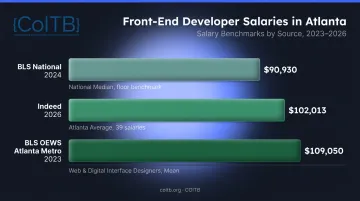
The BLS projects 7% national employment growth for web developers and digital designers from 2024 to 2034 — in line with the broader tech sector and above the average for all occupations. In Atlanta specifically, that demand is driven by a few industries where front-end work is central:
- Fintech and payments — Georgia processes the majority of U.S. card transactions, driving steady demand for payment UI developers
- Healthcare technology — Major health systems and health-tech startups across metro Atlanta rely heavily on front-end talent
- Media and e-commerce, including a significant digital agency and retail tech presence
- Enterprise SaaS — a growing base of B2B software companies actively recruiting front-end engineers
Entry-level front-end roles in Atlanta typically start between $55,000–$75,000, with mid-level positions ranging from $80,000–$100,000+ depending on stack and industry. A verifiable credential helps candidates land closer to the top of that entry-level band and move into mid-level roles faster.
Conclusion
Atlanta is a strong market for front-end developers right now, and the certificate landscape reflects that demand: real options exist at multiple price points and formats. The right program still depends on your situation — how you learn best, how quickly you need to be job-ready, what you can spend, and which credential format resonates with your target employers.
Before committing, scan actual Atlanta job listings and note what employers ask for. Some will list "React experience" without mentioning certifications. Others will screen for independently verifiable credentials. Knowing which type you're targeting helps you choose the program worth your time and money.
For learners who want to validate front-end skills with a standards-aligned credential on their own schedule — whether through a bootcamp, self-study, or any other path — COITB's front-end certifications offer a fully remote option with no commute required.
The ReactJS Framework Developer and HTML-CSS Web Designer credentials are independently verifiable, can be stacked as your skills grow, and are open to Atlanta learners wherever they are.
Frequently Asked Questions
How much do front-end developers make in Atlanta?
According to Indeed, the average front-end developer salary in Atlanta is $102,013/year based on recent listings. BLS data for the broader Web and Digital Interface Designers category in the Atlanta metro puts the mean at $109,050. Entry-level roles typically start between $55,000–$75,000.
Which front-end developer certificate is best in Atlanta?
The right choice depends on your experience, budget, and how you learn. COITB suits candidates wanting independently verified credentials; General Assembly fits career changers wanting cohort-based immersion; Meta/Coursera works for self-paced learners on a budget. Review the options above against your specific goals.
Can I complete a front-end developer certificate online while living in Atlanta?
Yes. COITB, Noble Desktop, and Meta/Coursera are all fully online and accessible to Atlanta residents with no commute or relocation required. COITB also supports remote proctored testing from any location with a stable internet connection and webcam.
How long does it take to earn a front-end developer certificate?
Timelines vary by program. Meta/Coursera takes about 7 months at 6 hours/week; Noble Desktop runs 4 weeks full-time or ~4 months part-time; General Assembly's bootcamp is 12 weeks full-time. COITB exam-based credentials fit a flexible schedule based on your readiness.
Do Atlanta employers recognize front-end developer certifications?
Recognition varies by credential type. Bootcamp certificates are familiar to many hiring managers, while standards-aligned credentials from credentialing bodies signal independently verified competency that employers can confirm through badge URLs and certification IDs. A strong portfolio alongside any credential remains important.
What skills should a front-end developer certificate cover?
At minimum: HTML, CSS, JavaScript, responsive design, and one modern framework (React is the most in-demand). Familiarity with Git for version control and basic UX principles is increasingly expected by Atlanta employers, particularly at product companies and agencies.