The problem? Knowing Python isn't always enough. Employers increasingly want proof. With dozens of certifications available — from free course completions to proctored professional exams — picking the right one takes more than a quick Google search.
This guide breaks down the top Python certifications by level, explains what each one actually validates, and helps you match a credential to your specific career goal.
Key Takeaways
- The Python Institute's track (PCEP → PCAP → PCPP1) offers the most structured, proctored credential path for Python-specific validation.
- COITB's Professional Python Developer certification delivers ISO/IEC 17024-aligned, remote-proctored validation for entry-to-mid-level candidates.
- Google's IT Automation certificate is a strong pick for IT professionals who want automation skills backed by recognizable brand credibility.
- Proctored exams carry more weight in hiring pipelines than completion-based course badges.
- A credential signals job-readiness. Back it up with a GitHub portfolio of real projects to convert that signal into offers.
Why Python Certifications Matter in Today's Job Market
Stack Overflow's 2025 developer survey reported Python saw a 7-percentage-point increase from 2024 and describes it as the go-to language for AI, data science, and backend work. The JetBrains Python Developers Survey 2024 found that 51% of Python developers use it for data exploration and processing, 26% for DevOps and automation, and 23% for web development.
That breadth is the point. Python spans more career paths than almost any other language, which makes validating Python skills useful across a wide range of roles.
Certifications vs. Completion Certificates: What's the Difference?
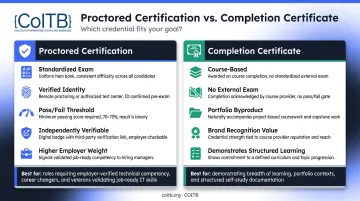
The two most common Python credential types work differently — and carry different weight with employers.
| Type | What It Is | Example |
|---|---|---|
| Proctored Certification | Standardized exam, verified identity, pass/fail threshold | PCEP, PCAP, COITB |
| Completion Certificate | Course finished, no external exam | Google (Coursera), IBM |
Both have legitimate uses. Proctored certifications carry more weight when applying to roles where employers need independent skill verification — especially for candidates without a CS degree or extensive work history. Completion certificates demonstrate structured learning and often include project portfolios, which matter for demonstrating applied work.
The certifications below cover both types. Which makes sense for you depends on where you are in your career and what the roles you're targeting actually ask for.
Top Python Certifications: Entry-Level to Advanced
These credentials were selected based on exam credibility, issuing body recognition, standards alignment, and fit across different career paths — from complete beginners to senior developers.
PCEP: Certified Entry-Level Python Programmer (Python Institute)
PCEP (exam code PCEP-30-02) is the Python Institute's official entry point. It validates foundational Python knowledge: variables, data types, control flow, functions, and basic data collections. No prior coding experience required.
Why it stands out:
- One of the most affordable formal Python credentials available
- Delivered via OpenEDG TestNow — no test center, no advance scheduling required
- Recognized by Cisco (whose Python Essentials 1 course was developed in collaboration with OpenEDG) and Stanford University
- Lifetime validity on PCEP-30-02
| Detail | Info |
|---|---|
| Cost | $69 single attempt; $86 exam + retake bundle |
| Exam Format | 30 questions, 40 minutes, online on-demand via OpenEDG TestNow |
| Best For | Absolute beginners and career changers wanting a low-cost, formal credential to validate Python fundamentals |
PCAP: Certified Associate in Python Programming (Python Institute)
PCAP moves beyond fundamentals into object-oriented programming, modules and packages, generators, iterators, file processing, and exception handling. It assumes you already have a working grasp of Python basics.
Why it stands out:
- Delivered through Pearson VUE's network of 5,000+ global testing centers or via online proctoring, giving it stronger credibility than most platform certificates
- OOP makes up a substantial portion of the exam, which meaningfully differentiates intermediate candidates from beginners
- An interim step toward the professional-level PCPP1
| Detail | Info |
|---|---|
| Cost | From $295 single attempt; from $345 exam + retake; from $359 with practice test |
| Exam Format | 40 questions, 65 minutes, Pearson VUE or online proctoring; 70% passing score |
| Best For | Junior to mid-level developers, career changers seeking credible formal validation, data analysts using Python professionally |
PCPP1: Certified Professional in Python Programming 1 (Python Institute)
PCPP1 targets experienced developers who want formal validation of advanced Python. Topics include metaclasses, serialization, GUI programming with tkinter, network programming with sockets and REST, and professional coding conventions (PEP 8/PEP 20).
Why it stands out:
- Stanford University's IT training program offers a dedicated prep course for this exam — a strong signal of academic and employer recognition
- No retake bundle available; failed candidates must purchase a new voucher, so thorough preparation matters
- PCPP1 holders are rare enough that the credential stands out on a résumé for senior and specialist roles
| Detail | Info |
|---|---|
| Cost | From $325 single attempt (no retake bundle) |
| Exam Format | 45 questions, 65 minutes, Pearson VUE or online proctoring |
| Best For | Intermediate to senior developers and software architects seeking formal validation of advanced Python expertise |
Google IT Automation with Python Professional Certificate (Coursera)
Google's Coursera program teaches Python specifically for IT automation — covering OS interaction, Git, configuration management, cloud automation, and troubleshooting. No prior programming experience required. This is a completion-based program, not a proctored exam.
Why it stands out:
- Backed by Google's 150+ employer consortium
- About 75% of Google Career Certificate graduates report a positive career outcome (new job, promotion, or raise) within six months, per Google's own survey data
- Earners receive a digital badge via Credly and ACE-recommended college credit (16 credits, valid through 2028)
- Non-technical recruiters who recognize the Google brand respond well to this credential in hiring pipelines
| Detail | Info |
|---|---|
| Cost | $49/month; most learners complete for under $300 total |
| Exam Format | Multi-course completion program with video lessons, quizzes, labs, and a capstone project; no proctored exam |
| Best For | IT professionals, help desk staff, and sysadmins adding Python automation skills with a recognized brand credential |
COITB Professional Python Developer Certification
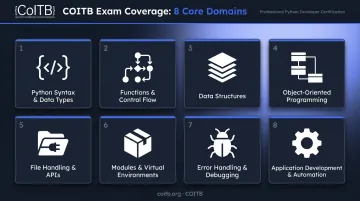
COITB is a non-profit credentialing body whose certifications are aligned to ISO/IEC 17024 — the international standard for personnel certification bodies. The Professional Python Developer certification validates foundational to mid-level Python skills across eight domains:
- Python syntax, variables, and data types
- Functions and control flow
- Data structures (lists, dictionaries, strings)
- Object-oriented programming (classes, inheritance, encapsulation, polymorphism)
- File handling and APIs
- Modules, libraries, and virtual environments
- Error handling and debugging
- Application development and automation scripts
The exam also covers list comprehensions, generators, decorators, and PEP 8 style standards — reflecting the practical, real-world focus of the credential.
A few details worth noting before you register:
- Available via remote online proctoring (24/7 from any U.S. location) or in-person at authorized COITB test centers
- Designed for candidates with 0–6 months of hands-on Python experience — accessible to bootcamp graduates, self-taught developers, career changers, and veterans
- Pricing is published at coitb.org; a free practice assessment is available before you register
- Digital badge included at no additional cost upon passing
| Detail | Info |
|---|---|
| Exam Format | 58 questions, 75 minutes, 70% passing score |
| Standards Alignment | ISO/IEC 17024 aligned |
| Delivery | Remote online proctoring (24/7) or authorized test centers; flexible on-demand scheduling |
| Best For | Bootcamp graduates, self-taught developers, career changers, and veterans seeking an industry-recognized Python credential with real-world skills validation |
Veterans and transitioning service members should verify GI Bill, VET TEC, MyCAA, or VR&E eligibility with a VA Education Benefits counselor before registering — approval status should be confirmed through VA WEAMS or your State Approving Agency.
How to Choose the Right Python Certification for Your Goals
Match Your Experience Level
- Zero coding background: Start with PCEP or COITB's Professional Python Developer certification. Both are designed for candidates at the beginning of their Python journey.
- Know Python fundamentals already: Move directly to PCAP. You'll validate intermediate skills and differentiate yourself from entry-level candidates.
- Experienced developer: PCPP1 validates senior-level Python and carries meaningful weight for specialist roles.
Match Your Career Path
| Target Role | Best Credential |
|---|---|
| IT Support Specialist, Sysadmin | Google IT Automation |
| Junior Developer, Career Changer | PCEP, COITB Professional Python Developer |
| Software Engineer, Data Analyst | PCAP |
| Senior Engineer, Software Architect | PCPP1 |
| Data Scientist, AI/ML Practitioner | COITB Professional Python Developer, PCAP |
Proctored Exam vs. Completion Certificate
Choose based on how you'll use the credential:
- Proctored exam (PCEP, PCAP, PCPP1, COITB): Better for getting past HR filters and ATS systems, especially if you lack a CS degree or years of verifiable work experience. Employers and recruiters can independently verify the credential.
- Completion certificate (Google, IBM): Better for structured learning with a portfolio project as a byproduct. Useful when the brand name carries weight with non-technical recruiters.
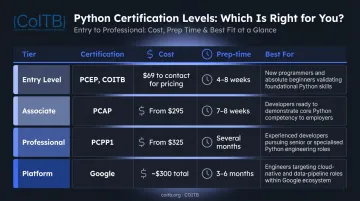
Cost and Time Considerations
| Level | Approximate Cost | Preparation Time |
|---|---|---|
| Entry (PCEP, COITB) | $69–contact for COITB pricing | 4–8 weeks |
| Associate (PCAP) | From $295 | 7–8 weeks |
| Professional (PCPP1) | From $325 | Several months |
| Platform (Google) | 3–6 months |
Be realistic about weekly study hours. If you can dedicate 5 hours per week, a 6-week plan becomes a 10-week plan.
Certification + Portfolio: Both Matter
A certification validates your knowledge. A portfolio proves you can apply it. Once you've budgeted the time and cost above, plan for both — they serve different purposes in the hiring process.
Employers don't hire based on a credential alone. They want to see GitHub repositories, deployed applications, or automation scripts you've built. The credential gets your résumé past the initial screen; the portfolio closes the interview.
How We Selected These Python Certifications
Each certification in this guide was evaluated against the same criteria:
- Exam credibility — proctored vs. completion-based, delivery infrastructure
- Issuing body recognition — non-profit credentialing body, standards alignment, or employer brand
- Standards alignment — ISO/IEC 17024 compliance where applicable
- Experience-level fit — from complete beginners to senior developers
- Career outcome relevance — does it map to real hiring pipelines?
- Cost-to-value ratio — is the investment proportionate to the career benefit?
That last criterion — issuing body recognition — is where many candidates go wrong. It's common to choose a certification based on brand name alone, without checking whether it matches your actual skill level or target role. A proctored credential from an accredited body signals verified competency to a hiring manager; a course completion badge signals effort. Both have a place, but they serve different purposes in a hiring pipeline. Knowing which one a role requires will save you time and money.
Conclusion
The Python certification landscape offers a clear path. Entry-level candidates have PCEP and COITB's Professional Python Developer certification. Intermediate developers have PCAP. Advanced practitioners have PCPP1. And those targeting IT automation or specific industry tracks have Google's completion-based program.
Start with an honest skills assessment and a specific career target — not a brand name. The credential that matches where you are and where you're headed will do more for your job search than a prestigious-sounding exam you're not ready for.
That's exactly where COITB's Professional Python Developer certification fits. It's built for candidates at any experience level — bootcamp graduates, career changers, and veterans entering tech — with no prerequisites and no rigid exam window to work around.
Key features:
- ISO/IEC 17024 aligned — a recognized credentialing standard that signals exam integrity to employers
- Remote online proctoring with flexible on-demand scheduling (webcam + stable internet required)
- Open to all backgrounds — military CAC and VA-issued ID accepted for identity verification
Start with the free practice assessment at coitb.org, or contact the team directly at support@coitb.org to check current pricing and exam details.
Frequently Asked Questions
How much does a Python certification cost?
Entry-level options like PCEP start at $69 for a single attempt. PCAP runs from $295, and PCPP1 from $325. Google's Coursera program costs $49/month, with most learners finishing for under $300 total. COITB's Professional Python Developer pricing is available by contacting support@coitb.org directly, as pricing is updated periodically.
Is there an official Python certification?
The Python Institute (via OpenEDG) offers the most widely recognized official Python-specific certification track — PCEP, PCAP, and PCPP1. These are proctored exams recognized by institutions including Cisco and Stanford University.
Which Python certification is best?
The right choice depends on your current skill level and target role. PCEP or COITB's credential suits beginners and career changers. PCAP is the strongest intermediate proctored option. Google's program is best for IT professionals targeting automation roles. PCPP1 serves experienced developers pursuing senior or specialist positions.
Is a Python certification worth it?
For candidates without a CS degree or extensive work history, yes. Certifications clear HR filters and demonstrate structured, verified learning — and carry the most weight when paired with a portfolio of real projects.
What is the difference between PCEP and PCAP?
PCEP covers Python fundamentals — variables, loops, functions, and basic data types. PCAP builds on that with object-oriented programming, modules, generators, file processing, and exception handling. PCAP carries more employer recognition and is the stronger credential for those already past the beginner stage.
Do employers care about Python certifications?
Certifications are rarely listed as hard requirements, but they're viewed positively — especially for candidates without years of verifiable experience. Proctored credentials carry more weight than course completion badges because they reflect a standardized, pass/fail assessment that can be independently verified.