The challenge for most beginners isn't motivation — it's direction. Should you pursue IT support? Cybersecurity? Networking? Software development? Each path has its own starting certifications, and choosing the wrong one wastes months of study time.
According to the U.S. Bureau of Labor Statistics, computer and IT occupations are projected to grow much faster than average from 2024 to 2034, generating roughly 317,700 job openings per year with a median annual wage of $105,990 as of May 2024. The demand is real — the question is which credential gets you in the door.
This article covers the best beginner IT certifications, what each validates, who they're suited for, and how to pick the right starting point for your specific career track.
Key Takeaways
- Certifications validate real skills to employers — even without a degree or prior job experience
- IT support, cybersecurity, networking, and software development each have their own best entry-point credential
- CompTIA A+ and Security+ are among the most employer-requested credentials in IT support and cybersecurity
- COITB fills the software development and AI credentialing gap that infrastructure-focused certifications leave open
- Matching your certification to your target role, not just picking the most recognizable name, determines your return on investment
Why IT Certifications Matter for Career Starters
A certification is a third-party validated credential — awarded only after passing a standardized exam administered by an independent body. For hiring managers reviewing resumes from career changers, bootcamp graduates, and self-taught professionals, that external verification matters. It converts informal learning into something concrete they can confirm.
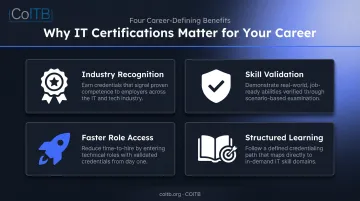
Four Career Benefits Worth Knowing
- Industry recognition — hiring managers use certifications as a quick competency signal, especially for entry-level screening
- Skill validation — third-party confirmation carries more weight than self-reported proficiency
- Faster role access — some roles list specific certifications as minimum requirements, not preferences
- Structured learning — exam objectives give you a defined scope to study, removing the guesswork from career prep
The demand signal is real. The U.S. Bureau of Labor Statistics projects web development and digital design roles to grow 16% through 2032 — faster than the average for all occupations. Employers filling those roles increasingly use certifications as a baseline filter, not a bonus credential.
Best Beginner IT Certifications to Start Your Career
These certifications were selected based on employer demand, beginner accessibility, career ROI, and broad industry recognition. No prior experience is required for most of them.
CompTIA Tech+
Best for: Absolute beginners exploring whether IT is the right career path.
Tech+ (exam code FC0-U71) is the rebranded version of CompTIA's IT Fundamentals+ (ITF+), launched in July 2024. It covers core IT concepts across six domains:
Tech+ (exam code FC0-U71) is the rebranded version of CompTIA's IT Fundamentals+ (ITF+), launched in July 2024. It covers core IT concepts across six domains:
- Tech Concepts (13%)
- Infrastructure (24%)
- Applications and Software (18%)
- Software Development Concepts (13%)
- Data and Database Fundamentals (13%)
- Security (19%)
The exam objectives include references to emerging technologies like cloud, virtualization, wireless networks, and generative AI.
| Detail | Info |
|---|---|
| Exam Code | FC0-U71 |
| Format | Single exam, 70 questions, 60 minutes |
| Passing Score | 650 out of 900 |
| Prerequisites | None — no prior experience required |
| Expiration | No expiration listed on official CompTIA page |
| Ideal For | Students, career explorers, non-technical professionals |
| Aligned Roles | IT support assistant, junior help desk technician |
For current exam pricing, check CompTIA's official Tech+ page directly, as pricing was not confirmed in accessible CompTIA text during research.
CompTIA A+
Best for: Anyone targeting IT support, help desk, or technical service roles.
CompTIA A+ is the most widely recognized entry-level IT credential. It requires passing two exams — Core 1 (220-1101) and Core 2 (220-1102) — covering hardware, networking, operating systems, security, and troubleshooting. The current price is $258 per exam based on CompTIA's certification page, putting the total at approximately $516 for both vouchers.
CompTIA's official guidance recommends at least 120 hours of study plus hands-on practice for candidates with no prior experience. In 2024, there were more than 65,000 U.S. help desk technician postings, according to CompTIA's own research.
| Detail | Info |
|---|---|
| Exam Codes | 220-1101 (Core 1) and 220-1102 (Core 2) |
| Format | Two exams, 90 minutes each, max 90 questions each |
| Prerequisites | None formal; 9–12 months hands-on experience recommended |
| Renewal | Every 3 years |
| Ideal For | IT support beginners; anyone targeting help desk roles |
| Aligned Roles | Help desk technician, IT support specialist, desktop support analyst |

A+ is vendor-neutral and globally accepted — from small businesses to government contractors. It also serves as the foundation for CompTIA's broader pathway toward Network+ and Security+.
CompTIA Security+
Best for: Those targeting cybersecurity careers, or IT professionals ready to specialize.
Security+ (exam SY0-701) is the leading foundational cybersecurity certification. Its five domains are:
- General Security Concepts (12%)
- Threats, Vulnerabilities, and Mitigations (22%)
- Security Architecture (18%)
- Security Operations (28%)
- Security Program Management and Oversight (20%)
Security+ holds DoD approval under DoDM 8140.03, making it a requirement — not just a preference — for many federal and defense contractor roles. CyberSeek reports an average advertised salary of $106,265 for cybersecurity specialist roles, a category Security+ directly supports. CompTIA recommends two years of IT experience with a security focus before attempting this exam, though it has no formal prerequisites.
| Detail | Info |
|---|---|
| Exam Code | SY0-701 |
| Format | Single exam, 90 minutes, max 90 questions |
| Prerequisites | None formal; 2 years security/IT experience recommended |
| Renewal | Every 3 years |
| Ideal For | Cybersecurity career starters; IT professionals specializing |
| Aligned Roles | Security analyst, systems administrator, cybersecurity specialist |
For current pricing, visit CompTIA's Security+ page directly — pricing was not confirmed in accessible official text during research.
Cisco CCNA
Best for: Aspiring network engineers and IT professionals targeting infrastructure roles.
The CCNA (exam 200-301) is the most recognized entry-level networking certification in enterprise hiring. A single 120-minute exam covers network fundamentals, network access, IP connectivity, IP services, security fundamentals, and automation and programmability. The official exam cost is $300 USD (or Cisco Learning Credits).
Cisco recommends candidates have at least one year of hands-on networking experience before attempting the exam, though there are no formal prerequisites. CCNA holders have a direct pathway to advanced Cisco credentials (CCNP) and are competitive for enterprise infrastructure and NOC roles.
| Detail | Info |
|---|---|
| Exam Code | 200-301 |
| Format | Single exam, 120 minutes |
| Cost | $300 USD |
| Prerequisites | None formal; 1+ year networking experience recommended |
| Renewal | Every 3 years |
| Ideal For | Aspiring network engineers and administrators |
| Aligned Roles | Network administrator, NOC technician, junior systems engineer |
COITB Certifications (Software Development & AI Track)
Best for: Aspiring software developers, web designers, AI practitioners, bootcamp graduates, and self-taught coders.
Most beginner certifications focus on IT infrastructure and support. COITB fills a different gap — validating skills in modern application development and AI tools that employers actually hire for in software roles.
COITB is a non-profit credentialing body whose mission is to "validate real-world skills, elevate professional standards, and support the growth of a strong, future-ready IT workforce." Its seven credentials follow ISO/IEC 17024 exam standards — the same framework used by globally recognized credentialing bodies — and target candidates with 0–6 months of hands-on experience. No CS degree required.
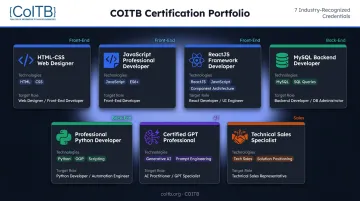
The seven COITB certifications:
| Certification | Technologies Covered | Target Roles |
|---|---|---|
| ReactJS Framework Developer | JSX, Hooks, state management, React Router, API integration | Front-end developer, full-stack engineer |
| HTML-CSS Web Designer | HTML5, CSS3, Flexbox, Grid, responsive design, accessibility | Web designer, junior front-end developer |
| JavaScript Professional Developer | ES6+, async/await, DOM, Fetch API, REST integration | Front-end developer, JS-stack engineer |
| Professional Python Developer | Python 3 OOP, file I/O, decorators, standard library | Back-end developer, data engineer |
| MySQL Backend Developer | SQL querying, schema design, stored procedures, ACID | Back-end developer, DBA |
| Certified GPT Professional | Prompt engineering, GPT API, fine-tuning, responsible AI | AI practitioner, GPT developer |
| Technical Sales Specialist | Customer discovery, demo design, SaaS economics, RFP response | Sales engineer, pre-sales consultant |
Exams range from 58–90 questions over 75–90 minutes, with passing scores between 70–75% depending on the credential. All exams are available via remote online proctoring (webcam + stable internet required) or in-person at authorized COITB test centers. Passing earns a digital badge for use on LinkedIn and your resume.
For pricing and registration, visit coitb.org/auth/signup or contact COITB at support@coitb.org.
How to Choose the Right Beginner IT Certification
Role alignment matters more than name recognition. The most popular certification isn't always the right one for where you want to go.
Match Credential to Career Track
| Career Track | Best Starting Certification |
|---|---|
| IT support / help desk | CompTIA A+ |
| Cybersecurity | CompTIA Security+ |
| Networking / infrastructure | Cisco CCNA |
| Software development | COITB (HTML-CSS → ReactJS or JavaScript) |
| AI / generative AI | COITB Certified GPT Professional |
| Complete beginner, exploring IT | CompTIA Tech+ |
Before committing, scan job postings in your target role. Which credentials show up in requirements or preferred qualifications sections tells you exactly what employers in your market are hiring for.
Factor in Cost, Time, and Renewal
- Entry-level exam fees range from $258–$300 for CompTIA A+ and Cisco CCNA — budget for study materials and at least one potential retake
- CompTIA certifications (A+, Security+) expire every 3 years and require continuing education for renewal; CompTIA Tech+ currently has no expiration date
- COITB certifications have a defined validity period with a formal recertification process — details at coitb.org/certification-resources/recertification-requirement-policy
- Some employers offer professional development stipends — worth checking before paying out of pocket
Vendor-neutral credentials like CompTIA travel well across industries. Vendor-specific credentials like CCNA carry more weight in targeted environments, particularly enterprise networking. Consider which employer landscape you're entering when choosing between the two.
How to Prepare for Your First IT Certification Exam
Build Your Study Foundation
Start with the official exam objectives published by your certification provider — they define exactly what the exam covers and how much weight each domain carries. COITB publishes domain breakdowns for all seven credentials, so you know precisely where to focus your time.
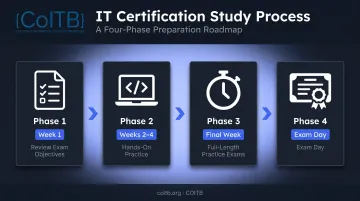
Study time varies by credential. Entry-level web design and foundational coding exams can often be covered in 2–4 weeks of focused effort. More technical credentials — like ReactJS Framework Developer or Certified GPT Professional — typically require 6–10 weeks, depending on your existing background. Either way, hands-on practice alongside reading is essential.
Practice Under Exam Conditions
Performance-based questions (PBQs) appear in many entry-level exams. These test your ability to solve real-world problems — not just recall definitions.
- Use timed, full-length practice exams to build stamina and simulate test-day pressure
- Identify weak domains from your practice scores, then target those specifically — not everything from scratch
- Work through scenario-based questions hands-on rather than just reading answer explanations
Use Community Resources Strategically
Online communities offer peer accountability and real exam experience insights — particularly valuable if you're studying independently. Strong options include:
- Reddit (r/learnprogramming, r/webdev) for Q&A and study tips
- Discord servers tied to your specific tech stack (React, Python, JavaScript)
- LinkedIn groups for professional context and networking alongside your credential
Set a firm exam date early. A deadline turns studying from an open-ended commitment into a manageable sprint.
Conclusion
A beginner IT certification gives hiring managers something concrete to evaluate — verified, standardized proof of skills that a résumé alone can't provide. That holds true whether you're coming from a degree program, a bootcamp, self-study, or a completely different field.
Match your certification to your intended career track rather than chasing the most recognizable name. Software development, web design, AI, and technical sales each have distinct entry points — choosing the right one saves months of misdirected effort.
For software developers, web designers, and AI professionals ready to validate their skills, COITB offers credentials built for exactly that starting point. Here's how to move forward:
- Gauge your readiness first: Take the free practice assessment at coitb.org/assessment
- Register when you're ready: Create your account at coitb.org/auth/signup
- Get answers before you commit: Reach out to the team at support@coitb.org
Frequently Asked Questions
How much does an IT certification cost?
Entry-level exam fees for verified certifications range from approximately $258 (CompTIA A+, per exam) to $300 (Cisco CCNA). Total costs also include study materials and potential retakes. Some employers offer professional development stipends that can offset the expense.
What does it take to get an IT certification?
Choose a target certification, study the official exam objectives using guides and practice tests, then register and pass a proctored exam. Most beginner certifications have no formal prerequisites, though hands-on practice meaningfully improves pass rates — especially for performance-based question formats.
Is an IT certification worth it?
Yes, particularly for entry-level candidates. Certifications help you stand out in competitive hiring, meet credential requirements for specific roles, and translate into stronger salary outcomes — cybersecurity specialist roles, for instance, advertise an average salary of $106,265 according to CyberSeek data.
What is the best IT certification to get?
It depends on your target role: CompTIA A+ for IT support, Security+ for cybersecurity, CCNA for networking. For software development or AI roles, credentials that validate real coding skills — like COITB's React, Python, or GPT certifications — are more relevant than infrastructure-focused options.
Do I need prior experience to earn a beginner IT certification?
Most entry-level certifications, including CompTIA Tech+ and COITB credentials, require no prior experience. Security+ recommends some IT background but doesn't mandate it. Hands-on practice is advisable regardless.
How long does it take to prepare for a beginner IT certification exam?
CompTIA recommends at least 120 hours of study for A+ candidates with no prior experience. Simpler foundational exams like Tech+ can typically be covered in 2–4 weeks. CCNA generally requires several months of part-time preparation given the depth of networking content covered.