For beginners, the natural response is to find a coding program and start learning. The problem is that the market for coding education has exploded alongside demand. Self-paced platforms, bootcamps, mobile apps, university-style courses — each promises a path into tech, but they vary wildly in curriculum focus, cost, and career outcomes. Picking the wrong one doesn't just waste time; it can send a beginner six months down the wrong track.
This article cuts through that noise. Below is a curated list of the five best coding programs for beginners in 2026, how they were evaluated, and what to look for when choosing one.
TL;DR
- freeCodeCamp — best for beginners who want a fully free, structured path into web development
- Codecademy — beginner-friendly interactive platform with guided career paths built in
- The Odin Project — built for self-directed learners who want project-based, full-stack training at no cost
- Mimo — top pick for mobile-first learners who prefer AI-assisted, bite-sized daily lessons
- DataCamp — strongest choice if your goal is data science, Python, or SQL from day one
What Is a Coding Program, and Why Does It Matter for Beginners?
A coding program is a structured learning system that teaches programming languages, problem-solving, and software development fundamentals in a defined sequence. Unlike watching random YouTube tutorials or reading documentation, structured programs give beginners a clear roadmap rather than scattered content.
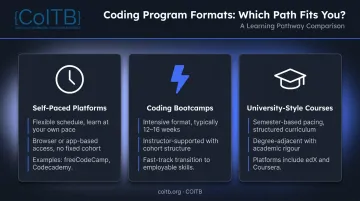
Three main formats exist:
- Self-paced online platforms — browser or app-based learning at your own schedule (freeCodeCamp, Codecademy, Mimo)
- Coding bootcamps — intensive, time-compressed programs typically running 12–16 weeks, often with instructor support
- University-style courses — semester-based, degree-adjacent programs through platforms like edX or Coursera
Why Format Selection Matters
Format isn't just a preference — it shapes outcomes. A career changer who needs to transition fast may benefit from a bootcamp's intensity. A working adult managing a full-time job will need the flexibility of a self-paced platform. Choosing the wrong format often leads to abandonment, not failure to learn.
Format also affects what comes after completion. Finishing a program is the starting point, not the finish line. Many employers want proof they can verify — not just a course completion record. Platform certificates and independent, third-party credentials serve different purposes, and understanding that distinction matters when you're job hunting.
Best Coding Programs for Beginners in 2026
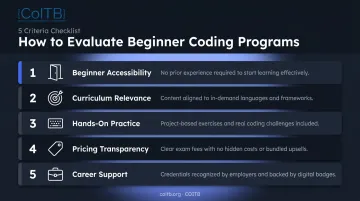
Programs were selected based on five criteria: beginner accessibility, curriculum relevance to in-demand 2026 roles, hands-on practice requirements, pricing transparency, and career support (certifications, portfolio projects, or job-readiness resources).
freeCodeCamp
freeCodeCamp is a non-profit, entirely free online platform that has helped millions of beginners worldwide enter web development through a structured, self-paced curriculum. Its current Full-Stack Developer track includes six approximately 300-hour checkpoint certifications covering Responsive Web Design, JavaScript, Front-End Development Libraries, Python, Relational Databases, and Back-End Development — capped by an approximately 1,800-hour Full-Stack Developer capstone.
The combination of zero cost and verifiable credentials is what separates it from most free platforms. There are no paywalls, no premium tiers, no upsells. Learners complete hundreds of hours of browser-based coding challenges and earn free verified certifications at each stage.
| Criteria | Details |
|---|---|
| Best For | Beginners who want a fully free, structured web development curriculum with certifications |
| Languages/Technologies | HTML, CSS, JavaScript, Python, SQL, Data Structures & Algorithms |
| Pricing | Free (donations-supported) |
Codecademy
Codecademy is one of the most widely used beginner coding platforms, with 50M+ learners and a browser-based interactive environment spanning 15 programming languages. Its career paths — 14 in total, covering roles from Front-End Engineer to AI Engineer to Data Scientist — give beginners a structured progression rather than a loose catalog of disconnected courses.
The "learn by doing" interface is its strongest feature for complete beginners: learners write real code directly in the browser and receive instant feedback, eliminating the friction of local environment setup. Career paths include portfolio projects and interview prep, which pushes graduates closer to job readiness.
| Criteria | Details |
|---|---|
| Best For | Complete beginners who want a guided, interactive experience with structured career paths |
| Languages/Technologies | Python, JavaScript, HTML, CSS, SQL, React, and more |
| Pricing | Free plan available; Pro from ~$14.99/month (billed annually) |
The Odin Project
The Odin Project is a free, open-source full-stack curriculum built almost entirely around project-based learning. From day one, learners build real projects — not just exercises. The curriculum covers HTML, CSS, JavaScript, Node.js, React, and SQL across two tracks: Full Stack JavaScript and Full Stack Ruby on Rails.
Unlike exercise-first platforms, it takes a developer-first approach from day one. Learners set up professional tools — VS Code, Git, the command line — early in the curriculum, mirroring actual developer workflows. Its active community forum provides peer support, and its GitHub curriculum repository has accumulated roughly 12.8K stars and 16.5K forks, reflecting genuine community engagement.
| Criteria | Details |
|---|---|
| Best For | Self-directed beginners who want free, project-based full-stack training with a developer-first approach |
| Languages/Technologies | HTML, CSS, JavaScript, Node.js, React, SQL |
| Pricing | Free |
Mimo
Mimo is an AI-powered, mobile-first coding app designed specifically for beginners who learn better in short, daily sessions. Its structured career paths — Full-Stack, Front-End, Back-End, and Python Development — are built around 5-minute bite-sized lessons accessible on iOS, Android, and web, with an integrated code editor so learners aren't just reading.
At the higher tier, learners get access to an AI coding assistant, professional certificates, and guided projects — a combination rare in mobile-first apps. With 35M+ learners and a 4.9/5 rating from over 109,000 App Store reviews, it has clearly connected with mobile learners. Few platforms bridge casual daily practice with career-oriented outcomes the way Mimo does.
| Criteria | Details |
|---|---|
| Best For | Beginners who want to learn in short daily sessions on mobile with AI-assisted guidance |
| Languages/Technologies | Python, JavaScript, HTML, CSS, SQL, TypeScript |
| Pricing | Free plan available; Pro $9.99/month; Max $39.99/month |
DataCamp
DataCamp is the most specialized platform on this list, with 750+ courses focused exclusively on data science, analytics, and AI. Python, SQL, R, Power BI, and Tableau form the core stack. Beginners targeting data-driven tech roles will find a depth here that general-purpose platforms can't match.
Two features make it particularly effective for beginners entering data roles:
- Rigorous credentials: Data Analyst and Data Scientist certifications include timed exams and practical assessments — not just course completion badges.
- AI-assisted learning: A built-in tool explains errors and concepts in real time, helping beginners push past sticking points instead of dropping off.
| Criteria | Details |
|---|---|
| Best For | Beginners targeting data science, analytics, or AI roles — not general web development |
| Languages/Technologies | Python, SQL, R, Power BI, Tableau, Machine Learning |
| Pricing | Free tier available; Premium from ~$28/month (billed annually) |
How We Chose the Best Coding Programs for Beginners
The most common mistake beginners make is choosing a coding program based on popularity or price alone — without checking whether it actually matches their goal. Every program on this list was screened against five criteria to cut through that noise.
The Five Evaluation Criteria
Every program on this list was assessed against these factors:
- Beginner accessibility — no prerequisites required to start
- Curriculum relevance — languages and skills aligned with roles employers are hiring for in 2026
- Hands-on practice — real coding required, not passive video consumption
- Pricing transparency — clear free vs. paid tiers with no hidden costs
- Career support — certifications, portfolio projects, or job-readiness resources included
The Credential Gap Problem
Those five criteria filter for quality — but even a high-quality program leaves one gap unaddressed. Employers and recruiters can't verify what a self-taught learner actually knows from a résumé line that says "completed Codecademy Python course."
Nearly 1 in 4 U.S. job postings requests a non-degree credential, according to Lightcast — and that share rises to 1 in 3 among postings that don't require a bachelor's degree. Platform-issued certificates record course completion. Independent, third-party certifications validate competency against a defined standard — and that's a meaningful distinction to hiring managers.
This is where organizations like COITB become relevant. COITB is a non-profit credentialing body whose certifications are aligned with ISO/IEC 17024 — the international standard for personnel certification bodies. Critically, COITB doesn't deliver training or courses; it functions purely as an independent assessment body. That structural separation is what makes its credentials genuinely third-party.
A learner who completes freeCodeCamp's HTML/CSS curriculum, for example, can then sit COITB's HTML-CSS Web Designer certification exam to earn an employer-verifiable, independently assessed credential.
The technology coverage maps directly to what these programs teach:
| Technology (from coding programs) | COITB Certification |
|---|---|
| HTML & CSS | HTML-CSS Web Designer |
| JavaScript | JavaScript Professional Developer |
| Python | Professional Python Developer |
| React | ReactJS Framework Developer |
| MySQL/SQL | MySQL Backend Developer |
Conclusion
The best coding program for a beginner isn't the most popular one, and it's rarely the most expensive. It's the one that matches how you learn, what role you're targeting, and what your schedule realistically allows.
The five programs here each serve a different learner profile. Combining them is a practical move — freeCodeCamp for structured fundamentals paired with Mimo for daily mobile practice covers both depth and consistency without spending anything.
Employers look for verifiable evidence of skills, not just self-reported course completions. Completing a curriculum is the foundation, not the finish line.
If you're a self-taught developer, bootcamp graduate, or career changer building skills through any of these platforms, a third-party credential validates what you've learned in a way that résumé lines alone can't.
COITB offers ISO/IEC 17024-aligned certification exams across the exact technologies these programs teach — HTML, CSS, JavaScript, Python, React, and MySQL — with no degree required, no prior certification required, and exams available fully online via remote proctoring from anywhere. Browse COITB's certification offerings or take a free practice assessment to see exactly where you stand before you register.
Frequently Asked Questions
Which program is best for coding?
The right choice depends on your goal. freeCodeCamp and Codecademy are strong all-around picks for web development beginners, DataCamp is the best option for those targeting data science, and The Odin Project suits self-directed learners who want depth and real project experience from day one.
Is C++ or Python easier?
Python is generally easier for beginners due to its readable, English-like syntax and minimal boilerplate code. C++ has a steeper learning curve and is preferred for systems programming and game development. Most beginner coding programs start with Python because the barrier to entry is lower.
What coding language should a beginner learn first?
Python or JavaScript are the most practical starting languages in 2026. Python is the better pick for data science or general programming goals; JavaScript is the natural first choice for web development. Both have large communities, abundant learning resources, and strong job market demand.
How long does it take to complete a beginner coding program?
Most self-paced beginner programs take 3–9 months to complete depending on weekly study hours, while intensive bootcamps can compress that timeline into 12–16 weeks. Job readiness typically requires consistent practice beyond the course itself, not just reaching the completion screen.
Can I learn coding for free?
Yes. Several high-quality free options exist in 2026, including freeCodeCamp, The Odin Project, Khan Academy, and Grasshopper. Free programs can genuinely prepare beginners for tech careers, especially when paired with hands-on projects and an industry-recognized credential — such as those from COITB — that independently verifies the skills developed.
What is the fastest way to learn coding as a beginner?
The fastest approach combines structured daily practice (even 30–60 minutes), building real projects as early as possible, and seeking feedback through communities or mentors. Passive video watching alone is one of the slower paths to proficiency. Active application — building things, breaking things, fixing them — is what actually accelerates retention.