
Introduction
When hundreds of applicants apply for the same role, hiring managers need a fast way to separate candidates who can actually do the work. Certifications fill that gap — they give recruiters a verified, third-party signal of hands-on skill that a résumé alone can't provide.
This matters especially for career changers, bootcamp graduates, and self-taught developers. Without a traditional computer science degree, a recognized certification closes that credibility gap quickly.
This guide covers a curated set of top programming certifications across web development, cloud, enterprise, and AI — plus a practical framework for choosing the right one based on your career target and current experience level.
Key Takeaways
- Programming certifications verify specific, hands-on technical skills — going beyond a general degree
- High-demand credentials cover front-end development (React, HTML/CSS, JavaScript), back-end skills (Python, MySQL), AI/GPT, and technical sales
- Match your certification to your target job descriptions, not just what's popular
- Entry-level options exist for candidates with little or no prior experience
- ISO/IEC 17024-aligned credentials signal verified, standardized competency — not just course completion
What Are Programming Certifications?
Programming certifications are formal, exam-based credentials issued by recognized bodies that validate proficiency in a specific language, platform, or methodology. Unlike broad academic degrees, they test role-specific, applied skill rather than general theory.
Employers value them because they reduce hiring risk. A certification gives recruiters a standardized benchmark to compare candidates who may have varied educational backgrounds.
Lightcast's 2024 Credential Challenge report found that nearly 1 in 4 job postings now request some form of non-degree credential — rising to 1 in 3 for roles that don't require a bachelor's degree. That trend extends into IT and software development hiring.
Types of Programming Certifications
Not all certifications carry the same weight. Here's how they break down:
- Standalone exam-based credentials — Issued by dedicated bodies (Python Institute, Oracle). Validity tied directly to passing a proctored exam.
- Professional certificate programs — Course-tied credentials from platforms like Coursera or edX (IBM, Google). Often completion-based with lighter exam requirements.
- Credentialing body certifications aligned to international standards — Such as ISO/IEC 17024, the global benchmark for personnel certification programs. These require demonstrable fairness, validity, reliability, and impartiality in how the exam is developed and administered.
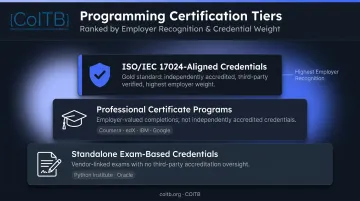
That third category carries the most weight with employers. ISO/IEC 17024 alignment signals that the credential is built on a structured, auditable process — not just a brand name. ANAB describes ISO/IEC 17024 accreditation as a competence-based standard that demonstrates fairness, validity, and integrity of personnel certification programs.
Top Programming Certifications to Boost Your Career
The certifications below were selected based on employer recognition, career track breadth, and accessibility across experience levels — from beginner to intermediate. Each one maps to real hiring demand.
Python Institute Certifications (PCEP and PCAP)
The Python Institute offers a tiered credential path. The PCEP (Certified Entry-Level Python Programmer) targets absolute beginners; the PCAP (Certified Associate in Python Programming) validates intermediate skills including OOP and module handling.
According to JetBrains' State of Developer Ecosystem 2024, 57% of developers used Python in the last 12 months, and RedMonk's January 2025 rankings place Python second among all programming languages globally.
PCEP requires no prerequisites, making it accessible to self-taught learners and bootcamp graduates. PCAP builds on that foundation with the intermediate skills employers actually need in data science, automation, and backend roles.
| Detail | PCEP | PCAP |
|---|---|---|
| Exam Cost | From $69 | From $295 |
| Experience Required | None | 6–12 months recommended |
| Expiration | Lifetime validity (current version) | Lifetime validity (current version) |
AWS Certified Developer – Associate
Issued by Amazon Web Services, this credential validates a developer's ability to build, deploy, and debug cloud-native applications on AWS — covering Lambda, DynamoDB, S3, and CI/CD workflows.
AWS holds the largest share of the global cloud infrastructure market. Synergy Research Group reported that in Q3 2025, AWS held 29% of worldwide cloud infrastructure market share — the largest of any single provider. It appears in a high share of cloud developer job postings across industries.
| Detail | AWS Certified Developer – Associate |
|---|---|
| Exam Cost | $150 USD |
| Experience Required | 1+ year hands-on AWS experience recommended; no formal prerequisite |
| Exam Format | 65 questions, 130 minutes; online or test center |
| Validity | 3 years |
Oracle Certified Professional: Java SE Programmer
Oracle's Java SE certification validates deep knowledge of the Java platform — core language features, OOP, generics, collections, and the Streams API. The current versions target Java SE 17 (exam 1Z0-829) or SE 21 (exam 1Z0-830).
Java remains a dominant force in enterprise environments. JetBrains' 2024 survey found 46% of developers used Java in the last 12 months, with RedMonk ranking it third globally as of January 2025. It powers financial systems, e-commerce platforms, and the entire Android ecosystem.
| Detail | Oracle Certified Professional: Java SE |
|---|---|
| Exam Cost | Contact Oracle Education for current pricing |
| Experience Required | Strong hands-on Java SE experience; no minimum years specified |
| Exam Format | 50 questions (SE 17), 90 minutes, 68% passing score |
| Expiration | Oracle's official expiration policy for Java SE credentials is not explicitly published; verify directly with Oracle before assuming permanence |
Microsoft Azure Certifications (AZ-900 and AZ-204)
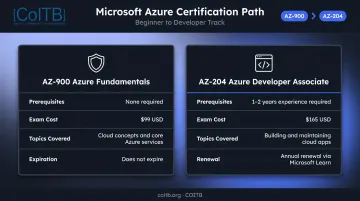
Microsoft offers a clear two-tier path into Azure development. The AZ-900 (Azure Fundamentals) covers cloud concepts and core Azure services with no prerequisites. The AZ-204 (Azure Developer Associate) targets developers building and maintaining cloud applications on Azure, requiring 1–2 years of development experience.
Azure holds 20% of the global cloud infrastructure market (Synergy Research Group, Q3 2025) and dominates enterprise environments built on the Microsoft stack. That makes Azure credentials particularly valuable for developers working in .NET environments or large organizations already invested in Microsoft tooling.
| Detail | AZ-900 | AZ-204 |
|---|---|---|
| Exam Cost | $99 USD | $165 USD |
| Best For | Beginners moving toward cloud or DevOps | Developers building on Azure or .NET |
| Expiration | Does not expire (fundamentals) | Expires annually; free renewal via Microsoft Learn |
COITB Certifications in Application Development and AI
COITB is a non-profit credentialing body whose certifications are aligned to ISO/IEC 17024 standards — the same international benchmark that governs how personnel certification programs are developed, audited, and maintained.
Most cloud and enterprise certifications assume significant prior experience. COITB certifications are purpose-built for candidates with 0–6 months of technology experience. That makes them a practical first step for career changers, bootcamp graduates, veterans, and self-taught developers who need a third-party credential to verify what they know.
Credentials available:
| Certification | Technologies Covered | Exam Format |
|---|---|---|
| ReactJS Framework Developer | JSX, Hooks, React Router, API integration, state management | 90 questions, 90 min, 73% passing |
| HTML-CSS Web Designer | HTML5, CSS3, Flexbox, Grid, responsive design, accessibility | 90 questions, 90 min, 75% passing |
| JavaScript Professional Developer | ES6+, DOM, async/await, Fetch API, REST | 90 questions, 90 min, 73% passing |
| Professional Python Developer | Python 3 OOP, file I/O, decorators, generators | 58 questions, 75 min, 70% passing |
| MySQL Backend Developer | Schema design, SQL querying, CTEs, stored procedures | 90 questions, 90 min, 70% passing |
| Certified GPT Professional | Prompt engineering, OpenAI API, AI architecture, responsible AI | 60 questions, 75 min, 71% passing |
| Technical Sales Specialist | SaaS economics, solution positioning, technical objection handling | 60 questions, 75 min, 70% passing |
All exams are available via remote online proctoring (webcam and stable internet required; military CAC and VA-issued ID accepted) or at authorized in-person test centers. Digital badges are issued on passing and can be verified directly via LinkedIn or employer portals. Certifications are subject to renewal per COITB's Recertification Requirement Policy — visit coitb.org for current terms.
How to Choose the Right Programming Certification
Start With Your Target Job Descriptions
The most common mistake candidates make is picking a certification based on brand recognition rather than what employers in their target roles are actually requesting. Pull up 10–15 job postings for your desired role and note which certifications or technologies appear repeatedly. That list should drive your decision, not a ranking article.
Factor in Your Experience Level
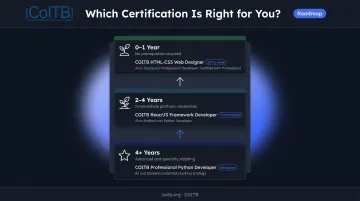
Your experience level narrows the field considerably:
- 0–1 year of experience: Prioritize certifications with no prerequisites and clear learning paths. Entry-level credentials with no prior experience requirements are the right starting point. COITB's application development and AI certifications — including HTML-CSS Web Designer, JavaScript Professional Developer, and Certified GPT Professional — are designed specifically for early-stage candidates.
- 2–4 years of experience: Intermediate credentials that validate hands-on platform experience make sense here. Look for exams that assume real project work, not just conceptual familiarity. COITB's ReactJS Framework Developer and Professional Python Developer certifications fit candidates who've been building in those languages.
- 4+ years of experience: Specialty and advanced credentials offer the most differentiation at senior levels. Stacking a recognized AI or backend credential on top of existing technical experience signals depth, not just familiarity.
Evaluate Credential Standards and Renewal Terms
Check these two factors before committing:
- Is it aligned to a recognized standard? A certification aligned to ISO/IEC 17024 carries more verifiable weight with employers than a course completion badge. That structured, auditable process is what makes the credential trustworthy to hiring managers.
- What are the renewal requirements? Renewal cycles vary widely — some credentials update every 2–3 years, others annually. Know the ongoing commitment before you invest time and money.
With these filters in place — job-market demand, your experience level, and credential quality — you can narrow dozens of options down to the two or three worth serious consideration.
Conclusion
A competitive job market rewards candidates who can prove their skills, not just describe them. The right certification — chosen based on your target role, current experience, and the recognition standards behind it — is one of the clearest signals you can send to a hiring manager.
Treat this as a career investment with a specific return in mind: not the most popular credential, but the one that matches the jobs you're actually applying for.
If that describes where you are — entering the field or switching careers — COITB's ISO/IEC 17024-aligned certifications in application development and AI offer a structured path forward. No prior credentials required, flexible remote testing, and coverage across React, Python, JavaScript, MySQL, and GPT. Contact support@coitb.org to learn more.
Frequently Asked Questions
Which programming certification is best?
There's no single best certification — the right choice depends entirely on your target role. Python and cloud credentials (AWS, Azure) consistently rank among the most employer-recognized for development roles, while COITB's entry-level certifications — including ReactJS, HTML-CSS, JavaScript, Python, and GPT — are strong starting points for those entering the field with little prior experience.
Is a programming certification worth it?
Chosen strategically, yes. Certifications differentiate candidates in competitive applicant pools, give employers a verified signal of skill, and support salary negotiations. Credentials aligned to recognized standards like ISO/IEC 17024 carry the strongest employer credibility.
Which programming certifications can lead to a $100K salary?
Cloud and enterprise credentials such as AWS, Azure, and advanced Java are frequently associated with high-paying roles. The U.S. Bureau of Labor Statistics reports a median annual wage of $133,080 for software developers as of May 2024. Note that certifications support salary outcomes alongside experience, not as a standalone guarantee.
How long does it take to get a programming certification?
It varies by credential. Entry-level options like PCEP or AZ-900 typically require 4–8 weeks of self-study. Associate-level cloud credentials like the AWS Certified Developer generally require 2–4 months, depending on how much hands-on AWS experience you already have.
Can I get a programming certification with no experience?
Yes. Several certifications are designed specifically for beginners — including the Python Institute's PCEP and COITB's full catalog of application development and AI certifications, designed for candidates with no prior credentials or experience.
Do programming certifications expire?
Most cloud and security certifications expire every 2–3 years to keep pace with platform changes — Azure role-based credentials renew annually via a free online assessment. Some language-specific credentials, like Python Institute's current PCEP and PCAP versions, carry lifetime validity. Check the renewal terms before choosing a certification.