Introduction
Python isn't just popular—it's dominant. According to the 2025 Stack Overflow Developer Survey, 57.9% of all respondents use Python, with the language climbing 7 percentage points from the prior year. For anyone considering a career in tech, that demand creates an obvious follow-up question: does getting a Python certification actually move the needle?
The honest answer is more nuanced than most blog posts admit. Certifications cost real money and study time, and the internet serves up contradictory opinions—some developers swear by them, others call them worthless. This guide gives you a straight answer.
Below: a conditional verdict on certification value, what employers actually look for, how credential tiers compare, and how to pick the right exam for your career stage.
Key Takeaways
- Python certifications add real value for beginners, career changers, and anyone without a CS degree—less so for developers with strong portfolios
- The strongest candidates pair a recognized credential with hands-on project work
- Credential source matters: proctored exams outweigh course completion certificates
- Entry-level certifications are low-risk investments; professional-tier exams require serious preparation
- Most employers view certifications as a positive signal, not a hiring requirement
Are Python Certifications Worth It?
The honest verdict: yes, but conditionally.
A Python certification's value depends on where you are in your career, what role you're targeting, and whether you back it up with real skills. A credential alone won't get you hired. But for the right candidate, it can be the difference between a résumé that gets opened and one that doesn't.
Who Benefits Most
Career changers and beginners get the clearest return. Without a CS degree or verifiable employment history in tech, a recognized certification serves as a credible proxy for skill. It tells a hiring manager you covered the fundamentals in a structured, measurable way—not just that you watched a few YouTube videos.
Working developers with strong portfolios see the least benefit. If you have GitHub projects, real deployment experience, or several years of hands-on Python work, a certification adds a résumé line but rarely changes hiring outcomes on its own.
The Salary Reality
Salary is where most candidates want to see the payoff — and the data is encouraging, even if certifications aren't the direct driver. Glassdoor reports an average of $129,969 for Python developers, while the Bureau of Labor Statistics puts the median for software developers at $133,080. No study isolates a salary premium from a Python certification specifically — pay tracks demonstrated skill, not the credential alone.
The Real ROI of a Python Certification
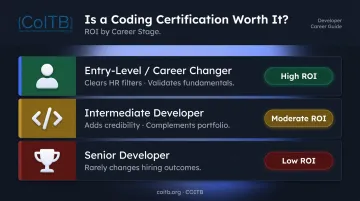
ROI breaks down differently depending on your situation:
| Career Stage | ROI Level | Why |
|---|---|---|
| Entry-level / career changer | High | Clears HR filters, validates fundamentals for candidates with limited track record |
| Intermediate developer | Moderate | Adds credibility when paired with portfolio work |
| Senior developer | Low | Rarely changes hiring outcomes unless the role explicitly requires it |
Certifications also carry value that doesn't show up in a salary comparison. Structured learning paths force you to fill knowledge gaps, and preparing for a proctored exam sharpens understanding differently than self-directed study. If you're entry-level or making a career change, that structured accountability is often exactly what a hiring manager needs to see.
Python Certification Levels at a Glance
Not all Python credentials are created equal. The two ecosystems most candidates encounter are the Python Institute's multi-tier ladder and independent credentialing bodies.
Python Institute Credentials
| Certification | Level | Focus Areas | Starting Price |
|---|---|---|---|
| PCEP | Entry | Syntax, data types, control flow, basic I/O | From $69 |
| PCAP | Associate | OOP, modules, error handling, file processing, generators | From $295 |
| PCPP1 | Professional Level 1 | Advanced OOP, GUI programming, network programming, file processing | From $325 |
| PCPP2 | Professional Level 2 | Advanced topics; builds on PCPP1 | From $295 |
PCAP is the most widely recognized intermediate credential in this ladder. PCPP1 targets developers who want to validate advanced Python knowledge—but it's a serious commitment in both prep time and cost.
Alternative Credentialing Bodies
Beyond the Python Institute, non-profit credentialing organizations offer alternative pathways. COITB's Professional Python Developer certification is one example—designed for candidates with 0–6 months of hands-on experience and aligned to ISO/IEC 17024 standards, which govern how certification bodies develop and administer exams.
The exam covers a practical range of competencies:
- Python 3 syntax and data structures
- OOP (classes, inheritance, encapsulation, polymorphism, magic methods)
- File I/O and API interaction
- Exception handling, decorators, and generators
- Modules, packages, and virtual environments
- PEP 8 best practices
The format is 58 multiple-choice and scenario-based items in 75 minutes, with a 70% passing threshold. It's available via online remote proctoring or at authorized test centers, making it accessible for candidates in rural areas, veterans, and anyone without easy access to a physical testing location.
A note on matching level to readiness: attempting a professional-tier exam without solid foundational knowledge wastes money and momentum. Start where you actually are.
What Employers Actually Look For
Most job postings don't list Python certifications as a hard requirement. That's not a knock against certifications—it reflects how hiring actually works.
What employers prioritize, according to hiring leaders interviewed by InfoWorld, is demonstrable ability:
- Kevin Miller, CTO at IFS: proof of delivery and problem-solving matters more than exam results
- Morgan Watts, VP of IT at 8x8: aptitude and what candidates have built outweighs a list of certifications
- Greg Fuller, VP at Codecademy: certifications validate foundational skills for entry-level candidates; employers still seek understanding of the full software lifecycle

This doesn't mean certifications are irrelevant. They function differently than most candidates expect.
Where Certifications Actually Help
Applicant Tracking Systems (ATS) are the first filter most résumés face. ATS software extracts fields including skills, certifications, education, and experience before a human ever reviews the application. For candidates with limited experience, a recognized certification can be the keyword that gets a résumé flagged for review.
Not all credentials carry the same weight at this stage. A proctored exam from a credentialing body aligned to recognized standards (such as ISO/IEC 17024) carries more weight than an unverified course completion badge. HR screeners treat structured exams with published syllabi as legitimate signals; a course badge rarely gets the same consideration.
Certification vs. Portfolio: Do You Need Both?
The strongest candidates pair both. A recognized certification proves structured knowledge; a portfolio proves application.
Practical Python projects that complement a certification:
- A web automation script (Selenium or Playwright)
- A data analysis dashboard (Pandas + Matplotlib or Streamlit)
- A REST API built with Flask or FastAPI
- A file-processing automation tool that solves a real business problem
Neither the cert nor the portfolio is sufficient alone for most roles. Together, they cover both the résumé screening stage and the technical interview.
How to Choose the Right Python Certification
Step 1: Align to Your Target Role
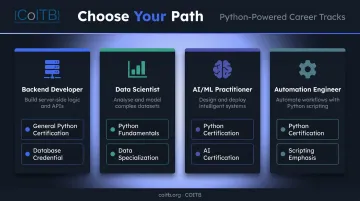
Different roles need different credentials:
- Backend developer → General Python cert + MySQL/database credential
- Data scientist → Python fundamentals, then data-focused credentials or specializations
- AI/ML practitioner → Python credential stacked with AI-focused certification (such as COITB's Certified GPT Professional)
- Automation engineer → Python cert emphasizing scripting and system interaction
Start with the role, then find the credential that supports it.
Step 2: Evaluate the Credentialing Body
Look for:
- Proctored, externally validated exams — not just course completion certificates
- Published exam syllabi you can study against
- Standards alignment, such as ISO/IEC 17024, which governs consistent, auditable certification of persons
- Verifiable digital badges that employers can independently confirm
COITB's Python certification meets these criteria. Its ISO/IEC 17024-aligned governance framework covers documented internal audit policies, candidate ID verification, defined cut scores, and digital badges verifiable on LinkedIn, résumés, and employer portals.
Veterans may find it eligible for GI Bill, VET TEC, MyCAA, or VR&E funding. Verify current approval status with your VA Education Benefits counselor before registering.
Step 3: Apply the Decision Framework
| Your Situation | Recommended Path |
|---|---|
| Beginner with no Python background | Start with entry-level cert; build projects simultaneously |
| Career changer with some coding exposure | Target an associate-level cert from a credible body |
| Working developer wanting advancement | Confirm whether your target role values a cert before committing |
Entry-level exams ($59–$70) are low-risk for beginners. Associate and professional exams require more financial commitment and study hours — factor in prep materials, potential retakes, and opportunity cost before registering for a professional-tier exam.
Frequently Asked Questions
Is it worth getting a Python professional certification?
It depends on your career stage. Professional-level certs like PCPP1 add value for developers in specialized roles who need to validate advanced knowledge. For most people earlier in their career, a strong portfolio carries more weight—unless the specific role requires it.
Which Python professional certification is best?
PCAP from the Python Institute is the most widely recognized intermediate credential. If you want a single credential with clear employer signal, look for ISO/IEC 17024-aligned bodies—COITB's Professional Python Developer certification follows that standard and is built for candidates ready to demonstrate job-ready skills.
How much does PCPP1 cost?
The PCPP1 exam starts at approximately $325, though fees change—verify current pricing at pythoninstitute.org before registering. Budget for study materials and potential retake costs as well.
Is PCPP1 hard?
PCPP1 is rigorous, covering advanced OOP, GUI development, network programming, and file processing. PCAP is recommended (though not formally required) before attempting it. The Python Institute's aligned study series estimates approximately 115 hours of preparation.
Do employers care about Python certifications?
Most employers view certifications as a positive signal rather than a decisive factor. They're most useful for clearing initial resume filters and demonstrating structured learning. Hiring decisions hinge on demonstrated ability through portfolios and technical interviews.
Can I get a Python job without a degree if I have a certification?
Many employers hire based on demonstrable skills, particularly for entry-level and junior roles. A recognized certification paired with a portfolio of real Python projects can effectively substitute for a CS degree—covering both the resume screening stage and the technical validation stage of hiring.