Introduction
Python now powers everything from web backends to AI pipelines — and its reach keeps expanding. According to the 2025 Stack Overflow Developer Survey, 57.9% of developers use Python, a jump of 7 percentage points from 2024. That kind of adoption creates real competition for Python-related roles.
When thousands of candidates claim Python skills, hiring managers need a reliable way to identify who can actually perform. Certification provides that signal. The issuing body's credibility, exam format, and alignment to real-world tasks all determine whether a credential moves you forward in a hiring process or gets ignored.
This guide breaks down the top Python certification exams across beginner, associate, and professional levels, covering the Python Institute's structured track and ISO/IEC 17024-aligned alternatives. Use it to identify the credential that matches your current experience and your next career target.
Key Takeaways
- PCEP is the entry point into the Python Institute track — no prerequisites, ~$69, tests fundamentals
- PCAP covers OOP and modules at associate level (~$295); PCPP1 and PCPP2 push into professional territory
- COITB's Professional Python Developer is ISO/IEC 17024-aligned, requires no prior credentials, and fits the 0–6 month experience range
- Pair any credential with a portfolio of practical projects to make it count with employers
- Your career goal (general dev, AI, backend, data) should drive which exam you sit first
What Is a Python Certification and Why Does It Matter?
A Python certification is a formal credential that validates your ability to write, understand, and apply Python code — earned by passing a structured, independently scored exam. That distinguishes it from a course completion certificate, which confirms you finished the content, not that you can actually apply it.
For hiring managers, certifications provide a standardized benchmark that's hard to fake. This matters most for candidates without traditional CS degrees: self-taught developers, bootcamp graduates, and career changers competing against candidates with four-year credentials.
Python opens doors across multiple job categories:
- Software developer and backend engineer
- Data analyst and data engineer
- AI/ML practitioner and automation specialist
- Technical project manager adding coding skills to existing PM credentials
Understanding which credential fits your goals matters before you register for anything. Options range from language-focused exams (such as those from the Python Institute) to role-based assessments and credentials aligned to standards like ISO/IEC 17024. Your starting point — background, experience level, and target role — should drive which path you take.
Top Python Certification Exams You Need to Know
The certifications below are recognized across the tech industry and span entry to expert level, covering both general Python programming and specialized tracks.
PCEP – Certified Entry-Level Python Programmer
Offered by the OpenEDG Python Institute, PCEP is the official starting point in their certification path. It has no formal prerequisites, making it one of the most accessible Python credentials available. Absolute beginners can sit this exam without any prior programming background.
PCEP validates foundational programming concepts: data types, control flow, loops, functions, and basic Python syntax. It's valuable for aspiring developers, project managers beginning a tech pivot, and anyone who needs documented proof of Python literacy before moving up the Python Institute ladder.
| Detail | Specification |
|---|---|
| Exam Format | 30 questions (MCQ, drag-and-drop, gap-fill, sorting); 40 min + 5 min NDA |
| Passing Score | 70% |
| Cost | From $69 (verify at pythoninstitute.org) |
| Key Skills | Python syntax, data types, operators, control flow, functions, basic I/O |
Note: PCEP-30-02 is scheduled for retirement on August 31, 2026. Check the Python Institute website for the current active version.
PCAP – Certified Associate in Python Programming
PCAP builds directly on PCEP-level concepts. No formal prerequisite exists, but foundational Python knowledge is strongly recommended (PCEP is the recommended prior step). This is the associate-level credential for developers ready to move past syntax drills.
Coverage includes object-oriented programming, modules and packages, file handling, exception management, list comprehensions, lambdas, and closures. These are the building blocks of production Python code — the kind of skills hiring managers look for when reviewing junior developer candidates.
| Detail | Specification |
|---|---|
| Exam Format | 40 questions (MCQ, scenario-based); 65 min + 10 min NDA |
| Passing Score | 70% |
| Cost | From $295 (verify at pythoninstitute.org) |
| Key Skills | OOP principles, modules, packages, string operations, exception handling, file I/O |
PCPP1 – Certified Professional in Python Programming 1
PCPP1 targets working developers and IT specialists moving into advanced Python applications. PCAP is recommended (not formally required) before sitting this exam. The official audience includes junior and middle-level software developers, network programmers, data analysts, and testers.
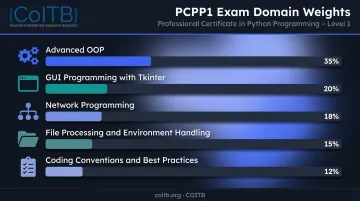
The exam spans five domains:
- Advanced OOP — 35% of exam weight
- Coding conventions and best practices — 12% (PEP 1, 8, 20, 257, 484)
- GUI programming with Tkinter — 20%
- Network programming — 18% (REST, sockets, requests)
- File processing and environment handling — 15% (CSV, logging, sqlite3)
| Detail | Specification |
|---|---|
| Exam Format | 45 questions; 65 min + 10 min NDA |
| Passing Score | 70% |
| Cost | From $325 (verify at pythoninstitute.org) |
| Recommended Prior | PCAP (not formally required) |
PCPP2 – Certified Professional in Python Programming 2
PCPP2 is the most advanced tier in the Python Institute's general programming track. Both PCAP and PCPP1 are recommended beforehand, though neither is a formal prerequisite. PCPP2 is currently listed as in development on the Python Institute's site; confirm availability before registering.
Domains include design patterns, interprocess communication, threading and multiprocessing, SQL and NoSQL database access, and testing with unittest and pytest.
| Detail | Specification |
|---|---|
| Exam Format | 45 questions; 65 min + 10 min NDA |
| Passing Score | 70% |
| Cost | From $295 (verify at pythoninstitute.org; status: in development) |
| Key Skills | Design patterns, multithreading, database access, advanced testing |
COITB Professional Python Developer Certification
COITB (College of IT and Business) is a non-profit credentialing body whose Python certification is ISO/IEC 17024-aligned — the international standard for personnel certification bodies. That alignment reflects a formal governance framework: internal audits benchmarked to ISO/IEC 17024, psychometric management review, advisory board oversight, and structured appeal and complaint processes.
One distinction to understand: ISO/IEC 17024-alignment describes the governance structure COITB operates under. External ANAB accreditation is a separate designation requiring independent third-party verification of the certification body's competence.
Who it's designed for:
- Beginners and aspiring developers with 0–6 months of Python practice
- Career changers, bootcamp graduates, and self-taught developers
- Veterans and transitioning service members (GI Bill, VET TEC, MyCAA, and VR&E funding may apply — verify eligibility with your VA Education Benefits counselor before registering)
- Project managers stacking technical credentials onto existing PMP or PSM credentials
Knowledge domains tested:
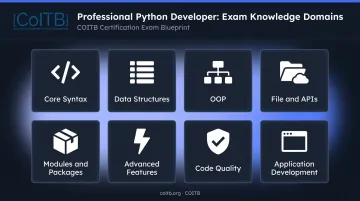
- Core Python syntax, data types, operators, and control flow
- Data structures: lists, dictionaries, strings, comprehensions, generators
- Object-oriented programming: classes, inheritance, encapsulation, polymorphism, dunder methods
- File handling, APIs, and JSON processing
- Modules, packages, virtual environments, pip, and standard library
- Advanced features: decorators, exception handling, generators
- Code quality: PEP 8 style, debugging, clean code practices
- Application development and automation scripting
| Detail | Specification |
|---|---|
| Exam Format | 58 items (MCQ and scenario-based) |
| Time Allowed | 75 minutes |
| Passing Score | 70% or higher |
| Delivery | Online remote proctored or authorized in-person test center |
| Prerequisites | None — open to candidates with 0–6 months experience |
| Digital Badge | Included at no extra cost; shareable on LinkedIn and résumé |
A free practice assessment is available at coitb.org/assessment to gauge readiness before registering.
What to Look For When Choosing a Python Certification
Match the credential to your current level
Jumping straight to a professional-level exam before building solid foundational knowledge is a common mistake. Exam fees at the professional tier run $295–$325, and failing without adequate preparation wastes both money and time.
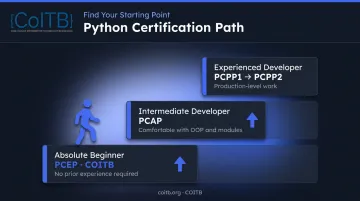
A practical starting framework:
- Absolute beginner (no prior Python): PCEP or COITB's Professional Python Developer — neither requires prior experience, making both solid starting points
- Intermediate developer (comfortable with OOP and modules): PCAP
- Experienced developer targeting production-level work: PCPP1, then PCPP2
Evaluate the issuing body's credibility
Once you've matched your level, the next question is whether the credential will carry weight with employers. Look for:
- A published syllabus with defined passing standards
- Proctored, independent assessment (not self-graded)
- Documented psychometric development process
- A clear upgrade or renewal path
- External alignment or accreditation — and understand the difference between an issuer claiming alignment versus independent third-party verification
Factor in total cost and time
| Tier | Cost Range | Best For |
|---|---|---|
| Entry-level (PCEP, COITB) | $59–$69 | Newcomers; strong ROI with limited investment |
| Associate (PCAP) | ~$295 | Developers with foundational Python ready to go deeper |
| Professional (PCPP1, PCPP2) | $295–$325 | Experienced developers building production systems |
Preparation time also matters. PCEP is approachable in 4–8 weeks of focused study. PCPP1 and PCPP2 require months of hands-on development experience, not just dedicated exam prep.
Conclusion
The right Python credential depends on your skill level, your target role, and what signal you need to send to employers — whether that's a structured progression exam or an ISO/IEC 17024-aligned credential built for flexible, accessible validation.
What makes any certification count is what sits behind it: a portfolio of projects showing you can apply what you've validated on paper. That combination — credential plus demonstrated work — is what moves résumés off the pile.
If you're at the beginning of your Python journey — or returning to it after a career in another field — COITB's Professional Python Developer certification offers a no-prerequisites entry point with remote proctoring that fits your schedule. Start with a free practice assessment at coitb.org/assessment.
Frequently Asked Questions
Which certification is best for Python?
The best fit depends on where you are. PCEP suits absolute beginners with no prior credentials; PCAP is the right step for intermediate developers comfortable with OOP and modules. COITB's Professional Python Developer is a strong option for candidates who want an accessible, ISO/IEC 17024-aligned credential without formal prerequisites.
How difficult is the Python certification exam?
Difficulty scales with level — PCEP is approachable for most beginners with 4–8 weeks of focused study, while PCPP1 and PCPP2 demand substantial hands-on experience beyond study time alone. All Python Institute exams require a 70% passing score, as does COITB's exam.
Are there formal exams for Python certification?
Yes. Multiple organizations administer structured Python certification exams — including the Python Institute (PCEP, PCAP, PCPP1, PCPP2) and ISO/IEC 17024-aligned bodies like COITB — each with defined question counts, time limits, and passing score thresholds.
How much does a Python certification cost?
Entry-level exams start around $69, PCAP runs approximately $295, and PCPP1 starts at $325. COITB's pricing is available by contacting support@coitb.org directly. Veteran funding programs (GI Bill, VET TEC, VR&E) may offset costs — verify eligibility before registering.
Do Python certifications expire?
Some credentials require renewal; others don't. COITB's Recertification Requirement Policy includes renewal cycles and continuing education requirements — review it at coitb.org/certification-resources/recertification-requirement-policy. Check each issuing body's policy before committing.
Can a Python certification help me get a job?
Pearson VUE's 2026 employer survey found 48% of IT employers use certification as a hiring prerequisite. Certifications improve resume visibility, especially for candidates without CS degrees — but they're most effective when combined with a portfolio of practical Python projects showing what you can build.