Introduction
The U.S. software development field is growing faster than almost any other occupation. According to the Bureau of Labor Statistics, software developer employment is projected to grow 16% from 2024 to 2034 — adding roughly 267,700 jobs. That's a field already supporting 1.69 million employed developers, expanding at more than double the average for all occupations.
In a market this competitive, a résumé built on self-taught skills or bootcamp experience isn't always enough on its own. Certifications bridge that gap — giving employers a third-party, verifiable signal that a candidate has been assessed against a defined standard, not simply self-declared competent on an application.
They matter across a wide range of career situations — including:
- Career changers moving from finance, sales, or operations into tech
- Veterans and military spouses translating service experience into civilian IT roles
- Bootcamp graduates and self-taught developers who want a third-party credential to validate what they've already built
- Project managers stacking technical credentials to move into engineering or technical program management
This guide breaks down what software engineering certifications are, which providers are worth your time at each experience level, and how to match the right credential to your specific career goal.
Key Takeaways
- Software engineering certifications validate specific technical skills and are recognized by employers during hiring
- Options exist at every level — from entry credentials for bootcamp grads to advanced certs for senior engineers
- Top providers range from non-profit credentialing bodies like COITB to cloud platform vendors and professional associations — each covering different skill domains
- Match your certification to your experience level, target role, and the technologies listed in job postings
- Exam costs vary widely across providers; factor in study materials and renewal fees when calculating your total investment
What Are Software Engineering Certifications and Why Do They Matter?
A software engineering certification is a credential awarded by a recognized credentialing body that confirms competency in a specific technology, framework, or area of software development.
The distinction from a college degree matters. A CS degree demonstrates broad foundational knowledge — algorithms, systems theory, the full academic stack. A certification is narrower and more applied: proof that *this developer builds React applications* or understands how to secure software across the SDLC. Both have value, but they answer different questions for employers.
Why Employers Pay Attention
Skillsoft's 2024 survey of more than 5,100 IT professionals and decision-makers found that 97% of decision-makers believed certified employees add value — and more than one-third estimated that contribution at $25,000 or more in annual added value. Employers also reported that certified staff help close skills gaps (49%), resolve issues more efficiently (49%), and increase productivity (48%).
The survey covers IT broadly, not software engineering alone — but the signal is consistent: credentials move the needle in hiring conversations.
Who Benefits Most
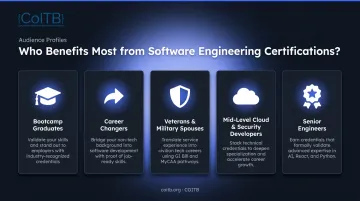
Certifications carry the most weight for:
- Bootcamp graduates and self-taught developers without a CS degree
- Career changers entering tech from non-technical backgrounds
- Veterans and military spouses building portable civilian tech credentials
- Mid-level developers specializing in cloud, security, or AI
- Senior engineers seeking vendor-neutral validation of domain expertise
Best Software Engineering Certifications and Providers
The following certifications were selected based on employer recognition, skills relevance, accessibility across experience levels, and credentialing body credibility — spanning entry-level through advanced specializations.
COITB (Council of Information Technology Businesses)
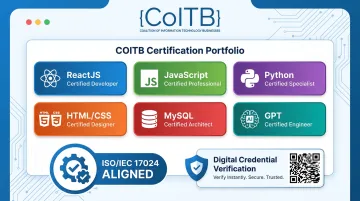
COITB is a non-profit credentialing body offering ISO/IEC 17024-aligned certifications in application development and AI. Seven credentials cover technologies actively in demand across U.S. tech hiring: HTML, CSS, JavaScript, React, Python, MySQL, GPT, and technical sales.
COITB's model targets an audience most advanced certifications overlook. While other credentials assume years of professional experience, COITB explicitly serves candidates with 0–6 months of hands-on practice — bootcamp graduates, self-taught developers, career changers, veterans using GI Bill or VET TEC funding, and military spouses.
The ReactJS Framework Developer certification, for example, requires 1–6 months of HTML/CSS/JavaScript exposure — not a formal job title.
Exams are delivered remotely proctored (available 24/7, with military CAC and VA-issued IDs accepted) or in person at authorized test centers. No formal prerequisites block registration. Passing candidates receive a digital badge usable on LinkedIn, résumés, and employer application portals for one-click verification.
The ISO/IEC 17024 alignment means COITB operates under a documented governance framework — with formal appeal rights, defined recertification cycles, candidate data protections, and Certification IDs that support employer verification. That's the difference between a verified credential and a certificate of completion: employers can independently confirm the credential exists.
| Details | |
|---|---|
| Credentials Offered | ReactJS Framework Developer, HTML-CSS Web Designer, JavaScript Professional Developer, Professional Python Developer, MySQL Backend Developer, Certified GPT Professional, Technical Sales Specialist |
| Exam Format | 58–90 questions; 75–90 minutes; multiple-choice and scenario-based; 70–75% passing threshold |
| Key Features | ISO/IEC 17024 aligned; covers web development, AI/GPT, application development; remote proctored; open to all experience levels |
| Best For | Bootcamp graduates, self-taught developers, career changers, veterans, military spouses entering tech |
AWS Certified Developer – Associate
The AWS Certified Developer – Associate (DVA-C02) is one of the most employer-recognized cloud development credentials available. It validates the ability to develop, test, deploy, and debug applications built on AWS — covering core services, deployment pipelines, security, and the software development lifecycle within AWS environments.
AWS is the dominant cloud infrastructure provider globally, which makes this credential directly relevant for developers targeting cloud-native roles at enterprise companies. No formal prerequisites are required, though AWS recommends at least one year of hands-on AWS development experience before attempting the exam.
Skillsoft's 2025 IT Skills and Salary survey reported a $125,879 global average salary for AWS Certified Developer – Associate holders. That's a holder average across experience levels and geographies, not a controlled certification premium — but it reflects the salary tier where certified cloud developers operate.
| Details | |
|---|---|
| Key Features | Covers core AWS services, application deployment, security, debugging, and software lifecycle management; no formal prerequisites |
| Exam Details | 130 minutes; 65 questions; $150 exam fee; valid for 3 years |
| Best For | Developers targeting cloud-based roles; engineers building or maintaining applications on AWS infrastructure |
Microsoft Certified: Azure Developer Associate
The Azure Developer Associate (AZ-204) validates proficiency in designing, building, testing, and maintaining cloud applications on Microsoft Azure — particularly valuable in enterprise environments where Microsoft technologies dominate the stack.
No formal prerequisites are required to sit AZ-204, though Microsoft recommends at least two years of programming experience. The credential serves as a recognized pathway toward the Microsoft Certified: DevOps Engineer Expert when combined with passing AZ-400.
One important flag: AZ-204 and its associated renewal assessments are scheduled to retire on July 31, 2026. Candidates considering this certification should factor that timeline into their decision — either completing it well before retirement or monitoring Microsoft's replacement credential announcements.
| Details | |
|---|---|
| Key Features | Covers Azure services, cloud app design, authentication, deployment pipelines, and monitoring; pathway to DevOps Engineer Expert |
| Exam Details | ~100 minutes; $165 exam fee; annual renewal required; retires July 31, 2026 |
| Best For | Mid-level developers in Microsoft ecosystems; enterprise application developers; professionals targeting cloud DevOps pathways |
(ISC)² CSSLP – Certified Secure Software Lifecycle Professional
The CSSLP from ISC² addresses a gap that most other certifications ignore: software security across every phase of development. It covers secure design, authentication, authorization, software testing, risk management, and operational maintenance — not as a security afterthought, but as an integrated development discipline.
ISC²'s research found that 26% of respondents identified an application security skills gap — signaling real demand for this specialization. The CSSLP is also ANAB-accredited to ISO/IEC 17024, adding independent credentialing rigor.
This is an advanced credential. Candidates need four years of cumulative, full-time SDLC experience across one or more of the eight CSSLP domains (a relevant degree can waive up to one year). Candidates who pass but lack the experience can become an Associate of ISC² and acquire the experience within five years.
ISC²'s 2024 Cybersecurity Workforce Study reported a $147,375 North American average salary for CSSLP holders — though this is a holder average including Canada, not a US-only figure or a controlled certification premium.
| Details | |
|---|---|
| Key Features | Covers secure SDLC, authentication, software testing, risk management; ANAB-accredited to ISO/IEC 17024 |
| Exam Details | 3 hours; 125 questions; $599 exam fee; requires 4 years of SDLC experience (waiver available for degree) |
| Best For | Experienced software engineers; security-focused developers; professionals on government or regulated-industry contracts |
IEEE Computer Society – Professional Software Engineering Master (PSEM)
The PSEM is the most rigorous vendor-neutral software engineering credential on this list. It's issued by the IEEE Computer Society — the engineering standards body that defines professional software engineering practices globally — and validates advanced knowledge across software design, construction, requirements, testing, and project management.
Where the cloud and security credentials above focus on a single platform or specialty, PSEM validates software engineering as a full discipline. IEEE's recommended guidelines are four years of college-level CS education and four years of relevant professional experience — though these are guidelines, not hard registration requirements.
The exam is 3 hours, 160 questions, delivered fully online and remotely proctored. Pricing is $690 for IEEE members and $865 for non-members (exam-only). Credentials are valid for three years and available for recertification.
Note: While PSEM remains active, IEEE's two other software credentials — the ASD and PSD certifications — began a gradual sunset in February 2026. PSEM is the surviving credential for candidates seeking IEEE-issued software engineering validation.
| Details | |
|---|---|
| Key Features | Covers software design, requirements, testing, construction, and project management; issued by an internationally recognized engineering standards body |
| Exam Details | 3 hours; 160 questions; $690 (members) / $865 (non-members); 3-year validity |
| Best For | Senior software engineers; engineering leads; professionals seeking broad domain validation recognized across industries |
How to Choose the Right Software Engineering Certification
The right certification depends on your career stage, target role, and timeline — not brand recognition alone. Start by pulling 10–15 job descriptions for your target role and noting which credentials appear most often. That's your actual shortlist.
Four Evaluation Criteria That Matter
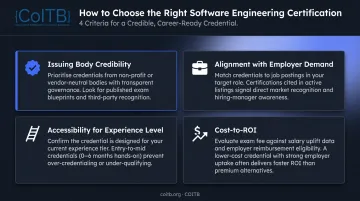
- Issuing body credibility — Is it an accredited standards body, a recognized vendor, or a credentialing organization with documented governance? Credentials from IEEE, ISC², AWS, Microsoft, and ISO/IEC 17024-aligned bodies like COITB carry verifiable credibility.
- Alignment with employer demand — Pull 10–15 job descriptions for your target role. Which credentials appear? That's your shortlist.
- Accessibility for your experience level — CSSLP and IEEE PSEM require years of experience; AWS recommends one year; COITB targets 0–6 months. Pursuing credentials you don't yet qualify for stalls progress and drains budget.
- Cost-to-ROI — Factor in exam fees, study materials, retake costs, and renewal requirements. A $599 CSSLP exam makes sense for an experienced security engineer. Entry-level credentials with lower exam fees — like COITB's application development certifications — typically deliver faster ROI for career changers and new developers.
Match Credential to Career Stage
| Career Stage | Recommended Starting Point |
|---|---|
| Entry-level / career changer | COITB (HTML-CSS, ReactJS, JavaScript, Python, GPT) |
| Mid-level cloud developer | AWS Certified Developer – Associate |
| Enterprise Azure developer | Azure Developer Associate (before July 2026) |
| Experienced security engineer | CSSLP |
| Senior software engineer (vendor-neutral) | IEEE PSEM |
Conclusion
Software engineering certifications deliver real value when matched to your experience level, career goals, and the technologies hiring managers actually want. A credential that signals cloud expertise won't help a developer chasing front-end roles, and an entry-level web development credential won't make a significant difference for a senior engineer targeting security contracts.
The practical starting point: open job postings for the role you want, look at what credentials appear, and cross-reference that against where you are today. Then pick the certification that closes the gap most directly.
For professionals starting out or formalizing skills in web development, AI, and application development, COITB offers ISO/IEC 17024-aligned certifications built around real-world skills validation. Key features:
- Remote proctored exams with flexible scheduling
- No experience barriers to registration
- Digital badges verifiable by employers on LinkedIn and application portals
- Credentials spanning HTML/CSS, JavaScript, React, Python, MySQL, and GPT/AI
Visit coitb.org or contact support@coitb.org to learn more.
Frequently Asked Questions
What is the best certification program for software engineers?
The best certification depends on your career stage and specialization. Cloud credentials like AWS Certified Developer and Azure Developer Associate are highly recognized for mid-level roles. For professionals starting out in web development or AI, COITB offers accessible, ISO/IEC 17024-aligned credentials with no experience prerequisites.
How long does it take to complete a software engineer certification program?
Timelines vary widely. Entry-level certifications can often be completed in weeks to a few months; cloud platform credentials like AWS and Azure typically require 3–6 months of hands-on study. Advanced credentials like the CSSLP require four years of professional SDLC experience before you're even eligible to sit the exam.
Which software engineering certifications are associated with high-earning roles?
Cloud certifications (AWS Certified Developer) and security certifications (CSSLP) are among the most closely correlated with high salaries — Skillsoft reported $125,879 globally for AWS Developer holders, while ISC²'s 2024 data showed a $147,375 North American average for CSSLP holders. These are holder averages rather than controlled certification premiums, but they signal the salary range where these credentials are competitive.
Do I need prior experience to earn a software engineering certification?
Requirements vary significantly. COITB has no formal experience prerequisites; AWS recommends (but doesn't require) one year of hands-on experience. The CSSLP requires four years of SDLC experience (with a one-year degree waiver), and the IEEE PSEM recommends four years each of education and experience — though those are guidelines, not hard gates.
Are software engineering certifications worth it for career changers?
Certifications are particularly valuable for career changers because they provide employer-recognized proof of skills instead of years of industry experience. Entry-level credentials in web development, application development, or AI are a practical starting point — they fill the credential gap that a self-taught résumé or bootcamp certificate alone can't close.
How much do software engineering certifications cost?
Exam fees range from $150 (AWS Certified Developer) to $599 (CSSLP) to $865 for non-members sitting the IEEE PSEM; COITB exam pricing is available at support@coitb.org. Factor in study materials, retake fees, and renewal costs when calculating your total investment.