According to Coursera's 2025 Micro-Credentials Impact Report, 96% of employers say micro-credentials strengthen a job application, and 87% hired at least one micro-credential holder in the past year. These are not marginal numbers — they reflect a structural shift in how employers evaluate candidates.
This guide compares the most popular micro-credential programs for business and tech professionals: Google Career Certificates, IBM Professional Certificates, CompTIA, LinkedIn Learning, and COITB. It breaks down what each offers, what it costs, and how to match the right credential to your career goals.
Key Takeaways
- 96% of employers say micro-credentials strengthen a job application — employer acceptance is no longer theoretical
- Assessment-based credentials carry more weight than course completion certificates in skills-based hiring
- Look for programs tied to specific job roles, not just broad subject areas — role alignment predicts hiring impact better than topic coverage alone
- Google, IBM, and CompTIA serve different audience needs — match the program to your target role
- ISO/IEC 17024-aligned credentials from COITB validate hands-on skills in AI, web development, and application development for entry- to mid-level tech roles
What Are Micro-Credentials and Why Do Business Professionals Need Them?
Micro-credentials are short, focused certifications that validate mastery of a specific skill or competency. Unlike a four-year degree — which signals broad educational exposure — a micro-credential is deliberately narrow. You earn it by demonstrating you can do a specific thing to a defined standard.
The OECD defines a micro-credential as proof of learning outcomes acquired after a short learning experience, assessed against transparent standards. That "assessed against transparent standards" clause is where credentials diverge significantly in quality.
Three Concepts Worth Understanding
Three terms come up repeatedly when evaluating micro-credential programs:
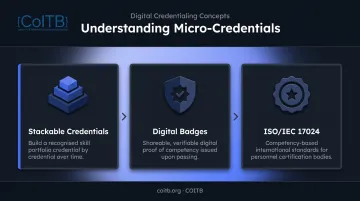
- Stackable credentials let professionals combine multiple micro-credentials over time, building toward a larger qualification or complete skill portfolio. A project manager might stack a Python credential with a GPT credential on top of an existing PMP — each addition closing a specific gap.
- Digital badges are verifiable, shareable proof of credential achievement, added to LinkedIn profiles, résumés, and employer portals. Hiring managers can verify authenticity with a single click.
- ISO/IEC 17024 is the international standard for personnel certification bodies. When a credentialing organization references this standard, it signals competency-based assessment — not just attendance tracking. That distinction matters for how seriously employers weigh the credential.
Understanding these three concepts helps explain why not all micro-credentials carry equal weight — and why the current hiring environment rewards the right ones. The market shift toward skills-based hiring makes this relevant to almost every professional. The World Economic Forum's Future of Jobs Report 2025 found that 48% of employers expect to use skills assessments or pre-employment tests to evaluate candidates' competencies. Micro-credentials that demonstrate those competencies independently are becoming a direct response to that demand.
Top Micro-Credential Programs for Business Professionals
These programs were evaluated across industry recognition, skills relevance, credential rigor, delivery flexibility, and cost. No single program is the right fit for every goal — the right credential depends on your target role and the employers you want to reach.
Google Career Certificates
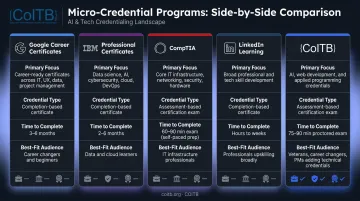
Google Career Certificates are delivered through Coursera and cover data analytics, project management, UX design, cybersecurity, and IT support. They're designed for entry-level professionals and career changers with no prior experience required.
The standout feature is Google's employer partnership network. Over 150 U.S. companies — including Deloitte, Verizon, Target, and Infosys — have committed to considering certificate graduates for entry-level roles. That direct employer connection is rare among course-based credentials, and it translates to real outcomes: over 70% of U.S. graduates reported a positive career outcome within six months of completion.
| Detail | Specifics |
|---|---|
| Focus Areas | Data analytics, IT support, project management, cybersecurity, UX design |
| Format | Fully online, self-paced via Coursera |
| Time to Complete | 3–6 months |
| Cost | ~$49/month via Coursera; financial aid available |
Best for: Career changers and entry-level candidates targeting roles at companies within Google's employer consortium.
IBM Professional Certificates
IBM Professional Certificates, available through Coursera and edX, cover data science, AI engineering, cybersecurity, cloud computing, and data analytics. They're built for professionals entering or advancing in technical roles, with individual certificates running 2–6 months.
IBM's brand authority in enterprise technology gives these credentials real weight in IT and data-focused job descriptions. Data scientists (a primary target audience for IBM certificates) command an average of $119,000 in annual earnings, with over 249,000 jobs currently in demand according to Lightcast's 2025 labor market data. IBM's certificate content tends to align closely with these roles.
| Detail | Specifics |
|---|---|
| Focus Areas | Data science, AI engineering, cybersecurity, cloud, data analytics |
| Format | Self-paced, online via Coursera or edX |
| Time to Complete | 2–6 months per certificate |
| Cost | ~$49/month (Coursera subscription) or per-course fees on edX |
Best for: Professionals targeting data science, AI, or cloud roles who want a recognizable enterprise tech brand on their résumé.
CompTIA Certifications
CompTIA is the largest vendor-neutral IT credentialing body globally, with over 3.6 million certifications awarded. Its portfolio spans IT fundamentals, networking (Network+), security (Security+), and cloud (Cloud+). The vendor-neutral angle means these credentials apply across technology ecosystems rather than locking you into a single platform.
CompTIA certifications carry particular weight in government and defense contexts. Security+ is approved for more than 20 DoD 8140.03 work roles, making it a near-requirement for cybersecurity positions in federal contracting and government IT. CompTIA states that A+ appears in more tech support job listings than any other IT credential.
| Detail | Specifics |
|---|---|
| Focus Areas | IT fundamentals, networking, security, cloud, project management |
| Format | Self-paced study; proctored exam at testing centers or online |
| Time to Complete | Weeks to months depending on certification level |
| Cost | Exam vouchers vary by certification — verify current pricing at CompTIA.org |
Best for: IT professionals targeting government, defense, or enterprise IT roles where vendor-neutral credentials are explicitly required.
LinkedIn Learning Certificates
LinkedIn Learning offers 24,000+ expert-led courses covering business, technology, and creative skills. Completion certificates integrate directly into a LinkedIn profile — which means earned credentials are immediately visible to the recruiters and hiring managers already browsing your profile.
The breadth-vs-depth trade-off is real here. LinkedIn Learning certificates confirm course completion, not demonstrated competency. They're most valuable as supplementary credentials — particularly for soft skills, management capabilities, and digital literacy — layered alongside more rigorous technical certifications.
| Detail | Specifics |
|---|---|
| Focus Areas | Leadership, communication, project management, data, digital marketing, technology |
| Format | Self-paced, video-based, online |
| Time to Complete | Hours to days per course |
| Cost | Included with LinkedIn Premium; some content available free |
Best for: Professionals building soft skills portfolios or demonstrating broad digital literacy alongside heavier technical credentials.
COITB
COITB is a non-profit credentialing body whose certification governance is designed with reference to ISO/IEC 17024 standards (the international framework for competency-based personnel certification). Its credentials cover AI, application development, and modern web technologies, targeting early-career and transitioning professionals with 0–6 months of hands-on experience.
Unlike course-based certificates, COITB exams require candidates to demonstrate actual technical competency through mixed multiple-choice and scenario-based assessments. There are no mandatory course prerequisites. Candidates qualify by passing the exam, not by completing a prescribed course.
Credentials offered:
- ReactJS Framework Developer (90 items, 90 min, 73% passing)
- HTML-CSS Web Designer (90 items, 90 min, 75% passing)
- JavaScript Professional Developer (90 items, 90 min, 73% passing)
- Professional Python Developer (58 items, 75 min, 70% passing)
- MySQL Backend Developer (90 items, 90 min, 70% passing)
- Certified GPT Professional (60 items, 75 min, 71% passing)
- Technical Sales Specialist (60 items, 75 min, 70% passing)
Exams are scheduled directly through the COITB platform, available 24/7 via remote online proctoring or at authorized test centers. Digital badges are issued on passing and can be added to LinkedIn and résumés with a one-click verification link for recruiters.
COITB also supports credential stacking for project managers. PMs holding PMP, PSM, or CSM credentials can add COITB technical credentials to close what COITB calls the "technical-credibility gap." For example, stacking Certified GPT Professional and ReactJS Framework Developer on top of a PMP targets Technical PM roles directly.
| Detail | Specifics |
|---|---|
| Focus Areas | AI/GPT, React, JavaScript, Python, MySQL, HTML/CSS, technical sales |
| Format | Mixed multiple-choice and scenario-based; remote online or test center |
| Time to Complete | Flexible; exam-based with self-scheduled appointments |
| Cost | Contact COITB for current exam pricing at coitb.org |
Best for: Bootcamp graduates, self-taught developers, career changers, veterans, and project managers who need third-party validation of hands-on technical skills.
How to Choose the Right Micro-Credential
Most professionals make one common mistake: selecting a credential based on brand recognition alone, without checking whether it's actually valued by their target employers.
What the Evaluation Should Cover
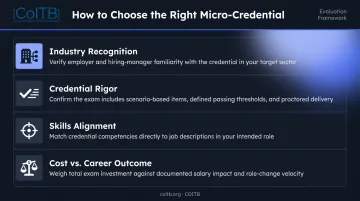
- Industry recognition — Is this credential cited in job postings for roles you're targeting? Does the issuing body have employer partnerships or DoD/government recognition?
- Credential rigor — Is this assessment-based or completion-based? A certificate that confirms attendance carries less weight than one requiring demonstrated competency
- Skills alignment — Does the credential cover skills in active demand in your sector? AI, Python, React, and JavaScript consistently appear across in-demand job listings
- Cost vs. career outcome — Consider the full cost (exam fees, study materials, platform subscriptions) against the realistic salary or role outcome the credential targets
Why Standards Matter
The credentialing industry distinguishes clearly between three types of credentials: certificates of attendance, assessment-based certificates, and professional certifications assessed against recognized standards. The Institute for Credentialing Excellence puts it plainly: attendance certificates confirm presence, while competency-based credentials confirm what someone can actually do.
This distinction is increasingly visible to employers. A 2025 Micro-Credentials Impact Report found employers are 1.3x more likely to offer higher starting salaries to entry-level candidates with credit-bearing micro-credentials than to those with completion-only certificates.
When evaluating any program, ask one direct question: does passing this credential require you to demonstrate skill, or just complete coursework? The programs that hold up under employer scrutiny are the ones where the answer is clear.
Conclusion
The right micro-credential depends on your target role, your current skills, and what employers in your field actually recognize. Google Career Certificates work for entry-level career changers entering Google's employer network. CompTIA is close to mandatory for government IT and defense. IBM carries weight in enterprise data and AI hiring. LinkedIn Learning supplements a profile but doesn't stand alone.
For professionals validating hands-on skills in AI, web development, or application development without a formal CS degree, COITB's exam-based certifications offer a third-party credential built on ISO/IEC 17024-aligned exam governance — a meaningful distinction in hiring contexts where self-reported skills don't hold up.
Take the free practice assessment at coitb.org/assessment to gauge readiness, then register at coitb.org/auth/signup to start building credentials that verify what you already know how to do.
Frequently Asked Questions
Do employers care about micro-credentials?
Yes. Coursera's 2025 Micro-Credentials Impact Report found 96% of employers say micro-credentials strengthen a job application, and 90% will offer higher starting salaries to candidates holding recognized credentials. Credentials backed by reputable issuing bodies carry the most weight.
What is the difference between a micro-credential and a certificate?
Certificates are often awarded for completing a course — they confirm attendance or participation. Micro-credentials, particularly assessment-based ones, require demonstrated skill proficiency against defined standards. That distinction directly affects employer perception and how much weight the credential carries in hiring decisions.
How long does it take to complete a micro-credential program?
Completion time ranges from a few hours for short-course badges to several months for structured professional certificates. Most programs designed for working professionals are built to be completed in 4–12 weeks alongside full-time employment, though self-paced formats give you control over the timeline.
Are micro-credentials worth it for career changers entering tech?
Micro-credentials are strong for career changers because they provide verifiable proof of new skills without a full degree. Programs in high-demand areas — AI, Python, React, application development — offer a clear return for professionals pivoting into tech from other industries.
What are stackable micro-credentials?
Stackable credentials are micro-credentials earned incrementally that build toward a stronger overall portfolio. A project manager might add a Certified GPT Professional credential and a ReactJS certification on top of an existing PMP to target Technical PM roles — each one adding a distinct, verifiable skill layer.
Can a micro-credential replace a college degree?
Not directly — but for many entry-level and mid-career tech roles, demonstrated competency via recognized credentials can outweigh formal degree requirements as skills-based hiring expands. Micro-credentials complement existing qualifications by giving employers a specific, verifiable signal of what you can do today.