Passing the exam is achievable. But the path matters. Many candidates underestimate the preparation required, misallocate their study time, or walk into the exam without ever practicing under timed conditions — and fail by a few percentage points.
This article covers how to choose between the CPC, CBCS, and CCA, what each exam actually tests, a step-by-step 6–8 week study framework, the variables that most affect your outcome, and specific strategies for exam day.
Key Takeaways
- Match the credential to your goal: ReactJS and HTML-CSS for front-end roles, Python or MySQL for back-end, GPT Professional for AI-focused positions
- A 6–8 week structured plan combining concept review and timed practice exams outperforms cramming every time
- Exam fluency matters — COITB exams are 58–90 scenario-based items with a 75–90 minute window, so pacing is critical
- Most first-time failures come from poor time management, not content gaps
- Passing scores range from 70–75% depending on the credential — knowing your target lets you study strategically
What to Know Before You Register
The Three Main Certifications
Not all medical coding credentials are equivalent. Here's how the three most common options compare:
| Exam | Issuing Body | Focus | Format | Fee |
|---|---|---|---|---|
| CPC | AAPC | Outpatient/physician coding | 100 questions, 4 hours | $425 (one attempt) / $499 (two) |
| CBCS | NHA | Billing and coding fundamentals | 125 items (100 scored), 3 hours | Check NHA directly |
| CCA | AHIMA | Multi-setting coding | 105 items (90 scored), 2 hours | $199 members / $299 nonmembers |
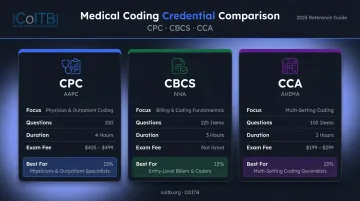
The CPC is widely considered the industry standard for physician-office coders. The CBCS suits candidates who want a broader billing-plus-coding foundation with a lower barrier to entry. The CCA fits those interested in hospital coding or who plan to pursue AHIMA's more advanced credentials later.
Eligibility and the CPC-A Designation
The CPC requires active AAPC membership before you can sit for the exam. Passing without two years of verified coding experience earns you a CPC-A (Apprentice) designation. Removing the apprentice status requires documenting two years of on-the-job coding experience, or one year plus an 80-hour coding course or completion of AAPC's Practicode program.
The CBCS and CCA have lower eligibility thresholds — no professional membership required — making them more accessible starting points for true beginners. Both are also NCCA-accredited, which signals that their credentialing processes meet established third-party standards.
Choosing the Right Starting Point
When choosing between these three credentials, let your career target drive the decision. Physician-office billing and coding roles typically favor the CPC. Hospital or multi-setting environments align better with the CCA. Candidates who want to test the waters before committing to a specialty may find the CBCS the lowest-risk entry point.
Step-by-Step Guide to Preparing for the Medical Coding Certification Exam
Step 1: Select Your Target Exam and Set a Test Date
First, pick your exam and then book a test date. Committing to a specific date creates accountability and prevents indefinite "I'll be ready soon" delays.
- Set your test date 6–8 weeks from when you plan to start serious studying
- Verify current exam formats, question counts, and allowed materials directly on the certifying body's official site — these details update periodically
- The CPC offers both in-person and live remote proctoring; the CCA is currently test-center only through Pearson VUE
Step 2: Map Content Domains and Find Your Weak Spots
The CPC covers 17 content areas plus 10 multi-code case scenarios. Here's the official breakdown:
| Content Area | Questions |
|---|---|
| Surgery (by body system, 6 areas) | 36 total |
| Evaluation and Management | 6 |
| Radiology | 6 |
| Laboratory and Pathology | 6 |
| Medicine | 6 |
| Coding Guidelines and Modifier Use | 7 |
| ICD-10-CM | 5 |
| Anesthesia | 4 |
| Medical Terminology | 4 |
| Anatomy | 4 |
| HCPCS Level II | 3 |
| Compliance and Regulatory | 3 |
| Multi-code Cases | 10 |
Take a diagnostic practice test at the start of your study period — not to pass, but to identify which domains need the most time. Allocate study hours proportionally to your actual weak spots, not just the areas that feel comfortable.
Step 3: Build a Structured Study Schedule
A 6–8 week schedule built around the CPC:
- Weeks 1–3: Content review by domain — work through each area systematically, spending more time on surgery sections given their combined question weight
- Weeks 4–5: Shift to timed, full-length practice exams; stop using untimed review
- Weeks 6–7: Return to weak domains identified during practice exams; targeted review only
- Final week: Light review, logistics prep, exam-day planning — no new material
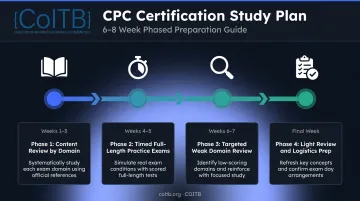
The CPC exam is 4 hours long with 100 questions, so building mental stamina is a key factor. Daily or near-daily study sessions build the mental endurance you need — cramming the week before doesn't.
Step 4: Master Your Code Books
The CPC allows your CPT® Professional Edition, a candidate-selected ICD-10-CM, and a candidate-selected HCPCS Level II book. You can highlight, tab, and add handwritten margin notes. What you cannot bring: copied study materials, supplemental inserts, or electronic devices.
Prep your code books before exam day:
- Tab major CPT sections — surgery chapters by body system, E/M, anesthesia, radiology
- Highlight frequently referenced guidelines — especially E/M documentation guidelines and ICD-10 sequencing rules
- Add margin notes for modifiers you regularly confuse
- Practice finding codes by scenario description, not just by looking up a code number you already know
Your speed using the index determines whether the open-book format helps or hurts you. If finding a code takes 90 seconds, you've already burned more time than the question is worth.
Step 5: Complete Timed Practice Exams Under Realistic Conditions
Practice exams only build exam readiness when taken under real conditions: full length, timed, with code books available.
Three well-regarded resources for practice exams:
- CPC candidates: AAPC offers three official 50-question practice exams formatted around the real exam
- CBCS candidates: NHA provides three distinct online practice tests with up to two attempts each
- CCA candidates: AHIMA's prep bundle includes 200 domain-organized questions and two timed, self-scoring full-length practice exams
None of these providers publish a claimed pass-rate lift for using their materials. Treat any third-party claims of guaranteed score improvement with skepticism.
Key Study Variables That Affect Whether You Pass
Exam outcomes depend less on raw intelligence and more on controlling a few key variables.
Code Book Familiarity
The open-book format is only an advantage if you can navigate quickly. Candidates who practice finding codes by scenario — starting from a clinical description rather than a memorized code number — consistently outperform those who treat the exam as a memorization test.
Budget time during your study weeks specifically for timed code book drills. The goal is under 60 seconds to locate and verify any single code.
Volume and Quality of Practice Questions
High-volume practice question exposure builds pattern recognition for how the exam frames scenarios. Exam questions read differently from textbook descriptions — they include clinical context, documentation details, and distractors that test your sequencing logic, not just code knowledge.
There's no officially published minimum practice question threshold for the CPC. The practical standard among instructors: complete enough full-length timed exams that the format feels entirely routine before test day.
Understanding Compliance and Coding Guidelines
Self-study candidates consistently underestimate the compliance workload. The CPC allots 3 questions to the compliance/regulatory domain, covering:
- Medicare parts A–D
- NCCI edits and place of service
- HIPAA, ABNs, fraud and abuse
- RVUs
Compliance topics also appear embedded in case scenarios, so 3% reflects the dedicated domain share — not the ceiling on total exposure.
More critically, coding guideline questions — sequencing rules, modifier requirements, bundling logic — appear throughout the exam. Misapplying a guideline on a multi-code case scenario can cost you several points at once.
Study Consistency Over Cramming
Spreading study across 6–8 weeks produces better retention than compressing the same hours into two weeks. The CPC covers 17 content areas including 6 surgical body system sections. Spaced practice builds the retrieval fluency you need to pull the right answer under time pressure.
Common Mistakes That Cause Candidates to Fail
Most candidates who don't pass on their first attempt share the same handful of preparation gaps. Recognizing these patterns early gives you a real advantage before exam day.
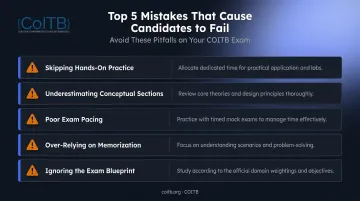
The most common mistakes include:
- Skipping hands-on practice — Reading study materials without working through practice questions leaves candidates unprepared for scenario-based items, which require applying knowledge, not just recalling it
- Underestimating conceptual sections — Topics that feel abstract (foundational theory, standards context) often appear embedded in scenario questions; candidates who skim these sections lose points they didn't expect to lose
- Poor pacing during the exam — Each question carries equal weight, so spending too long on a single difficult item puts easier questions at risk; flag and move on, then return with remaining time
- Over-relying on memorization — COITB exams test applied, job-ready skills; candidates who memorize definitions without understanding how to use them in context tend to struggle with multi-part scenarios
- Not reviewing the exam blueprint — The official candidate guide outlines exactly which domains are tested and at what weight; candidates who skip this document often over-prepare in one area while leaving gaps in another
Test-Day Strategies to Maximize Your Score
Time Pacing
COITB's certification exams run 75–90 minutes with 58–90 questions, giving you roughly 1–1.5 minutes per question. Use a first-pass approach:
- Answer every question you can answer confidently and quickly
- Mark uncertain questions and skip them
- Return to marked questions after completing the rest of the exam
- Never spend more than 2 minutes on any single question before moving on
Using Reference Materials and Notes
If your exam format permits reference notes or a scratch sheet, organize them by topic before the exam starts — syntax rules, common patterns, or key concepts grouped by subject area. Jumping between scattered notes mid-exam wastes time you don't have.
When a scenario-based question stumps you, use the answer choices as anchors. Eliminate options that clearly contradict what you know, then reason toward the best remaining choice rather than searching blindly through notes.
Physical and Logistical Preparation
- Confirm your exam location or remote testing setup 48 hours in advance
- Prepare all approved materials the night before — valid ID, any permitted scratch paper, and your testing environment if remote
- Get adequate sleep — even a 75-minute exam demands sharp focus and clear recall
- Eat a light, sustaining meal beforehand
- For remote testing, complete the room scan and ID verification process before your scheduled start time — COITB accepts military CAC and VA-issued ID, so have yours ready
Guessing Strategy
Never leave a question blank. COITB exams carry no penalty for wrong answers, so a reasoned guess beats an empty answer every time. When stuck, eliminate the two most obviously wrong options first, then choose between what remains using whatever partial knowledge you have. Passing requires 70–75% — you don't need perfection, just consistency.
Frequently Asked Questions
How do I become a certified coder?
Complete relevant training or self-study in your target language or framework, choose a recognized credential that matches your skill set, meet any eligibility requirements, and pass the exam. Some credentialing bodies issue a provisional status if experience requirements haven't yet been documented — verify the specific conditions with your chosen certifying organization before registering.
Which coding certification is best?
It depends on your goals and background. Entry-level candidates often benefit from a foundational credential (HTML/CSS, JavaScript) before pursuing more specialized ones (ReactJS, Python, MySQL). Those pivoting into AI or technical sales have purpose-built credentials available. Match the certification to the role you're targeting.
Is the CPC exam hard to pass?
Difficulty depends on your preparation and prior experience. Most IT certification exams run 58–90 questions with a 75–90 minute time limit. Candidates who work through practice questions, review exam objectives thoroughly, and time themselves during mock runs are well-positioned to pass on the first attempt.
Can you take the CPC exam at home?
Yes. Many IT certification exams — including those offered by COITB — support online remote proctoring. You'll need a valid government-issued photo ID (military CAC and VA-issued IDs are accepted), a webcam, and a stable internet connection. In-person testing at authorized test centers is also available. Confirm current requirements with your certifying body before scheduling.
What score do you need to pass the medical coding certification exam?
Passing thresholds vary by credential. COITB exams generally require a 70–75% passing score. Always verify the current passing threshold directly with the certifying body before your exam date, as score requirements can be updated.
How long should I study for the medical coding certification exam?
Most candidates need 4–8 weeks of structured daily preparation, depending on their existing experience. Those already working in tech or with relevant self-study under their belt may need less time. Complete beginners benefit from building hands-on project experience before scheduling the exam.